Cortisol Detox: Does It Work? What the Science Says
Written by Mouhsine
Admin
Published September 4, 2026
Cortisol detox” has become shorthand for everything from reducing stress and sleeping better to improving focus, losing weight, and getting your energy back.
The usual promise sounds simple:
Follow a special routine for a few days or weeks and your body will flush out excess cortisol or reset your stress hormones.
That is not how cortisol works.
Cortisol is an essential hormone, not a toxin. You cannot detox it from your body, and there is no medically established cortisol-cleanse or cortisol-reset protocol.
But some habits commonly included in these plans — consistent sleep, physical activity, regular meals, relaxation, and reducing unnecessary sources of stress — can still be sensible.
The useful part is the routine.
Not the detox story.
What Is Cortisol?
Cortisol is a hormone produced by your adrenal glands.
It is often called the “stress hormone,” but responding to stress is only part of what it does.
Cortisol is involved in processes including:
- helping your body respond to stress;
- regulating metabolism and blood sugar;
- helping regulate blood pressure;
- influencing inflammation;
- following a normal daily rhythm.
Your cortisol level is supposed to change.
It normally varies throughout the day and can also be affected by factors such as exercise, illness, stress, pregnancy, sleep, and certain medications.
So the goal is not to keep cortisol permanently low.
Your body needs cortisol.
Can You Actually Detox Cortisol?
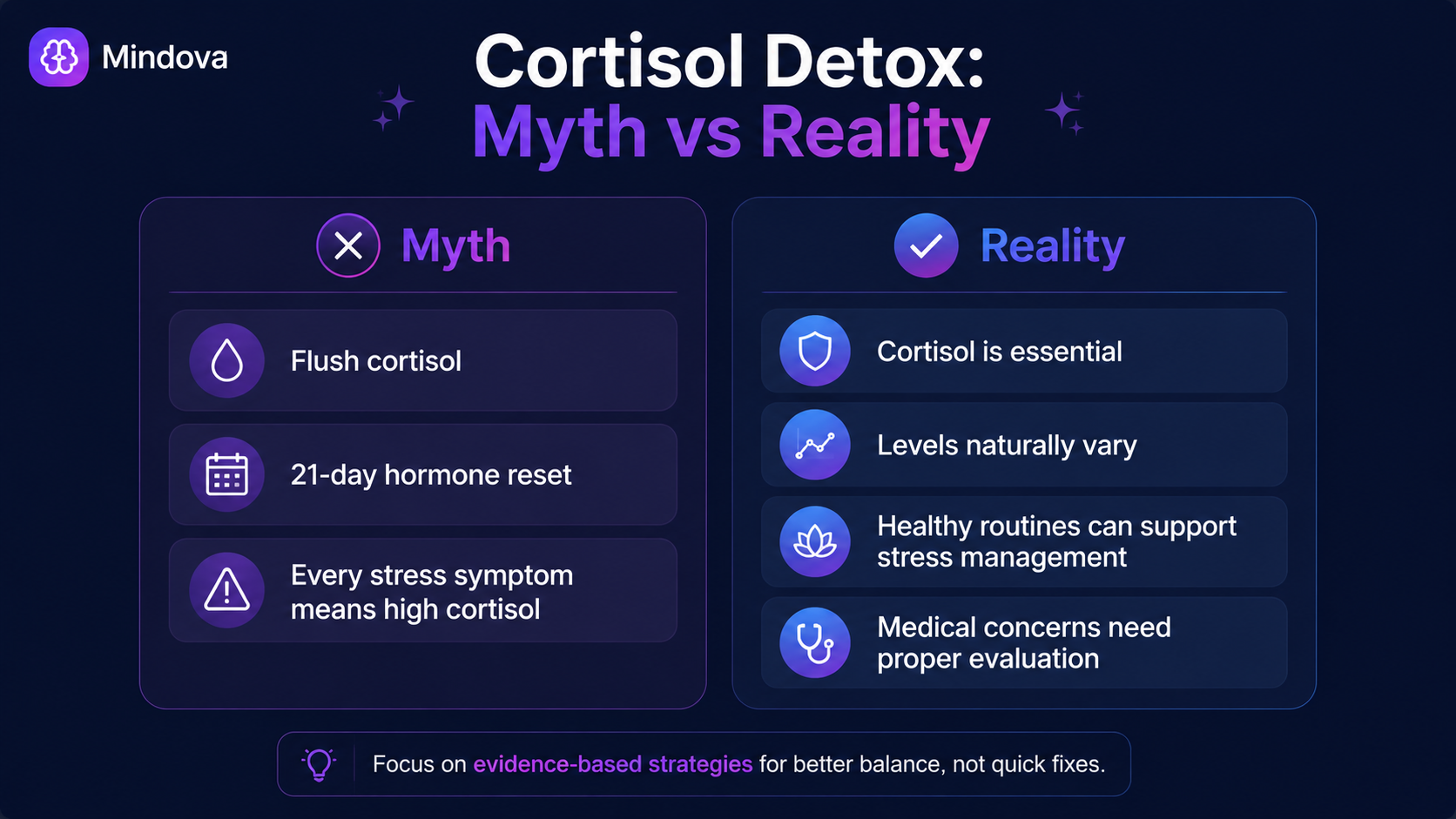
No.
There is no reservoir of “toxic cortisol” that needs to be flushed from your body.
Endocrinologists at ColumbiaDoctors specifically describe the cortisol-detox trend as misleading because cortisol is an essential hormone that the body already regulates.
That means claims such as:
- “flush cortisol from your body”;
- “reset cortisol in 24 hours”;
- “cleanse your adrenal glands”;
- “restore your cortisol baseline over a weekend”
should be treated skeptically.
A better goal is to support healthy routines and address the actual sources of stress or poor wellbeing instead of trying to cleanse a hormone.
Does a Cortisol Detox Work?
As a literal hormone detox: no.
There is no established medical cortisol-detox treatment for otherwise healthy people.
As a lifestyle routine: some parts may still be useful.
A “cortisol detox plan” might tell you to:
- sleep more consistently;
- exercise regularly;
- eat balanced meals;
- spend time outside;
- take breaks;
- practice relaxation;
- reduce unnecessary digital stimulation.
Those can be reasonable general health or stress-management habits.
But there is an important distinction:
A useful habit does not prove the explanation behind the detox.
Going to bed at a more consistent time may be useful.
That does not mean you “flushed cortisol” while sleeping.
Taking a walk may help you manage stress.
That does not mean you completed a cortisol cleanse.
Keep the useful behavior.
Drop the unsupported mechanism.
What About the 21-Day Cortisol Detox?
Search for cortisol detox and you will quickly find:
- 21-day cortisol detox plans;
- cortisol reset challenges;
- cortisol detox diets;
- cortisol detox drinks;
- printable cortisol detox schedules.
There is nothing medically established about 21 days as the time required to reset cortisol.
Twenty-one days can simply be a convenient period for experimenting with healthier routines.
Instead of:
For 21 days, I will reset my cortisol.
a more defensible goal would be:
For 21 days, I will test a few habits that might make my days healthier and easier to manage.
For example:
- keep a more consistent sleep and wake time;
- move regularly;
- eat normally rather than following an extreme cleanse;
- protect some downtime;
- reduce one unnecessary source of stress;
- notice which changes are actually sustainable.
At the end, evaluate the habits.
Do not try to determine whether your cortisol has “reset” based only on whether you feel calmer or more energetic.
Stress Does Not Automatically Mean You Have High Cortisol
This distinction matters.
Feeling:
- stressed;
- tired;
- distracted;
- anxious;
- unfocused;
- restless;
- unmotivated
does not prove that you have abnormally high cortisol.
Those experiences can have many possible causes.
Likewise, an online symptom checklist cannot tell you whether you have a cortisol disorder.
When healthcare professionals genuinely need to assess cortisol, they may use blood, urine, or saliva testing depending on the situation.
Timing can matter because cortisol naturally varies throughout the day.
That is very different from saying:
I feel stressed, therefore my cortisol must be dangerously high.
Normal Stress Is Not the Same as a Cortisol Disorder
Everyday stress and a medical disorder involving abnormal cortisol are not interchangeable.
Persistently excessive cortisol can occur in conditions such as Cushing syndrome, and certain steroid medications can also affect cortisol exposure.
Low cortisol can occur with conditions involving adrenal or pituitary function.
These are medical issues that require proper evaluation.
They are not problems to treat with an internet detox challenge.
If you have persistent or concerning symptoms, take steroid medication, or have been told you may have an adrenal or pituitary problem, speak with a qualified healthcare professional rather than trying to self-diagnose from a cortisol-detox checklist.
What Should You Do Instead of a Cortisol Detox?
You do not need an elaborate cleanse.
Start with the things you can actually observe and change.
1. Identify What Is Making Your Days Harder
Instead of:
My cortisol is ruining my focus.
ask:
What has actually changed in my routine?
Maybe you are:
- sleeping inconsistently;
- working for long periods without breaks;
- checking messages constantly;
- dealing with a genuinely stressful situation;
- staying online late into the night;
- taking on more than you can realistically handle.
Those are concrete problems.
You can work on them without guessing what your hormone levels are doing.
2. Protect Sleep Without Turning It Into a Hormone Hack
Sleep is frequently included in cortisol-reset plans.
A consistent sleep routine is reasonable general health advice.
But avoid turning it into:
Sleep eight hours and your cortisol will reset.
Human sleep and hormone regulation are more complicated than that.
Aim for a sustainable sleep routine because sleep matters in its own right.
Not because you are trying to pass a cortisol-detox challenge.
3. Move Regularly
Exercise itself can temporarily affect cortisol.
That does not automatically make the change harmful.
One common problem with cortisol advice online is treating every rise in cortisol as something that must be prevented.
Your body is designed to adjust cortisol dynamically.
Unless you have specific medical advice saying otherwise, normal exercise should not be treated as a “cortisol toxin.”
4. Use Stress-Management Practices for Their Actual Purpose
You might experiment with:
- slow breathing;
- meditation;
- walking;
- spending time outside;
- talking with someone;
- taking proper breaks;
- reducing unnecessary demands.
You do not need to claim that each activity directly “detoxes cortisol.”
Ask the more useful question:
Does this help me manage stress or make my day easier?
5. Reduce Digital Overload If It Is Actually Part of the Problem
Sometimes one source of pressure is easy to identify.
You may be trying to work while constantly moving between:
- messages;
- news;
- email;
- YouTube;
- social feeds;
- work tabs;
- notifications.
If that describes your day, reducing unnecessary digital interruptions may make your work environment feel less fragmented.
That does not prove that you have high cortisol.
And it does not mean blocking a website “lowers cortisol.”
It simply means you are reducing a source of distraction.
For practical strategies, see How to Avoid Digital Distractions While Working.
If you want to step back from digital technology more broadly, see Digital Detox: What It Is and How to Try One.
Can Notifications Raise Cortisol?
This question needs more caution than many productivity articles give it.
Notifications and digital interruptions can feel stressful and can fragment attention.
But that does not justify a simple formula like:
notification → cortisol spike → chronic high cortisol.
The relationship between stress, technology use, physiology, and individual responses is much more complicated.
So if notifications make your day feel scattered, reduce them because you want fewer interruptions.
You do not need to diagnose your hormone levels first.
Where Mindova Fits
Mindova does not lower cortisol.
It does not measure cortisol.
And it is not a medical stress-management tool.
Its role is narrower:
help reduce avoidable website distractions in your desktop browser.
Mindova currently supports:
- website blocking;
- Individual Site Limits;
- an overall distraction limit;
- timed Focus Sessions;
- browsing and focus insights;
- optional AI Nudges.
For example, instead of:
I need Mindova to lower my cortisol.
a realistic goal would be:
I want Reddit and YouTube unavailable while I finish this report.
That is a problem a website blocker can actually help with.
See How to Block Distracting Websites.
Mindova does not currently provide recurring schedules, Locked Mode, native iPhone or Android app blocking, or cross-device blocking enforcement.
Frequently Asked Questions
What is a cortisol detox?
“Cortisol detox” is a wellness term generally used for lifestyle plans that claim to reduce, flush, or reset cortisol.
It is not an established medical detox protocol.
Can you flush cortisol out of your body?
No.
Cortisol is an essential hormone produced and regulated by your body, not a toxin that needs to be flushed out.
How long does a cortisol detox take?
There is no evidence-based cortisol-detox duration because there is no literal cortisol detox taking place.
Claims that cortisol will reset after a fixed number of hours or days should be treated cautiously.
Does a 21-day cortisol detox work?
Twenty-one days can be used as a convenient period for trying healthier routines.
There is no established evidence that 21 days specifically resets cortisol or your adrenal system.
What naturally lowers cortisol?
That question can be misleading because cortisol is supposed to rise and fall.
Rather than trying to keep cortisol permanently low, focus on healthy routines and appropriate stress management.
If you are concerned that your cortisol is medically abnormal, seek professional evaluation rather than trying to manipulate it yourself.
Can stress cause high cortisol?
Stress can affect cortisol levels.
But feeling stressed does not establish that you have a pathological cortisol problem, and cortisol levels naturally vary for many reasons.
Should I test my cortisol?
Cortisol testing is generally used when healthcare professionals are investigating specific medical concerns.
Because levels vary throughout the day and interpretation depends on context, testing is better discussed with a healthcare professional than ordered solely because an online checklist says you have “high cortisol.”
You Do Not Need to Detox a Hormone
The cortisol-detox trend starts with a reasonable observation:
Stress can make life harder, and people want practical ways to feel better.
The problem is the explanation that often follows.
Cortisol is not toxic waste.
Your body does not need a cleanse.
And an arbitrary 21-day challenge cannot promise to reset your endocrine system.
Keep the useful parts:
Sleep more consistently.
Move regularly.
Make room for recovery.
Reduce unnecessary sources of stress.
Create boundaries around digital distractions if they are part of the problem.
And if you have a genuine concern about abnormal cortisol, treat it as a medical question rather than a wellness challenge.
That is less exciting than a “cortisol reset.”
It is also much more accurate.
Sources
ColumbiaDoctors — What the Science Says About the Cortisol Detox Trend
Mouhsine
Admin
Passionate about helping people achieve peak mental performance through evidence-based strategies and mindful technology use.
Related Articles

Digital Detox: What Is It, and Does It Actually Help?
Learn what a digital detox really is, what research says about its benefits, and how to reduce distracting technology without quitting every screen.

How to Temporarily Deactivate Facebook Without Deleting Your Account
Learn how to temporarily deactivate Facebook on mobile or desktop, what happens to your profile and Messenger, and how to reactivate your account later.

Digital Detox Retreats: Cost, Benefits, and Are They Worth It?
What happens at a digital detox retreat, how much does one cost, and is it worth paying for? Compare retreat types, evidence, downsides, and at-home alternatives.
Comments
Be the first to comment.
Ready to protect your focus?
Block distracting sites, set daily limits, and run focus sessions. Mindova is free.