How to Improve Your Attention Span: What the Science Says
Written by Mouhsine
Admin
Published September 5, 2026 · Updated September 6, 2026
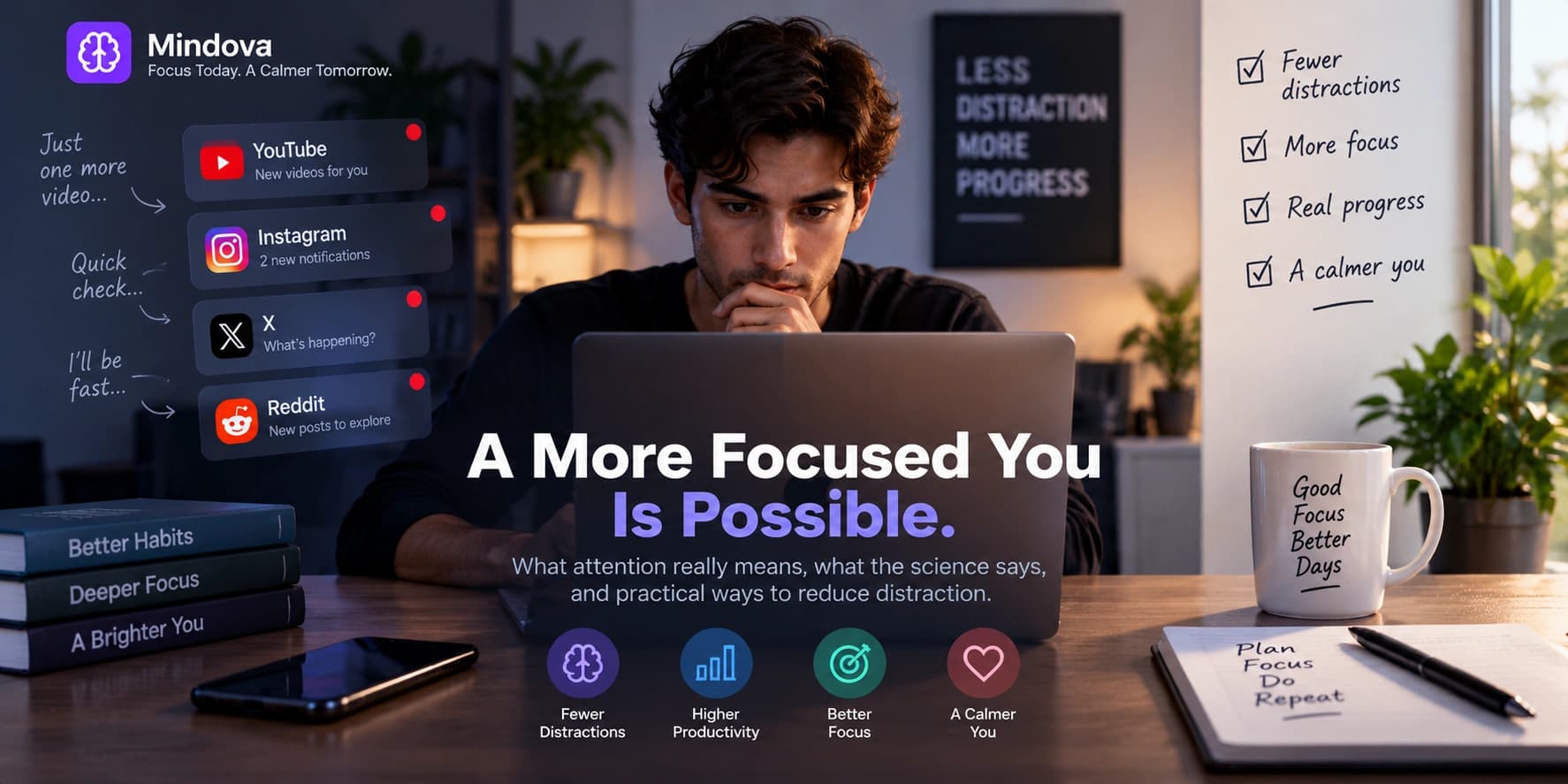
It is easy to think you have a broken attention span.
You sit down to work, open one unrelated tab, check a message, return to the document, then realize you have barely moved the task forward.
The usual explanation online is dramatic:
Your brain has been rewired for distraction.
That sounds scientific, but it skips several important steps.
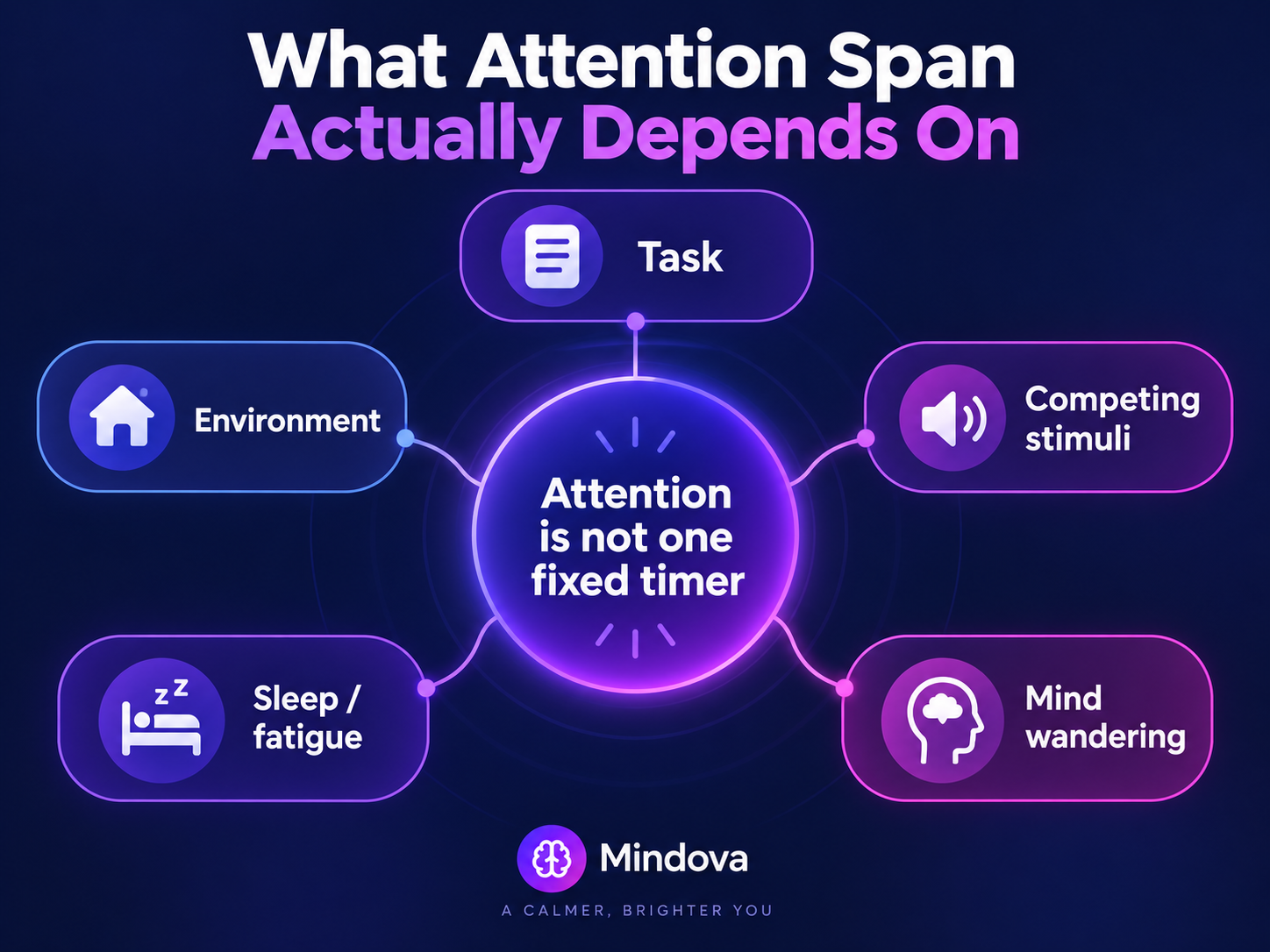
Attention is not one fixed timer inside your brain. How long you stay effectively engaged depends on the task, your environment, competing stimuli, fatigue, sleep, motivation, and what kind of attention researchers are measuring.
And although the brain is capable of change through neuroplasticity, that does not mean every focus routine automatically “rewires” your brain for productivity.
A more useful approach is simpler:
Reduce unnecessary competition for your attention, define what you are trying to focus on, practice returning when your attention moves, and improve the conditions around the work before assuming your brain needs to be fixed.
First: Your Attention Span Is Not One Fixed Number
You may have seen claims that the average human attention span is only a few seconds.
That is not a useful way to understand attention.
Researchers measure attention using different tasks and outcomes, including:
- reaction time;
- errors;
- sustained-attention performance;
- vigilance;
- mind wandering;
- ability to respond consistently over time.
There is no single stopwatch value that describes how long every adult can focus.
Someone may struggle to remain engaged with one repetitive task while having little difficulty concentrating on another activity for much longer.
The task matters.
The environment matters.
Your state at that moment matters.
So instead of asking:
What is my attention span in minutes?
a better question is:
What conditions are making it difficult for me to stay engaged with this particular task?
What Does Neuroplasticity Actually Mean?
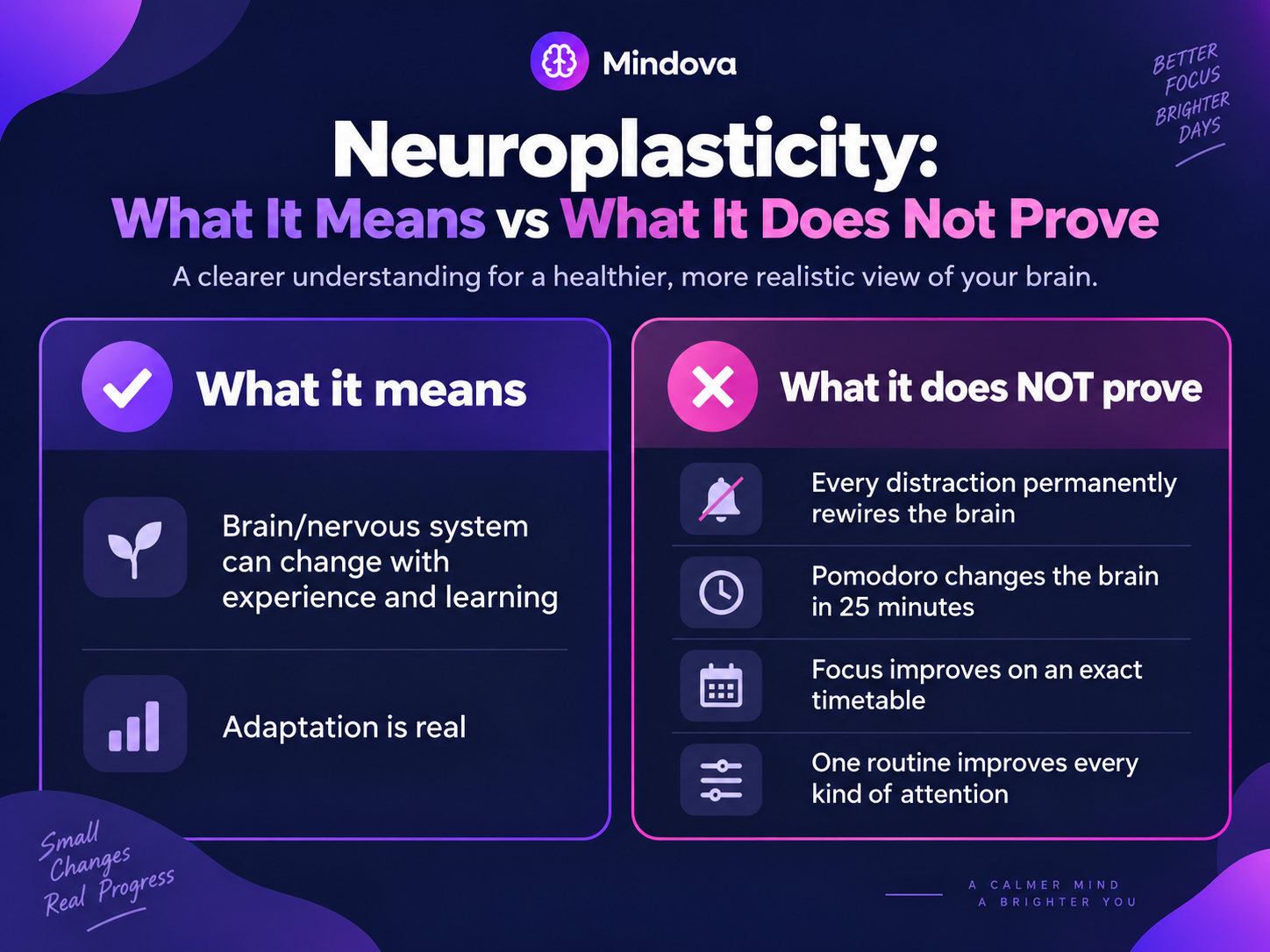
Neuroplasticity refers broadly to the nervous system's ability to change its structure, function, or connections in response to experience, learning, environmental demands, injury, and other influences.
That is real neuroscience.
But the word is often stretched far beyond what it proves.
For example:
The brain is plastic.
does not automatically prove:
Every time I resist checking Reddit, I permanently strengthen a focus pathway.
And it does not prove:
Twenty minutes of focused work each day will rewire my brain within a few weeks.
Those are additional claims that need their own evidence.
Neuroplasticity tells us that the nervous system is capable of change.
It does not provide a guaranteed formula for turning any productivity routine into broad improvements in attention.
Can Attention Be Trained?
Certain aspects of attention can respond to structured practice or training.
But the answer is not simply:
Yes, practice focus and your attention span gets longer.
A 2026 systematic review examined studies of Attention Training Technique, a specific metacognitive intervention involving deliberate attention exercises.
The review found evidence of cognitive and neural changes in some studies.
But the researchers also found substantial differences between studies, variation in quality, and inconsistent effects across outcomes.
That matters for productivity advice.
Attention Training Technique is a specific intervention.
It is not the same thing as:
- using Pomodoro;
- blocking social media;
- working for 30 minutes;
- forcing yourself to stare at a document;
- resisting a notification.
We should not take evidence for one structured technique and use it as proof that every focus habit “rewires the brain.”
Getting Better at One Attention Task Does Not Mean Every Kind of Focus Improves
This is another important limitation.
In cognitive-training research, improvement is often strongest on the task that was actually practiced.
Transfer to different tasks or broad everyday abilities can be less consistent.
So if someone becomes better at one attention exercise, that does not automatically mean they will:
- read complex reports better;
- resist every digital distraction;
- concentrate longer in meetings;
- write more effectively;
- become generally “more focused.”
Different tasks place different demands on attention.
That is why the practical goal should not be:
Train one universal attention muscle.
It should be:
Build better conditions and behaviors for the kind of attention your work actually requires.
Why Your Focus May Feel Worse
Before trying to “train your brain,” look at what is competing with the task.
Too Many Competing Stimuli
If you are trying to write while:
- notifications appear;
- several feeds remain open;
- messages are arriving;
- unrelated tabs are visible;
- your phone is within reach;
your attention has more opportunities to move.
That does not prove the environment permanently damaged your brain.
It simply means the task is competing with other stimuli.
Reducing that competition is often a more direct intervention than trying to develop extraordinary willpower.
Constant Task Switching
Switching between tasks is not the same as performing them simultaneously.
When you repeatedly move between:
document → email → chat → browser → document
you have to repeatedly reorient to what you were doing.
This does not mean you should never switch tasks.
Some jobs require it.
But unnecessary switching can make sustained work more difficult.
Poor Sleep
Attention also changes with your physical state.
Sleep restriction is one well-supported example.
A 2024 systematic review and meta-analysis found that one night of restricted sleep increased sleepiness and impaired sustained-attention performance.
We cover that evidence separately in How Sleep Affects Productivity, Focus, and Work Performance.
Sleep is not the only factor, but it is a good reminder that not every focus problem is a failure of discipline.
An Undefined Task
Sometimes you are not distracted because your attention span is short.
You are distracted because you do not know what you are supposed to do next.
Compare:
Work on presentation.
with:
Write the three bullet points for slide four.
The second gives your attention a clearer target.
Before trying to increase how long you can focus, make sure there is something specific to focus on.
Step 1: Reduce Predictable Distractions
Start with the environment.
Ask:
What repeatedly pulls me away from the work I intended to do?
Maybe it is:
- Reddit;
- YouTube;
- news;
- social media;
- email;
- several open tabs.
Do not try to remove every possible distraction from life.
Start with the predictable ones.
For example:
- Close tabs that are unrelated to the task.
- Silence unnecessary notifications.
- Move the phone away if it repeatedly interrupts you.
- Block or limit websites you routinely open without intending to.
The goal is not to create a perfect laboratory.
It is to reduce avoidable competition for your attention.
For the browser setup, see How to Block Distracting Websites.
Step 2: Define One Thing to Attend To
“Focus” is too vague.
Give your attention a target.
Instead of:
Work on the report.
try:
Review the introduction and rewrite the final two paragraphs.
Instead of:
Study.
try:
Answer questions 1–10 without looking at my notes.
Instead of:
Work on website.
try:
Fix the navigation bug on the pricing card.
A defined task gives you something concrete to return to when your attention moves.
That return is important.
Step 3: Use a Work Period You Can Realistically Protect
There is no universal scientifically optimal focus duration.
Twenty-five minutes is not a neurological law.
Neither is:
- 45 minutes;
- 60 minutes;
- 90 minutes.
Different tasks and situations require different lengths of uninterrupted work.
Choose a period that:
- fits the task;
- fits the time available;
- you can realistically protect from unnecessary interruption.
If 20 minutes is realistic today, use 20 minutes.
If an hour is appropriate and available, use an hour.
The purpose of the timer is to create a defined work period.
It is not to prove that your brain has one ideal focus interval.
If you prefer a structured timer method, see Pomodoro Technique: How It Works and How to Use It.
Step 4: When Your Attention Wanders, Notice and Return
The goal is not to keep attention perfectly fixed every second.
Attention naturally fluctuates.
You may notice that you:
- started thinking about something unrelated;
- opened a new tab automatically;
- reached for your phone;
- began rereading without processing;
- started planning another task.
The useful skill is:
notice → decide → return.
For example:
I opened Reddit without needing it.
Notice it.
Ask whether switching serves the task.
If not, close it and return.
That sounds almost trivial.
But it is more realistic than expecting perfect concentration.
You are not trying to eliminate every moment of mind wandering.
You are trying to reduce how often a small attentional shift becomes a 20-minute detour.
Step 5: Take Breaks When They Are Useful
Breaks can help make demanding work more sustainable.
But there is no universal rule that everyone needs the same break after the same number of minutes.
A useful break might mean:
- standing up;
- walking briefly;
- getting water;
- looking away from the screen;
- doing something unrelated to the task.
What matters is whether the break helps you return ready to continue.
If your “five-minute break” reliably becomes 30 minutes of scrolling, that break design is probably not helping the way you intended.
Adjust it.
Step 6: Support Attention Instead of Trying to Override Everything
Attention does not exist separately from the rest of your life.
Sleep, workload, interruptions, stress, the complexity of the task, and your environment can all influence how easy or difficult concentration feels.
That means productivity tools have limits.
A timer cannot replace sleep.
A blocker cannot clarify a poorly defined project.
A planning system cannot remove every interruption.
The better approach is to identify the main source of friction and respond to that problem specifically.
Do You Actually Need to “Train” Your Attention?
Sometimes.
But sometimes the environment needs more work than your attention does.
Imagine two situations.
Situation A
You are trying to write while:
- six social tabs are open;
- notifications are active;
- your phone is beside the keyboard;
- you have not decided what section to write.
Situation B
You have:
- one defined task;
- irrelevant tabs closed;
- predictable distractions reduced;
- enough time to work;
- a clear stopping point.
If Situation B feels dramatically easier, the problem may not have been a fundamentally damaged attention span.
You improved the conditions.
That is valuable even if no neurological transformation occurred.
What Not to Believe About Attention Span
A few popular claims deserve more skepticism.
“Humans now have an eight-second attention span.”
There is no useful universal eight-second attention-span number that describes adult concentration across tasks.
“Social media permanently destroyed your attention span.”
Digital environments can create frequent opportunities for distraction and switching.
That is different from proving that using social media permanently damaged your attention system.
“Every distraction rewires your brain.”
Neuroplasticity does not justify that precise claim.
“Pomodoro works because the brain can only focus for 25 minutes.”
The 25-minute interval is part of the Pomodoro method, not a universal neuroscience limit.
“If you practice focus for X days, your attention span will be fixed.”
There is no established universal timetable.
“If you cannot concentrate, you just need more discipline.”
Persistent attention difficulties can have many causes.
Productivity advice is not an appropriate substitute for evaluating a significant or ongoing health concern.
Focus Better by Fixing the Environment First
You do not need to prove that your brain is broken before reducing distraction.
If distracting websites repeatedly interrupt your work, that is already enough reason to change the environment.
A simple setup might be:
- Decide exactly what you are working on.
- Choose a realistic work period.
- Remove unrelated tabs.
- Make your predictable distraction sites unavailable.
- Work on the defined task.
- Notice when your attention moves.
- Return when switching does not serve the task.
- Take a break when appropriate.
This is not a brain-rewiring protocol.
It is a practical way to create better conditions for sustained work.
Deep Work and Attention Are Not the Same Thing
Improving the conditions for attention can make deeper work easier.
But Deep Work is a broader approach to organizing cognitively demanding work without distraction.
This article answers:
How can I make sustained attention easier?
Deep Work asks:
How should I structure demanding work that requires extended concentration?
For that broader method, see Deep Work: What It Is and How to Practice It.
Where Mindova Fits
Mindova does not train your brain.
It does not measure your neurological attention span.
And it cannot promise to “rewire” your focus.
Its role is much narrower:
Mindova can help reduce predictable browser distractions while you are trying to work.
It currently supports:
- website blocking;
- Individual Site Limits;
- an overall distraction limit;
- timed Focus Sessions;
- browsing and focus insights;
- optional AI Nudges.
For example:
Suppose your task is:
Finish the first section of the report.
You could:
- open the report;
- start a timed Focus Session;
- keep Reddit, YouTube, or other distracting websites unavailable;
- work on the defined section;
- return to it when your attention drifts.
Mindova provides the browser boundary.
You still decide:
- what deserves your attention;
- what task you are doing;
- when to take a break;
- whether the work period was useful.
Optional AI Nudges can provide contextual reminders that encourage you to return to your intended activity, but they do not read your mind or determine your mental state.
When Focus Problems May Need More Than Productivity Advice
Everyone loses focus sometimes.
But persistent difficulty concentrating can have many possible causes, including factors that a productivity article cannot evaluate.
Consider speaking with a qualified healthcare professional if problems with attention are:
- persistent;
- significantly affecting work or study;
- interfering with daily life;
- new or unusually severe;
- accompanied by other symptoms that concern you.
A website blocker, timer, or attention technique should not be used as a substitute for appropriate professional evaluation.
Frequently Asked Questions
Can you improve your attention span?
Some aspects of attention can respond to structured practice and better working conditions.
However, attention is not one fixed ability, and improvement on one training task does not guarantee broad improvements across every type of real-world focus.
Is attention span fixed?
No.
Attention varies with the task, environment, fatigue, sleep, competing stimuli, and other factors.
But that does not mean every problem with attention can be solved simply by “training harder.”
Does neuroplasticity mean I can retrain my focus?
Neuroplasticity means the nervous system is capable of change.
It does not, by itself, prove that a specific productivity technique will create broad or permanent improvements in attention.
The technique and outcome still need evidence.
How long should I focus at once?
There is no universal scientifically optimal focus duration.
Choose a work period appropriate for the task and realistic for the time and environment you have.
Does social media shorten attention span?
Social media and other digital environments can create frequent opportunities to switch attention.
That does not establish a simple universal rule that social media permanently shortens everyone's attention span.
If a particular platform repeatedly interrupts your work, reducing access to it during focused work can still be useful.
How long does it take to improve attention?
There is no universal number of days.
Results depend on what type of attention you are trying to improve, what you practice, the environment, and how improvement is measured.
Be skeptical of exact “rewire your brain in X days” promises.
Should I use Pomodoro to improve my attention?
You can use Pomodoro if timed work periods help you structure your work.
But its 25-minute interval is a productivity method, not a scientifically established universal attention-span limit.
What should I do if I keep getting distracted online?
Start by identifying the websites or digital behaviors that repeatedly interrupt your intended work.
Then reduce their availability during a defined work period and give yourself one specific task to return to.
Can Mindova train my attention span?
No.
Mindova does not train or rewire your brain.
It helps you reduce predictable browser distractions so you can create a cleaner environment for focused work.
Build Better Conditions for Attention
You do not need a dramatic story about a damaged brain to take distraction seriously.
Attention can fluctuate.
Digital environments can compete for it.
Sleep can influence it.
Tasks can be poorly defined.
And structured attention training may help certain abilities without automatically transforming every kind of focus.
So start with what you can control.
Define the task.
Reduce predictable distractions.
Choose a realistic work period.
Notice when attention moves.
Return when the distraction does not serve the work.
Take useful breaks.
And do not confuse a practical improvement in your environment with proof that you have “rewired your brain.”
The goal is not perfect attention.
It is making useful attention easier to sustain when the work actually matters.
Mouhsine
Admin
Passionate about helping people achieve peak mental performance through evidence-based strategies and mindful technology use.
Related Articles

How to Focus on Writing Without Digital Distractions
Learn how to stay focused while writing by separating drafting from research, reducing digital distractions, and keeping the online tools you actually need
Creative Block: How to Get Unstuck and Start Creating Again
Feeling creatively stuck? Learn what creative block can look like, how to identify what is stopping you, and practical ways to generate ideas and move forward
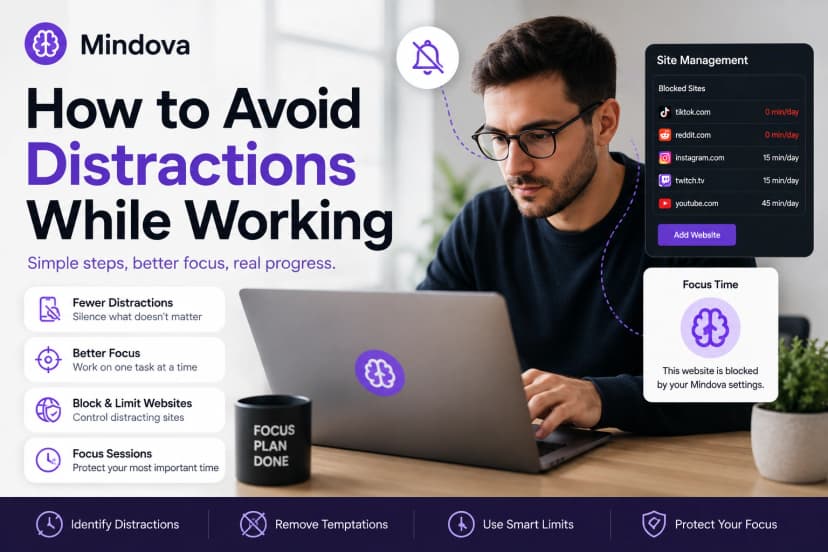
How to Avoid Distractions While Working: 10 Practical Strategies
Learn how to avoid distractions while working by reducing digital triggers, managing notifications, limiting distracting websites, and protecting focused work time.
Comments
Be the first to comment.
Ready to protect your focus?
Block distracting sites, set daily limits, and run focus sessions. Mindova is free.