Dopamine and Social Media: Why Checking Becomes Compulsive
Written by Mouhsine
Clinical Psychologist
Published September 3, 2026
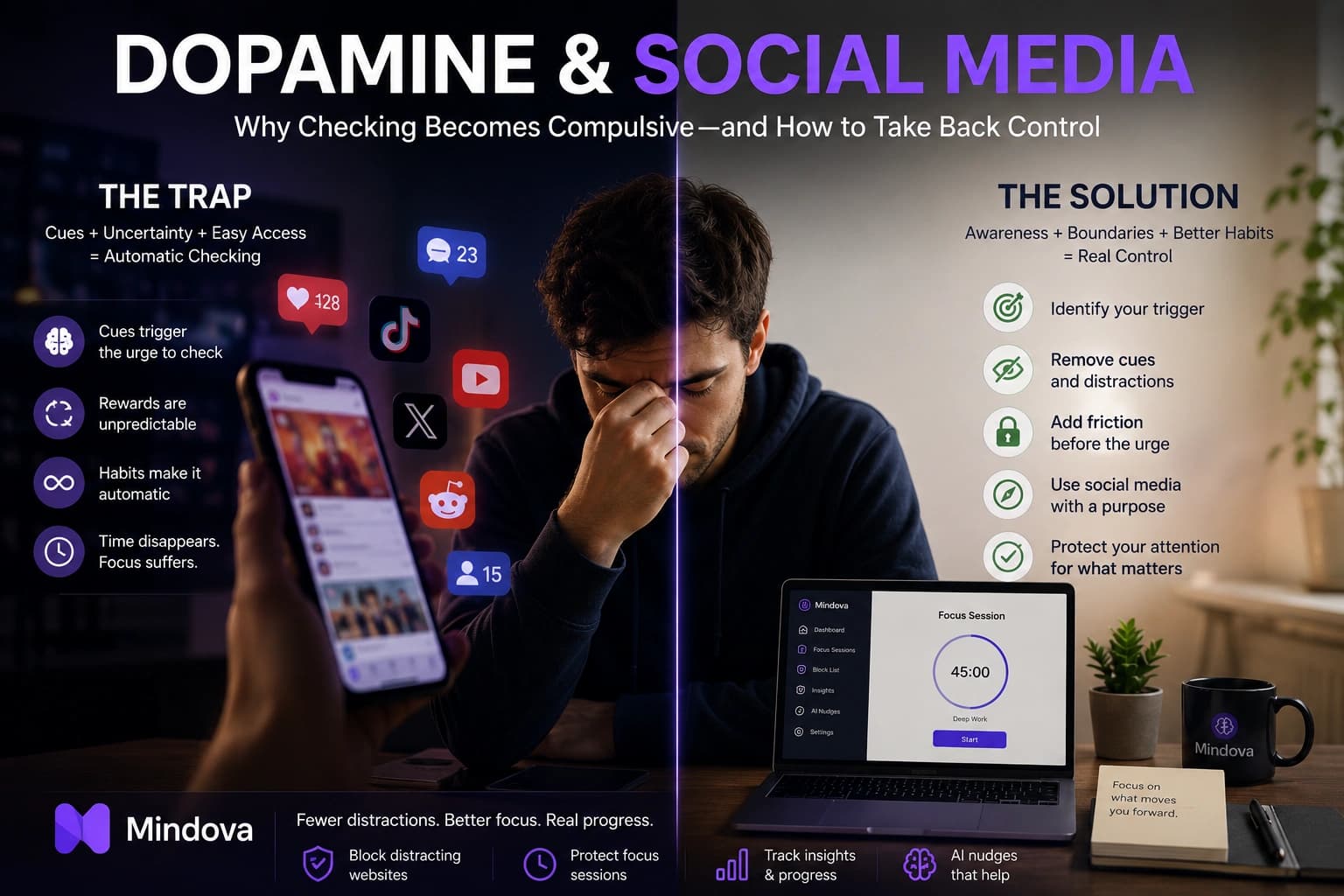
You open Instagram to answer one message.
A few minutes later, you are scrolling.
Or you reach for X, Reddit, TikTok, or YouTube the moment a difficult task slows down — sometimes before you consciously decide to do it.
It is tempting to explain this with one sentence:
“Social media gives you dopamine hits.”
The reality is more complicated.
Dopamine does play a role in reward learning and motivation, but it is not simply a pleasure chemical, and every like does not produce a predictable “hit” that automatically makes you addicted.
What matters more is how repeated rewards, cues, habits, and easy access can make checking increasingly automatic.
What Does Dopamine Actually Have to Do With Social Media?
Dopamine is a neurotransmitter involved in several processes, including:
- motivation;
- learning;
- movement;
- reward-related behavior;
- how cues become associated with possible outcomes.
That last part is especially relevant to social media.
A notification, app icon, moment of boredom, or even opening a new browser tab can become associated with the possibility of something interesting:
- a message;
- a comment;
- a funny video;
- new information;
- social approval;
- something unexpected.
Over time, those cues can become reasons to check.
That is different from saying:
“Your brain is addicted to dopamine.”
You need dopamine. The problem is not having too much dopamine in your body.
The useful question is:
Why has checking this platform become so automatic?
Why Social Media Rewards Keep You Checking
Social platforms contain many possible rewards.
Some are social:
- someone replied;
- somebody liked your post;
- you received a message.
Others are informational:
- a new story;
- breaking news;
- an interesting thread;
- a video you did not expect.
And the next thing you see is not always predictable.
That uncertainty can help maintain checking behavior because each new refresh or scroll carries the possibility of something worth seeing.
But the common comparison to slot machines needs some restraint.
Social media and gambling can both involve reinforcement and uncertainty, but they are not identical behaviors, and using social media does not automatically mean someone has a behavioral addiction.
How Checking Becomes a Habit
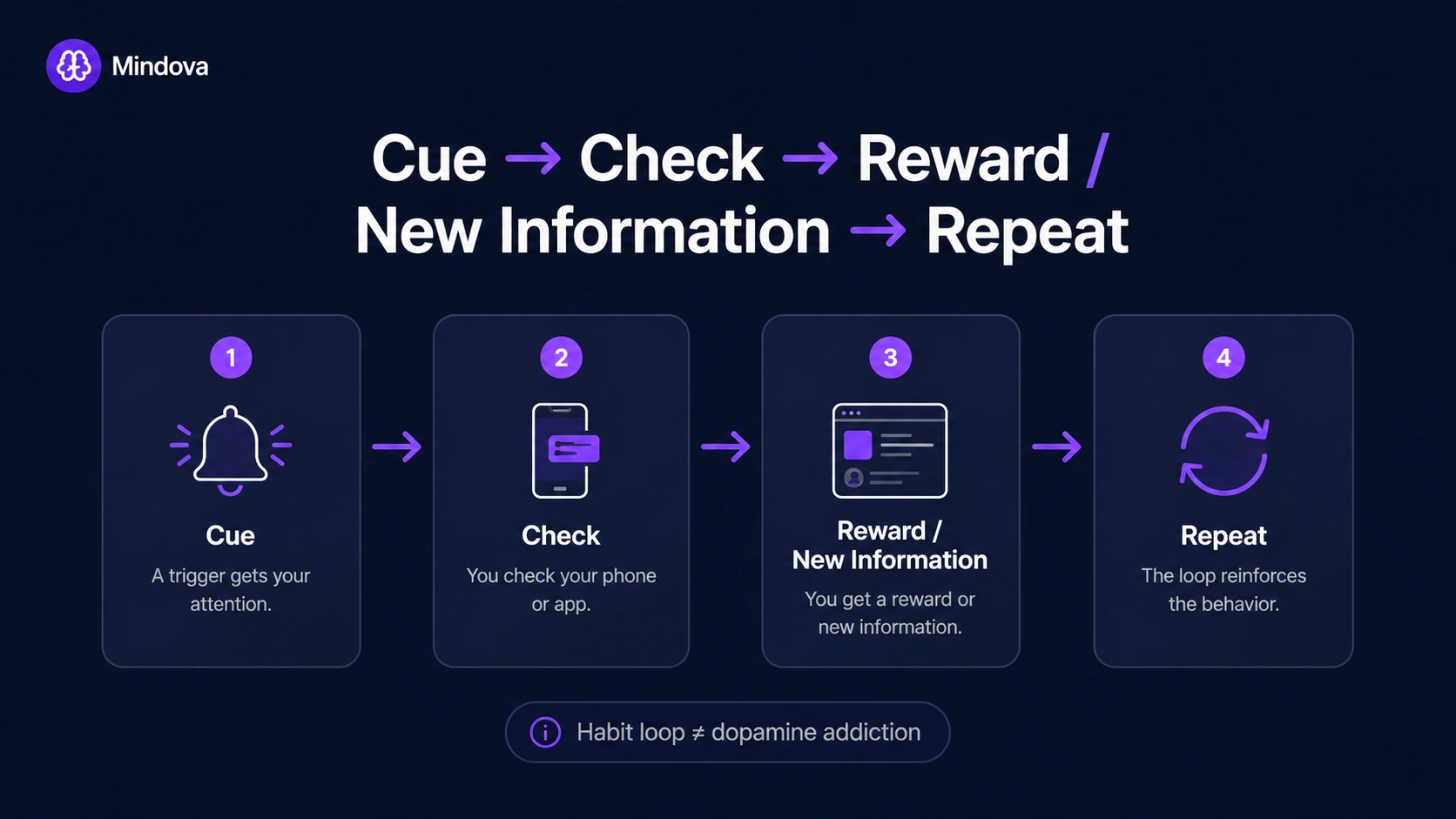
You do not need a complicated neuroscience explanation to understand a lot of repeated checking.
Imagine this pattern:
Cue: Your work gets difficult.
Action: You open Reddit.
Result: You get a few minutes of easier, more interesting stimulation.
Then it happens again tomorrow.
And again the next day.
Eventually, the difficult moment itself can become associated with opening Reddit.
Other cues might be:
- boredom;
- waiting for something;
- seeing a notification;
- finishing a small task;
- sitting down at your desk;
- picking up your phone;
- opening a browser.
Repeated social-media use can become increasingly habitual, meaning the action may be prompted by familiar cues before you have spent much time deciding whether you actually want to check.
That does not mean you have “lost free will.”
It means part of the behavior has become easier and more automatic through repetition.
Is Social Media Designed to Keep You Engaged?
Platforms have obvious reasons to encourage continued use.
Features such as:
- infinite feeds;
- recommendations;
- notifications;
- autoplay;
- social feedback;
- constantly changing content
can make it easy to continue consuming content.
But we should be careful with claims like:
“Every feature was designed specifically to hack your dopamine system.”
Unless there is direct evidence for a specific design decision, that goes beyond what we know.
The practical point does not require that claim.
Social media can provide very low-friction access to constantly changing rewards, and that alone can make stopping harder than starting.
Is Social Media Actually Addictive?
Some people use social media frequently without significant problems.
Others develop patterns that look much more compulsive.
Researchers increasingly study problematic social media use, particularly when use involves impaired control and begins interfering with areas such as:
- work;
- relationships;
- sleep;
- study;
- psychological wellbeing.
A 2025 clinical review proposed criteria for what researchers call Social Media Use Disorder, highlighting impaired control and functional impairment as central features. But Social Media Use Disorder is not currently recognized as an official disorder in major diagnostic systems.
Recent researchers have also argued that problematic social-media use can share some addictive-like characteristics with recognized addictions, while emphasizing that the evidence base is still developing.
So it is better not to call every frequent user “addicted.”
The more useful distinction is whether your use has become difficult to control and is causing meaningful problems.
Does Social Media Lower Your Dopamine Baseline?
There is no simple evidence-based rule that says:
Scroll enough → dopamine baseline drops → normal life becomes boring.
That explanation is popular online because it makes a complicated subject easy to visualize.
But the brain's reward system does not work like a battery meter you can watch rise and fall.
And you cannot know that you have a “low dopamine baseline” because work feels boring after scrolling.
If social media repeatedly replaces activities you actually intended to do, you already have enough information to work with.
You do not need to diagnose your dopamine levels.
Why “Just Use Willpower” Often Isn't a Great Strategy
Suppose YouTube distracts you ten times during a workday.
You could make ten separate decisions:
Don't open it.
Or you could change the environment before working.
For example:
- close the tab;
- remove the bookmark;
- turn off unnecessary notifications;
- log out;
- block the website temporarily;
- put a limit on the site.
The second approach does not prove that willpower is a limited biological resource.
It simply reduces the number of times you need to reconsider a decision you have already made.
How to Reduce Compulsive Social Media Checking
1. Find Your Main Trigger
Do not begin with:
I use social media too much.
Ask:
When do I open it without intending to?
Maybe it is:
- when work becomes difficult;
- between tasks;
- while waiting;
- when bored;
- immediately after waking;
- before sleeping.
One specific pattern is easier to change than “my entire relationship with technology.”
2. Remove Unnecessary Cues
If every notification creates another opportunity to check, turn off the ones you do not need.
You can also:
- remove distracting bookmarks;
- close feeds when you are finished;
- log out of accounts you open automatically;
- keep social sites out of your working tabs.
A cue you never see cannot prompt the same automatic response.
3. Add a Little Friction
The goal is not necessarily to ban social media forever.
Sometimes you only need to make an automatic action less automatic.
If you repeatedly open Reddit during work, blocking it during a focused session creates one extra boundary between the urge and the action.
If you still need the site, a limit may make more sense than a permanent block.
For browser-based distractions, see how to block distracting websites.
4. Give Checking a Purpose
Before opening a social platform, know why you are going there.
For example:
Reply to Sarah's message.
That is different from:
Let's see what's there.
The first has a natural stopping point.
The second can continue indefinitely.
5. Notice When Scrolling Changes Into Doomscrolling
Not all repeated scrolling is the same.
If you are repeatedly consuming upsetting news or negative content despite feeling worse afterward, you may be dealing with doomscrolling, which has a more specific pattern than general social-media checking.
See what doomscrolling is and how to stop it.
6. Take a Break If You Need One
Sometimes reducing cues is enough.
Sometimes a temporary break gives you a clearer view of the habit.
If you want to step away specifically from social platforms for a while, see our guide to taking a social media detox.
And if someone tells you that the break is necessary to “reset your dopamine,” that is a different claim.
We explain that myth separately in Does a Dopamine Detox Actually Work?.
Where Mindova Fits

Mindova does not block dopamine.
It does not diagnose social-media addiction.
And it cannot make you stop wanting to check something.
Its role is simpler:
add boundaries around distracting websites in your desktop browser.
Mindova currently supports:
- website blocking;
- Individual Site Limits;
- an overall distraction limit;
- timed Focus Sessions;
- browsing and focus insights;
- optional AI Nudges.
For example, if you automatically open Reddit during difficult work, you could block it during a timed Focus Session.
If YouTube is useful but regularly consumes more time than you want, an Individual Site Limit may fit better.
The point is not to change your brain chemistry.
It is to interrupt an automatic browser behavior long enough for you to return to the task you chose.
Frequently Asked Questions
Does social media release dopamine?
Social-media rewards can engage brain systems involved in reward processing, including systems in which dopamine plays a role.
But describing every notification or like as a predictable “dopamine hit” is an oversimplification.
Is dopamine the pleasure chemical?
Not simply.
Dopamine is involved in motivation, learning, movement and reward-related processes. Its role is much broader than producing pleasure.
Why do I keep checking social media automatically?
Repeated checking can become associated with cues such as boredom, notifications, difficult work or simply opening your phone or browser.
Over time, the response can become increasingly habitual.
Is social media the same as gambling?
No.
There are similarities worth studying, including reinforcement and uncertainty, but social-media use and gambling should not be treated as identical behaviors.
Am I addicted to social media?
Frequent use by itself does not establish an addiction.
Researchers focus more on patterns such as impaired control and meaningful interference with everyday functioning. Social Media Use Disorder is not currently an official diagnosis in major diagnostic systems.
Can a dopamine detox fix social media addiction?
There is no literal dopamine detox or dopamine reset.
If a temporary break helps you identify a problematic habit and establish better boundaries, that may still be useful for behavioral reasons.
You Don't Need to Fight Dopamine
The most useful explanation for repeated social-media checking is not:
Your dopamine is broken.
Look at the behavior instead.
What makes you open the platform?
When does it happen?
What keeps the session going?
And where could you add a boundary?
Sometimes the answer is turning off a notification.
Sometimes it is removing easy access.
Sometimes it is deciding what you are opening the platform to do.
And sometimes it is blocking a website for the hour when you actually want to work.
Understanding the pattern gives you something you can change.
Trying to “fix your dopamine” usually does not.
Mouhsine
Clinical Psychologist
Passionate about helping people achieve peak mental performance through evidence-based strategies and mindful technology use.
Related Articles

Digital Detox: What Is It, and Does It Actually Help?
Learn what a digital detox really is, what research says about its benefits, and how to reduce distracting technology without quitting every screen.

How to Temporarily Deactivate Facebook Without Deleting Your Account
Learn how to temporarily deactivate Facebook on mobile or desktop, what happens to your profile and Messenger, and how to reactivate your account later.

Digital Detox Retreats: Cost, Benefits, and Are They Worth It?
What happens at a digital detox retreat, how much does one cost, and is it worth paying for? Compare retreat types, evidence, downsides, and at-home alternatives.
Comments
Be the first to comment.
Ready to protect your focus?
Block distracting sites, set daily limits, and run focus sessions. Mindova is free.