Am I a Workaholic? Signs of Workaholism and What to Do
Written by Mouhsine
Admin
Published September 6, 2026

Working hard does not automatically make you a workaholic.
You can have a difficult deadline, work unusually long hours for a week, or care deeply about your job without having an unhealthy relationship with work.
The more useful question is:
Can you stop when stopping would be reasonable?
Workaholism is generally studied as a pattern involving a strong internal drive to work, excessive investment in work, and difficulty mentally or behaviorally disengaging from it.
That is different from simply having a busy job.
If work repeatedly follows you into evenings, weekends, relationships, sleep, and the moments when you intended to stop—and stepping away feels unusually difficult even when the work does not require it—the pattern may be worth taking seriously.
This article cannot diagnose you.
But it can help you distinguish working hard from a more compulsive relationship with work and decide what to examine next.
What Is Workaholism?
Researchers have spent decades trying to define workaholism precisely.
A major 2024 review of roughly 50 years of workaholism research describes it as involving both:
- a strong inner drive or pressure to work;
- unusually high investment of time and effort in work.
That distinction matters.
Workaholism is not simply:
I worked a 55-hour week.
The pattern is also about why you keep working and how difficult it is to disengage.
Workaholism: A Review of 50 Years of Research
Working Hard vs Workaholism
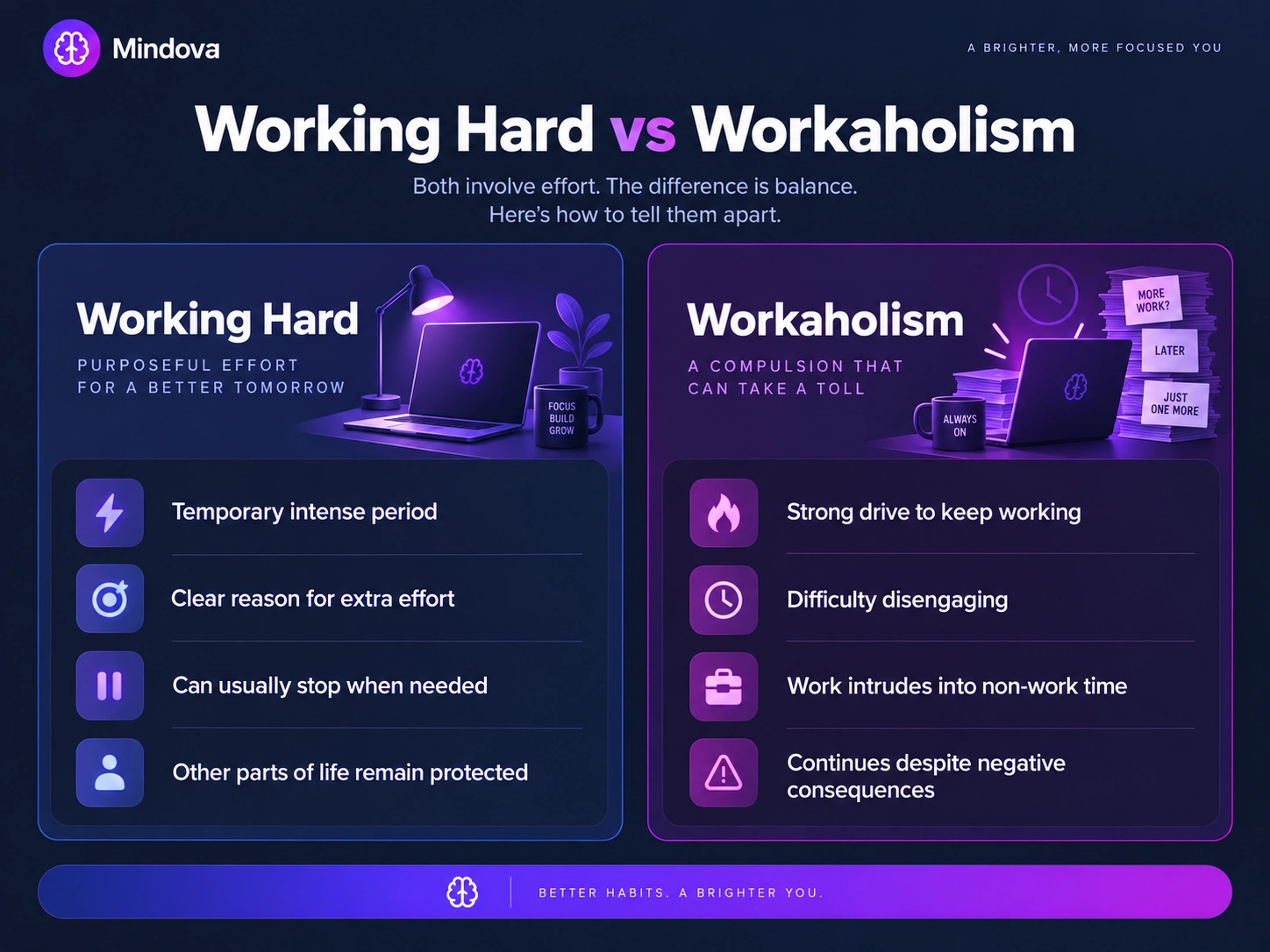
These can look similar from the outside.
Someone who works late might be:
- preparing for a launch;
- dealing with a temporary emergency;
- covering for an understaffed team;
- trying to meet a financial need;
- genuinely enjoying an important project.
The number of hours alone does not tell you the whole story.
A useful distinction is whether work remains chosen and bounded or begins to feel driven and difficult to stop.
Working hard may look like:
This week is intense because the launch is Friday. After that, I can step back.
A workaholic pattern may look more like:
The urgent work is finished, but I still feel uncomfortable stopping. I find something else to work on.
Or:
I am technically off work, but my mind remains stuck on work and I keep reopening it.
The second pattern is closer to what workaholism research is trying to describe.
Loving Your Job Is Not the Same as Being a Workaholic
Enjoying work is not automatically unhealthy.
Neither is:
- ambition;
- professional commitment;
- enthusiasm;
- wanting to improve at your craft.
Research distinguishes workaholism from healthy work engagement.
An engaged person may invest substantial effort because the work feels meaningful while still being able to disengage.
Workaholism is more closely associated with pressure to continue working even when continued work is no longer reasonably required.
That distinction prevents us from treating every highly motivated person as having a problem.
Signs Worth Paying Attention To
There is no checklist here that can diagnose workaholism.
Instead, look for patterns that repeat.
You Consistently Work Longer Than You Intended
Occasionally working late is normal.
The pattern becomes more relevant when:
I'll finish at six.
repeatedly becomes:
I'll just do one more thing.
and then another.
The issue is not one late evening.
It is whether your intended stopping points regularly fail.
You Find It Difficult to Switch Off
You stop working physically but not mentally.
During dinner, exercise, time with family, or bed, you are still:
- replaying work problems;
- checking work websites;
- planning tomorrow's tasks;
- worrying about unfinished work;
- feeling pulled back toward the laptop.
Some mental carryover is normal.
Persistent inability to disengage is more worth examining.
You Feel Strong Guilt or Restlessness When You Are Not Working
Rest may feel undeserved.
A free evening makes you anxious because:
I could be doing something useful.
A weekend without progress may feel like failure.
The important part is not occasional guilt.
It is whether not working repeatedly becomes uncomfortable enough that you return to work mainly to relieve that discomfort.
Work Repeatedly Pushes Out Other Parts of Life
For example:
- sleep gets cut first;
- plans with other people are repeatedly cancelled;
- exercise disappears;
- meals happen at the desk;
- evenings become catch-up time;
- weekends become extensions of the workweek.
Workaholism research has found associations with poorer work-life balance and difficulties in social and family functioning.
You Keep Working Despite Clear Negative Consequences
Maybe people close to you have raised concerns.
Maybe your sleep is suffering.
Maybe you feel consistently exhausted.
Maybe the additional hours are no longer improving the work.
Yet stopping still feels difficult.
That pattern deserves more attention than the raw number of hours.
Long Working Hours Are Not the Whole Story
This distinction is especially important.
Someone can work long hours without fitting a workaholic pattern.
And someone can struggle with compulsive working even if they do not work an extreme number of hours every week.
Still, long working hours can carry risks of their own.
WHO and the International Labour Organization reported that working 55 hours or more per week was associated with higher risks of stroke and death from ischemic heart disease compared with working 35–40 hours per week.
That evidence concerns long working hours.
It should not be misrepresented as:
Every person described as a workaholic has exactly this level of risk.
The concepts overlap, but they are not interchangeable.
Workaholism vs Burnout
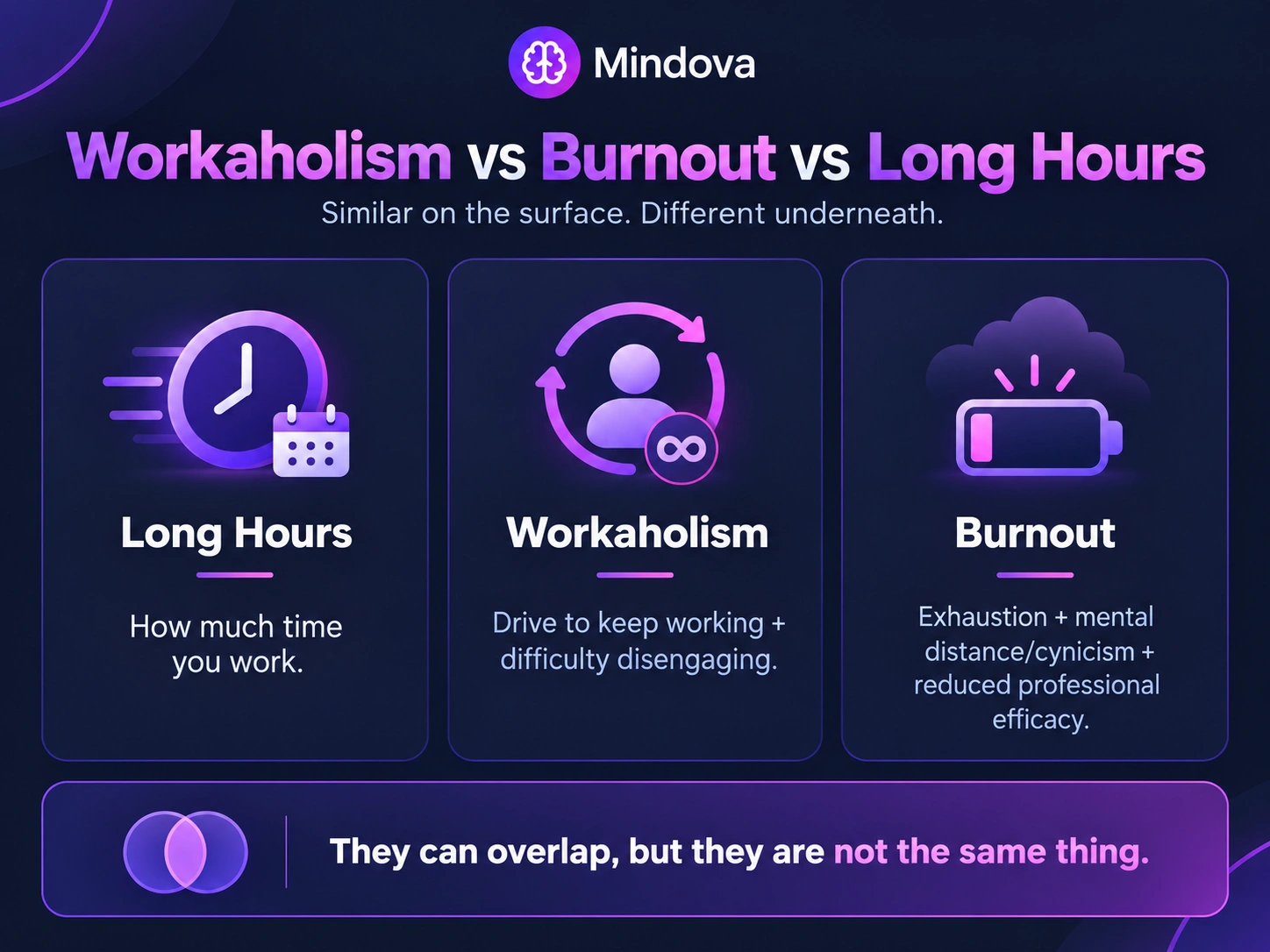
Workaholism and burnout are also not the same thing.
The World Health Organization describes burnout as an occupational phenomenon resulting from chronic workplace stress that has not been successfully managed.
WHO describes three dimensions:
- exhaustion;
- increased mental distance from work or cynicism;
- reduced professional efficacy.
Workaholism describes something different:
a strong drive to continue working and difficulty disengaging from work.
A person could show workaholic patterns without currently experiencing burnout.
And someone could experience burnout because of chronic workplace stress without being driven to work compulsively.
They can interact, but they should not be treated as synonyms.
Why Does Work Become So Difficult to Stop?
There is rarely one explanation.
And it is important not to reduce the problem to:
You lack boundaries.
Sometimes the pressure comes from the workplace itself.
External pressure can include:
- unrealistic workloads;
- understaffing;
- constant deadlines;
- expectations of after-hours availability;
- job insecurity;
- a culture that rewards visible overwork.
The 2024 workaholism review highlights the importance of job demands and organizational culture alongside individual factors.
In other cases, some of the pressure may continue internally even when external demands ease.
For example:
- difficulty feeling that work is ever “enough”;
- persistent pressure to keep producing;
- discomfort when resting;
- tying too much self-evaluation to work;
- automatically creating more work after necessary work is finished.
And often, the answer is both.
A demanding work environment can reinforce an existing difficulty with stopping.
Is the Problem Your Workload, Your Relationship With Work, or Both?
Before choosing a solution, separate these questions.
Ask about the workload
If you worked only reasonable hours:
Would the required work actually fit?
If the answer is no, the problem may be structurally impossible workload.
No productivity system can create extra hours.
You may need:
- different priorities;
- reduced scope;
- delegation;
- changed deadlines;
- more resources;
- a conversation about expectations.
If everything genuinely feels important, start with How to Prioritize Your Day When Everything Feels Important.
Then ask about the stopping point
Suppose the necessary work is complete.
Can you stop?
If the answer is still repeatedly no, the issue may go beyond workload management.
That is worth paying attention to separately.
What Can You Do If Work Is Taking Over?
There is no single proven “workaholism cure” that fits everyone.
The research literature itself is more cautious about interventions than much of the productivity internet.
A better approach is to identify where the pattern is coming from and work on that specific source.
1. Make the End of Work Concrete
“Stop when I'm finished” often fails because knowledge work rarely feels completely finished.
There is always another:
- email;
- edit;
- idea;
- report;
- improvement;
- task.
Instead, define a realistic stopping process.
For example:
At the end of my planned work period, I write tomorrow's first action, close the work tabs, and stop unless there is a genuine exception.
The goal is not to build a perfect ritual.
It is to make “work is over for today” observable.
2. Separate Necessary Work From Self-Generated Extra Work
Near the end of the day, ask:
Does this need to happen now?
Or:
Am I adding more because stopping feels uncomfortable?
Those are different situations.
You do not need to ignore legitimate deadlines.
But noticing the difference between required work and automatically creating more work can be useful.
3. Make After-Hours Work Less Automatic
Sometimes the pattern is digital.
You finish the day.
Then you reopen:
- email in the browser;
- a project dashboard;
- analytics;
- work documents;
- another “quick” research tab.
If this happens repeatedly, add friction.
For example:
- close work tabs completely;
- sign out where appropriate;
- put the work laptop away;
- remove work bookmarks from your immediate view;
- block specific work websites when you have intentionally decided to stop using them.
The point is not to make work impossible.
It is to interrupt the automatic:
I'll just check one thing.
4. Address Expectations When the Problem Is Structural
Personal boundaries cannot solve every workplace problem.
If your role expects:
- impossible workloads;
- permanent after-hours availability;
- chronic overtime;
- constant emergency response;
then the problem is not simply that you need a better evening routine.
Where possible, clarify:
- what actually has priority;
- what can wait;
- expected response times;
- who owns urgent work;
- which deadlines are negotiable;
- what should be dropped when new work arrives.
A good boundary is much easier to maintain when the system around it supports it.
5. Protect Non-Work Life Because It Matters
Rest, relationships, exercise, hobbies, and time that produces nothing do not need to justify themselves by making you more productive tomorrow.
That is an important distinction.
If every non-work activity is valued only because:
This will make me perform better later.
then work is still defining the value of everything around it.
A healthier boundary can simply be:
Work is important, and other parts of my life are important too.
6. Notice Whether You Can Actually Follow the Boundary
Suppose you decide:
I will stop at 6:30.
Then notice what happens.
Do you:
- stop reasonably often?
- repeatedly override the boundary?
- become very anxious or guilty?
- immediately reopen work?
- create exceptions almost every day?
The answer gives you useful information.
A boundary that repeatedly fails is not evidence that you are a bad person.
It means there is another part of the problem that needs attention.
Where Mindova Fits
Mindova does not treat workaholism.
It is not a diagnostic tool, therapist, or work-life-balance program.
Its role is narrower.
If browser behavior is part of the pattern—for example, repeatedly reopening work websites or distracting websites after you intended to stop—Mindova can help make that behavior less automatic.
Mindova currently supports:
- website blocking;
- Individual Site Limits;
- an overall distraction limit;
- timed Focus Sessions;
- browsing and focus insights;
- optional AI Nudges.
For example, during the workday you might use a Focus Session to protect a defined piece of work from distracting websites.
That can help keep work time more intentional instead of letting distraction stretch a two-hour task across an entire evening.
Or, after deciding that work is finished, you can block or limit specific browser-based sites that you habitually reopen.
Mindova provides a browser boundary.
It does not determine when you should work or whether your relationship with work is healthy.
Mindova does not currently provide recurring work schedules, Locked Mode, native desktop/mobile app blocking, or cross-device blocking enforcement.
For browser distraction specifically, see How to Block Distracting Websites.
When Professional Support May Be Useful
Productivity advice has limits.
Consider speaking with an appropriate healthcare or mental-health professional if work feels difficult to control or is significantly affecting:
- your physical health;
- sleep;
- mood;
- relationships;
- daily functioning;
- your ability to stop even when you genuinely want to.
The same applies if attempts to reduce work repeatedly fail and the pattern causes significant distress.
This article can help you recognize patterns.
It cannot determine why they are happening or diagnose a condition.
Frequently Asked Questions
What is a workaholic?
In research, workaholism generally refers to a pattern involving excessive investment in work together with a strong internal drive or pressure to keep working.
It is more than simply working hard during a busy period.
How do I know if I am a workaholic?
There is no single sign that proves it.
Patterns worth examining include persistent difficulty stopping, work dominating non-work time, strong guilt or restlessness when not working, repeatedly working beyond what is required, and continuing despite negative effects on other areas of life.
Is working long hours the same as workaholism?
No.
Long working hours describe how much time you work.
Workaholism also concerns the drive to keep working and difficulty disengaging.
You can have one without necessarily having the other.
Can I love my job without being a workaholic?
Yes.
Enjoying your work, being ambitious, or working intensely at times does not automatically mean you have a workaholic pattern.
A useful distinction is whether you can disengage reasonably when work is finished or when other parts of life need your attention.
Is workaholism the same as burnout?
No.
Workaholism describes a compulsive or strongly driven relationship with work.
Burnout is an occupational phenomenon associated with chronic workplace stress that has not been successfully managed.
They can occur together, but they are different concepts.
Is workaholism the same as working too much?
Not exactly.
Working too much can result from workload, financial pressure, deadlines, staffing, workplace culture, or other external demands.
Workaholism puts additional emphasis on the internal drive and difficulty disengaging.
How do I stop thinking about work after hours?
Start by making the transition out of work more concrete.
Write down unfinished tasks and tomorrow's next action, close work tabs, put work equipment away, and reduce easy access to browser-based work sites if repeatedly reopening them is part of the pattern.
If intrusive work thoughts or compulsive working remain persistent and distressing, consider professional support rather than treating it only as a productivity problem.
Can a website blocker help with workaholism?
A website blocker cannot treat workaholism.
It may help with one specific behavior: repeatedly opening work or distracting websites when you had already decided to stop.
The underlying reasons for compulsive working may require broader changes.
Can Mindova help me stop overworking?
Mindova cannot decide how much you should work or treat compulsive working.
It can help you create browser boundaries around specific websites and reduce predictable online distractions during or outside a focused work period.
The Goal Is Not to Care Less About Your Work
You do not need to become less ambitious.
You do not need to stop caring about your career.
And an intense week does not automatically mean something is wrong.
The question is whether you still have meaningful control over when work begins, when it ends, and what it is allowed to displace.
Look at the pattern.
Is the pressure mostly external?
Is it continuing internally after the external demand is gone?
Can you stop when stopping is reasonable?
What repeatedly loses when work expands?
Then work on the part of the system that is actually creating the problem.
Sometimes that means better prioritization.
Sometimes it means clearer expectations at work.
Sometimes it means making after-hours work less automatic.
And sometimes the difficulty is significant enough that productivity advice is not the right level of help.
The goal is not to work less at all costs.
It is to make sure work remains one part of your life rather than the rule that every other part has to fit around.
Mouhsine
Admin
Passionate about helping people achieve peak mental performance through evidence-based strategies and mindful technology use.
Related Articles

How to Focus on Writing Without Digital Distractions
Learn how to stay focused while writing by separating drafting from research, reducing digital distractions, and keeping the online tools you actually need
Creative Block: How to Get Unstuck and Start Creating Again
Feeling creatively stuck? Learn what creative block can look like, how to identify what is stopping you, and practical ways to generate ideas and move forward
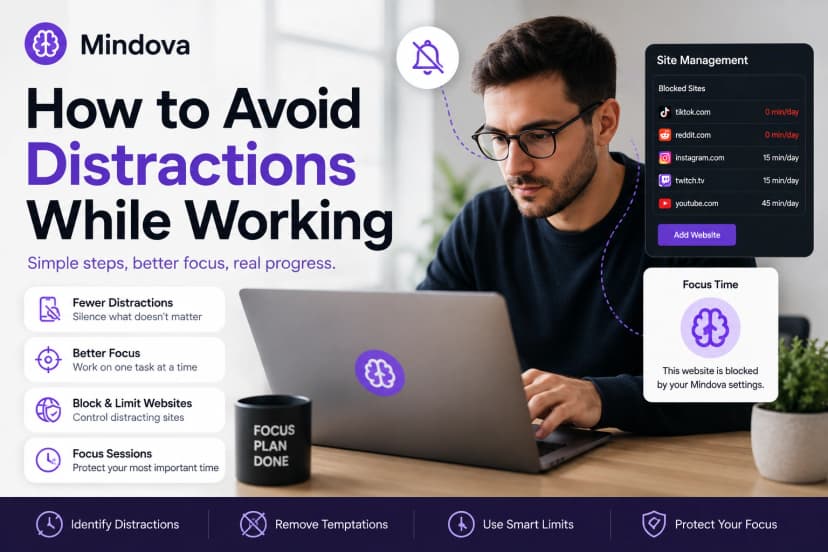
How to Avoid Distractions While Working: 10 Practical Strategies
Learn how to avoid distractions while working by reducing digital triggers, managing notifications, limiting distracting websites, and protecting focused work time.
Comments
Be the first to comment.
Ready to protect your focus?
Block distracting sites, set daily limits, and run focus sessions. Mindova is free.