Digital Detox: What Is It, and Does It Actually Help?
Written by Mouhsine
Admin
Published September 3, 2026
A digital detox does not have to mean deleting every app, switching off every screen, and disappearing for a weekend.
At its simplest, a digital detox is an intentional period of reducing or stepping away from specific forms of digital technology use.
That could mean:
- no social media for a weekend;
- keeping your phone out of the bedroom;
- staying away from news feeds for a day;
- blocking distracting websites while you work;
- spending an evening without nonessential screens.
The useful part is not being offline for the sake of being offline.
It is creating enough distance from a digital habit to notice whether it is taking more time or attention than you want.
Research on digital detoxes is mixed, and there is no single protocol that works for everyone. You also do not need to “reset your brain” for reducing a distracting behavior to be useful.
A better starting question is:
Which part of my digital life do I actually want to change?
What Is a Digital Detox?
A digital detox is a voluntary reduction or temporary break from some form of digital technology.
Depending on the person, that could involve:
- smartphones;
- social media;
- short-form video;
- gaming;
- news;
- email;
- messaging;
- streaming;
- unnecessary browsing.
It does not have to mean complete digital abstinence.
You may still need technology for:
- work;
- navigation;
- banking;
- authentication;
- calls;
- necessary messages;
- studying.
That is why a targeted detox is often more realistic than declaring every screen off-limits.
Instead of:
No technology this weekend.
you might decide:
No social media after dinner.
or:
No Reddit or YouTube while I work tomorrow morning.
The second version gives you something specific to test.
Does a Digital Detox Actually Work?
There is no simple yes-or-no answer.
Research on digital detox interventions has produced mixed results.
Some studies report improvements in particular outcomes after people reduce certain forms of digital or social-media use. Others find little effect, and the outcome can depend on what was reduced, for how long, who participated, and what researchers measured.
A review of digital-detox research found that reducing digital or social-media use may help in some circumstances, while complete abstinence is not consistently superior.
Digital Detox and Well-Being — PubMed
That means a digital detox should not be treated as a guaranteed treatment for:
- poor concentration;
- stress;
- low mood;
- sleep problems;
- lack of motivation;
- productivity problems.
A more useful way to think about it is as a behavioral experiment.
You temporarily change one part of your digital environment and see what happens.
What a Digital Detox Will Not Do
A lot of online advice adds claims that go beyond the evidence.
A digital detox does not reliably:
- reset your brain;
- reset dopamine;
- restore a universal attention span;
- eliminate stress;
- cure “brain fog”;
- make you productive after 24 hours;
- permanently remove the urge to check your phone.
If someone tells you that avoiding screens for a weekend will “reset your dopamine baseline,” that is a different claim entirely.
We cover that misconception in Does a Dopamine Detox Actually Work?.
You do not need a neuroscience reset story to justify reducing a behavior that is getting in your way.
When Might a Digital Detox Be Worth Trying?
You do not need to label yourself “addicted” before changing how you use technology.
A digital break may be worth testing if you repeatedly notice things like:
- opening a feed without consciously deciding to;
- checking websites while trying to work;
- scrolling much longer than you intended;
- reaching for a device whenever you become bored;
- using social media during time you wanted to spend elsewhere;
- repeatedly replacing difficult work with easier online activity;
- returning to the same sites even when you no longer find them useful.
The most important question is not:
How many hours of screen time do I have?
It is:
Is this particular digital behavior interfering with something I care about?
Ten hours on a laptop for work is different from spending two hours on a feed you intended to check for five minutes.
Context matters.
How to Do a Digital Detox That Is Actually Useful
You do not need a retreat or an elaborate 30-day challenge.
Start with one problem.
1. Identify the Behavior You Want to Change
Avoid vague goals such as:
I need less screen time.
Instead, identify the behavior.
For example:
I open Reddit whenever writing becomes difficult.
I scroll social media for an hour after getting into bed.
I keep refreshing news sites while working.
YouTube turns every five-minute break into thirty minutes.
Now you know what the detox is actually about.
2. Decide What Still Needs to Work
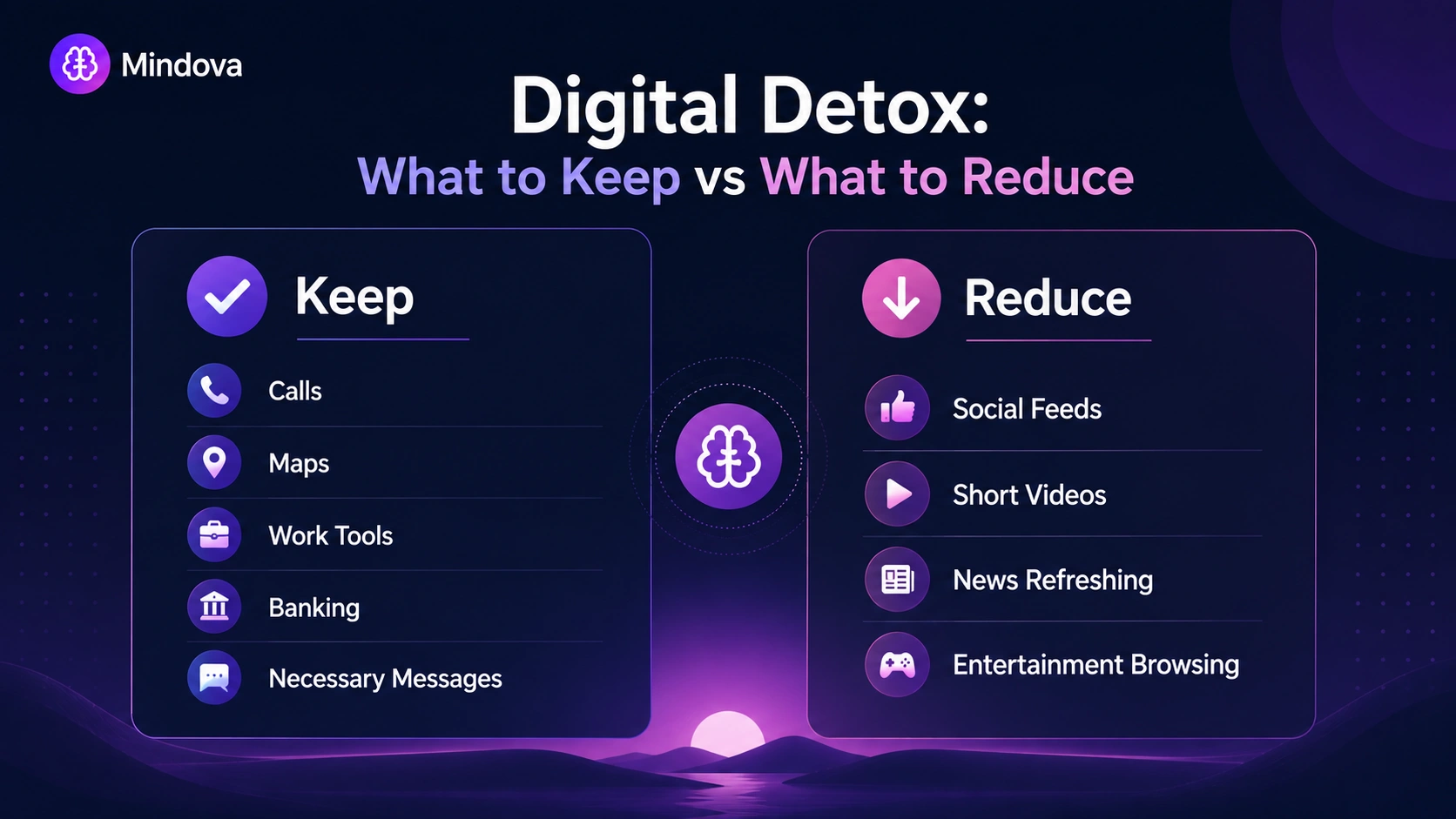
Technology is not one thing.
Before starting, separate what you need from what you want to reduce.
For example:
Keep:
- calls from family;
- maps;
- work tools;
- banking;
- necessary messages.
Reduce:
- social feeds;
- short videos;
- entertainment browsing;
- repeated news checking.
A digital detox should make your boundaries clearer, not make normal life unnecessarily difficult.
3. Choose a Realistic Duration
There is no scientifically correct digital-detox duration.
You do not need exactly:
- 24 hours;
- 48 hours;
- seven days;
- 30 days.
Match the experiment to the problem.
If distracting websites interfere with work, try one protected work session.
If evening scrolling is the problem, try several screen-light evenings.
If social media itself is the issue, a longer break may reveal more about the habit.
For a social-specific approach, see How to Take a Social Media Detox.
The duration is not a neurological countdown.
It is simply enough time to observe what changes when the behavior is unavailable.
4. Remove Easy Access
If you have already decided not to use something, avoid forcing yourself to make the same decision repeatedly.
Depending on the behavior, you could:
- turn off unnecessary notifications;
- remove a distracting bookmark;
- log out;
- close unrelated tabs;
- keep your phone somewhere less convenient;
- block a website during a focused period;
- limit a website you still need occasionally.
The objective is not to prove how much willpower you have.
It is to make an automatic action less automatic.
If distracting websites are the main issue, see How to Block Distracting Websites.
5. Decide What You Will Do Instead
Removing a digital activity creates empty space.
Decide what belongs there.
You might:
- walk;
- exercise;
- cook;
- read;
- work on a hobby;
- spend time with someone;
- do focused work;
- simply rest.
The replacement does not need to be productive.
And it does not have to be deliberately boring.
The point is to stop one digital behavior from automatically filling every available gap.
6. Notice What Makes You Reach Back
This may be the most useful part of the experiment.
When you want to reopen the platform or site you removed, ask:
What happened immediately before this?
Maybe:
- work became difficult;
- you finished a task;
- you were waiting;
- you became bored;
- you saw a notification;
- you wanted a break;
- you felt uncertain about what to do next.
You may discover that your problem is not:
I love social media too much.
It might actually be:
Every difficult moment at work has become a cue to check social media.
That is a much more actionable problem.
If repeated social checking is the main pattern, see Why Social Media Can Become So Automatic to Check.
What Should You Do When the Detox Ends?
Do not simply restore every old setting and return to exactly the same routine.
Review what happened.
Ask:
- What did I genuinely miss?
- What did I not miss at all?
- Which activity was hardest not to check?
- What triggered me to reach for it?
- Did removing it help anything I actually care about?
- Would I prefer a block, a limit, or unrestricted access?
- Which change could realistically survive a normal week?
You might decide that one platform needs:
- no change;
- notifications turned off;
- a daily limit;
- fewer visits;
- removal from your work environment;
- complete removal.
The goal is not to stay permanently “detoxed.”
The goal is to make your normal digital life work better.
Digital Detox vs Social Media Detox
These terms overlap, but they are not identical.
A digital detox can involve many forms of technology:
- phones;
- social media;
- games;
- news;
- email;
- entertainment;
- general browsing.
A social media detox focuses specifically on social platforms.
So a social media detox can be one form of digital detox, but a digital detox does not need to involve social media.
Someone whose main problem is repeatedly checking work email, for example, may need a digital boundary without needing a break from Instagram or TikTok.
Digital Detox vs Dopamine Detox
These are also different ideas.
A digital detox describes changing your use of technology.
A dopamine detox is an internet trend usually framed around avoiding rewarding or stimulating activities to supposedly “reset dopamine.”
You cannot literally detox dopamine.
If your dopamine detox consists of taking a break from Reddit, TikTok, YouTube, or news feeds, what you are really changing is your behavior and access to digital content.
That can still be useful.
It simply does not require the dopamine-reset explanation.
Digital Detox vs Digital Minimalism
A detox is temporary.
Digital minimalism is more about your long-term relationship with technology.
Instead of asking:
What should I avoid this weekend?
digital minimalism asks:
Which technologies deserve a place in my life, and what should I use them for?
A digital detox can help expose a problem.
Digital minimalism is one way of deciding what happens afterward.
If you are more interested in long-term technology boundaries, see the Mindova Digital Minimalism Guide.
Do You Need to Quit Technology Completely?
Usually, no.
Complete abstinence can be a personal experiment, but it is not automatically healthier or more effective.
Technology can also support:
- social connection;
- education;
- navigation;
- accessibility;
- work;
- creativity;
- entertainment;
- useful information.
The useful distinction is not:
Technology = bad. Offline = good.
It is:
Is the way I am using this particular technology helping or interfering with what I want to do?
That is why targeted reduction can be more useful than treating every device as the enemy.
Health guidance on digital detoxes similarly tends to frame them as intentional reductions rather than requiring total disconnection.
UCLA Health — Considering a Digital Detox?
Can a Digital Detox Improve Focus?
It may help if the digital behavior you remove repeatedly interrupts focused work.
Imagine that you are writing and open Reddit every time the next paragraph becomes difficult.
Removing Reddit does not magically increase your attention span.
But it does remove one predictable source of switching.
That gives the task more opportunity to hold your attention.
The explanation can be that simple.
You do not need to claim that your brain has “reset.”
Where Mindova Fits
Mindova is not a complete device-wide digital detox tool.
It does not disconnect you from technology or block native apps on your phone.
Its role is more specific:
help reduce distracting website use in supported desktop Chromium browsers.
Mindova currently supports:
- website blocking;
- Individual Site Limits;
- an overall distraction limit;
- timed Focus Sessions;
- browsing and focus insights;
- optional AI Nudges.
For example, a work-focused digital detox could look like this:
- Identify the websites that interrupt you most.
- Choose one task you want to protect.
- Start a timed Focus Session.
- Make those distracting websites unavailable during the session.
- Notice when you attempt to visit them.
- Review the pattern afterward.
If a website is useful but repeatedly consumes more time than you want, an Individual Site Limit may be more appropriate than blocking it completely.
Mindova does not currently provide recurring schedules, Locked Mode, native iPhone or Android app blocking, or cross-device blocking enforcement.
Frequently Asked Questions
What is a digital detox?
A digital detox is an intentional period of reducing or temporarily stopping certain forms of digital technology use.
It can involve complete abstinence, but it does not have to.
How long should a digital detox last?
There is no universal evidence-based duration.
Choose a period that makes sense for the behavior you want to observe or change.
Does a digital detox improve mental health?
Research is mixed.
Some interventions have produced improvements in certain outcomes, while others have found little or no effect. Results depend on factors such as what people reduce, the duration, the population studied, and the outcome measured.
Do I need to stop using my phone completely?
No.
You can target the parts of your digital use that are causing problems while keeping necessary or useful functions.
Does a digital detox reset dopamine?
There is no established evidence that temporarily avoiding digital technology resets dopamine.
Reducing a distracting behavior can still be useful without that explanation.
Is digital detox the same as social media detox?
No.
A social media detox focuses specifically on social platforms.
A digital detox can include social media but may also involve gaming, news, email, general browsing, or other digital activities.
What should I do after a digital detox?
Use what you learned to build realistic boundaries.
That could mean fewer notifications, a website limit, a protected focus period, or leaving a platform unchanged because you discovered it was not actually causing a problem.
A Digital Detox Should Teach You Something
Going offline is not automatically an achievement.
The useful part is what the break teaches you.
Maybe you discover that social media was not actually your biggest distraction.
Maybe YouTube only becomes a problem while you are working.
Maybe you prefer mornings without a feed.
Maybe you do not need a permanent ban at all — just a reasonable limit.
That is useful information.
You do not need to reject technology.
You need enough distance from an automatic behavior to decide whether you still want it operating the same way.
That is a much better reason to try a digital detox than chasing a “reset.”
Mouhsine
Admin
Passionate about helping people achieve peak mental performance through evidence-based strategies and mindful technology use.
Related Articles

How to Temporarily Deactivate Facebook Without Deleting Your Account
Learn how to temporarily deactivate Facebook on mobile or desktop, what happens to your profile and Messenger, and how to reactivate your account later.

Digital Detox Retreats: Cost, Benefits, and Are They Worth It?
What happens at a digital detox retreat, how much does one cost, and is it worth paying for? Compare retreat types, evidence, downsides, and at-home alternatives.
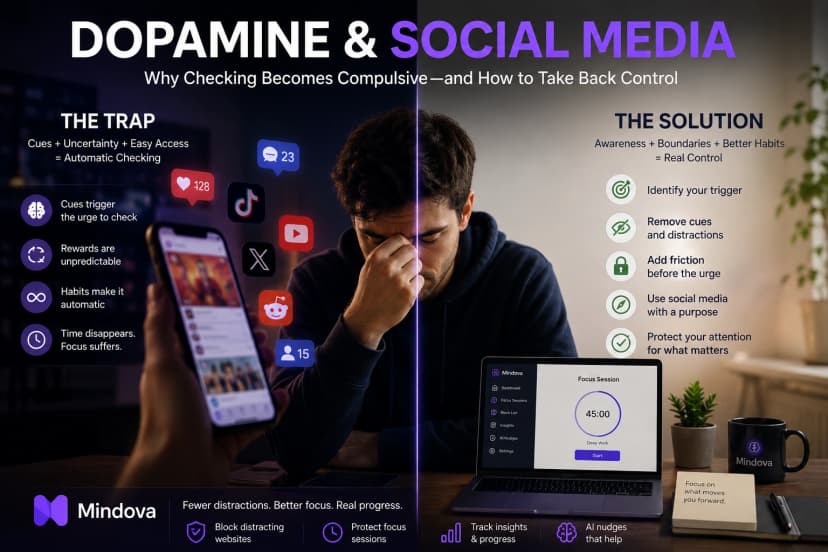
Dopamine and Social Media: Why Checking Becomes Compulsive
Learn what dopamine really has to do with social media, why checking can become habitual, and practical ways to reduce compulsive scrolling.
Comments
Be the first to comment.
Ready to protect your focus?
Block distracting sites, set daily limits, and run focus sessions. Mindova is free.