Mindful Productivity: How to Work With More Intention
Written by Mouhsine
Wellness Coach
Published September 6, 2026
You open your laptop to finish one important task.
Then an email arrives.
You check it.
That reminds you of something else.
A message appears.
You answer it.
You open another tab.
An hour later, you have been busy the entire time—but the work you meant to do has barely moved.
That is the problem mindful productivity tries to address.
Mindful productivity means working with deliberate awareness of what you are doing, where your attention is going, and whether your next action still serves the work you intended to do.
It is not about becoming perfectly calm.
It is not about meditating before every task.
And it is not a scientifically proven way to squeeze more output from every hour.
The practical idea is much simpler:
Choose what deserves attention, define what you intend to do, protect that work from predictable distraction, notice when your attention shifts, and decide deliberately what happens next.
What Is Mindful Productivity?
“Mindful productivity” is not one standardized scientific method.
It is a productivity approach that applies ideas commonly associated with mindfulness—especially awareness and deliberate attention—to everyday work.
In practice, that might look like this:
I know what I intend to accomplish during this work period.
Then something competes for your attention:
I notice it before automatically following it.
That small gap between impulse and action is where mindful productivity becomes useful.
Instead of:
Notification → click.
you create:
Notification → notice → decide.
Instead of:
Difficult paragraph → open Reddit.
you create:
Difficult paragraph → notice the urge to leave → decide whether switching actually helps.
Mindful productivity does not require perfect attention.
It encourages more deliberate decisions about where attention goes.
Mindful Productivity vs Being Busy
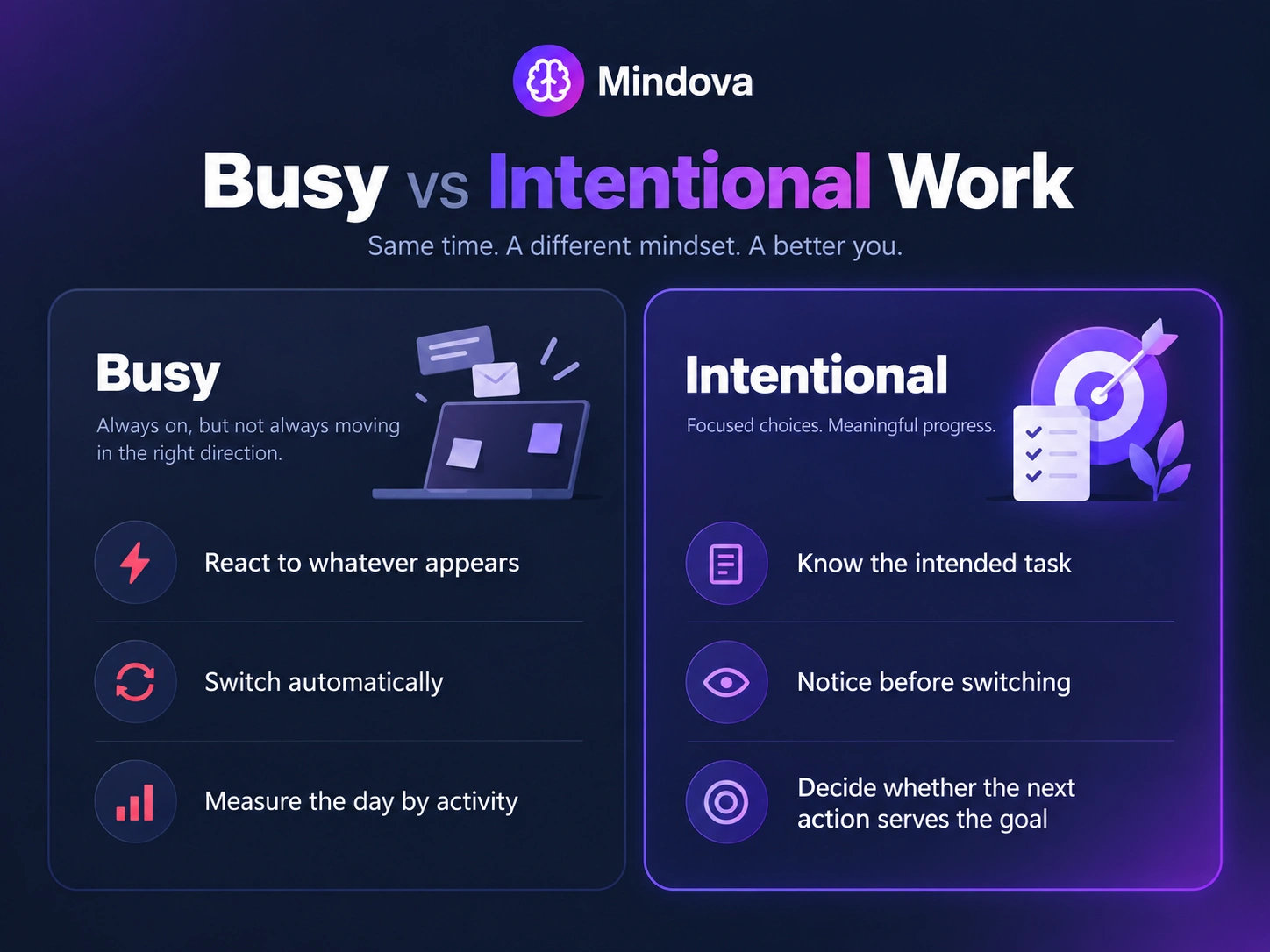
Being busy and working intentionally can look similar from the outside.
Both may involve:
- meetings;
- emails;
- documents;
- deadlines;
- completed tasks.
The difference is not simply how much you did.
Busy
I responded to whatever appeared next.
Intentional
I knew what I wanted to accomplish and made deliberate decisions when something competed with it.
That does not mean interruptions are always bad.
Sometimes something genuinely more important appears.
The difference is that the interruption wins because you decided it should, not simply because it appeared first.
If your real problem is deciding what deserves attention in the first place, see How to Prioritize Your Day When Everything Feels Important.
Does Mindfulness Actually Improve Productivity?
This is where productivity content often becomes too confident.
Mindfulness-based interventions have been studied extensively, including in workplaces.
But the research does not justify a simple claim like:
Mindfulness makes you more productive.
A systematic review and meta-analysis of 99 randomized studies involving 16,054 participants found a small improvement in task performance when mindfulness-based programs were compared with passive control groups.
However, the advantage was not statistically significant when they were compared with active control groups.
The researchers also rated overall confidence in the evidence as very low.
Other workplace research has found possible benefits for outcomes such as stress, well-being, and mindfulness itself, but the literature also contains substantial variation between studies and methodological limitations.
So the useful conclusion is not:
Mindfulness guarantees better performance.
It is:
Mindful working practices may be useful when they help you notice distraction, reduce automatic reactions, or work more deliberately.
The Five-Step Mindful Productivity Framework
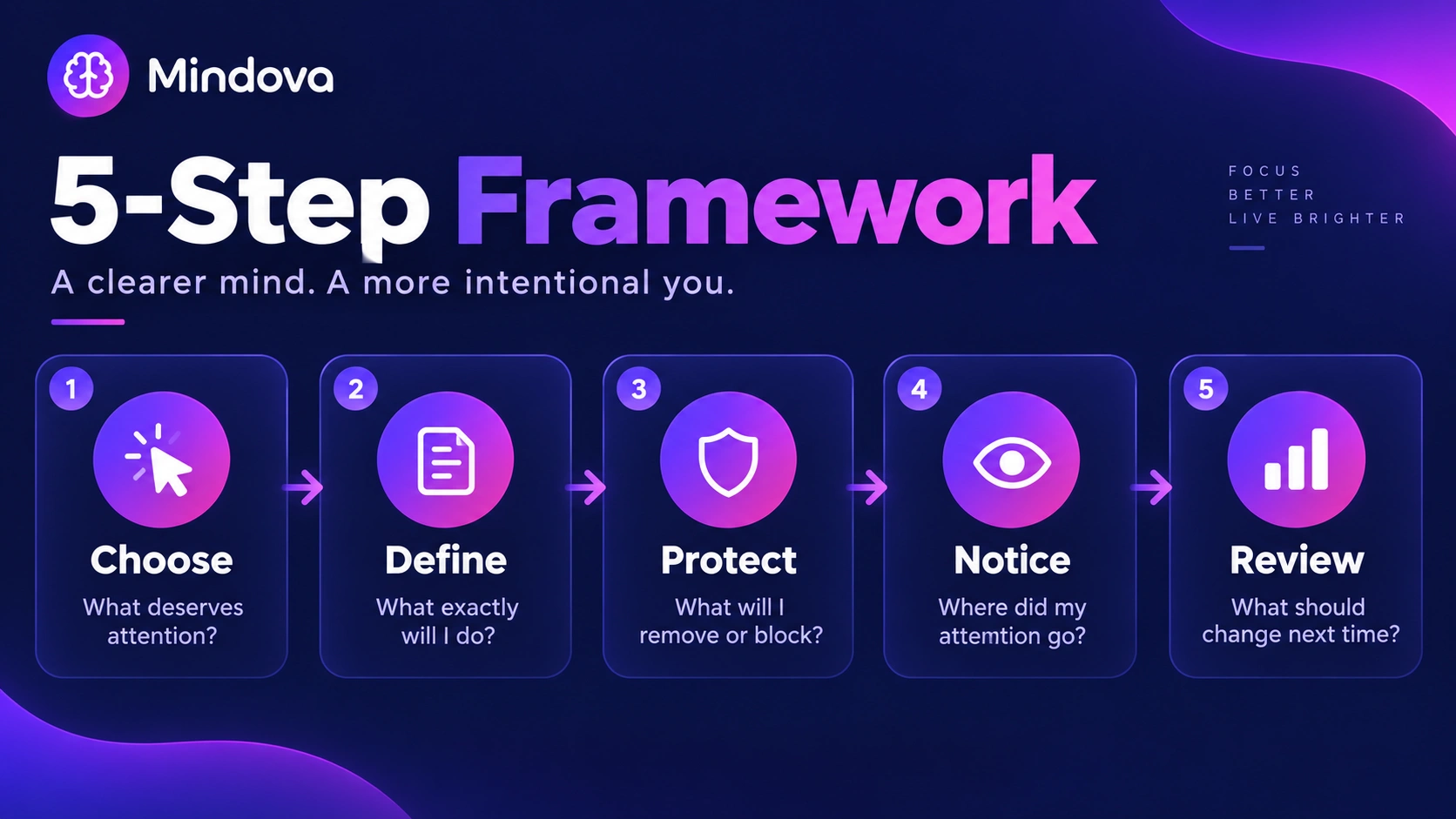
You do not need another complicated productivity system.
Use five steps:
Choose → Define → Protect → Notice → Review
1. Choose What Deserves Attention
Before opening five things, decide what you are actually trying to work on.
For example:
Finish the first draft of the client proposal.
Not:
Be productive this morning.
Mindful productivity starts with an intention.
Without one, there is nothing to compare your next action against.
If several tasks are competing for the same time, prioritize them before starting whenever possible.
2. Define What You Intend to Do
Now make the work concrete.
Compare:
Work on the report.
with:
Rewrite the introduction and finish section two.
The second gives your attention a clearer target.
You can also define what “enough” means for the current work period.
For example:
During this session, I am finishing the outline. I do not need to complete the entire article.
That makes it easier to notice when your work has drifted away from the original intention.
3. Protect the Work From Predictable Distractions
Mindfulness should not become an excuse to repeatedly test your willpower.
If you already know what usually pulls you away, change the environment before starting.
That might mean:
- closing unrelated tabs;
- silencing unnecessary notifications;
- moving your phone away;
- blocking distracting websites;
- starting a defined Focus Session.
You are not trying to remove every possible interruption.
You are reducing the ones you can already predict.
For browser-specific help, see How to Block Distracting Websites.
4. Notice When Your Attention Moves
This is the part that makes the framework genuinely mindful.
Imagine you are writing.
After ten minutes, you feel the urge to open another website.
The goal is not to pretend that urge never happened.
Instead:
Notice it.
Then ask:
Does switching serve the task I intended to do?
Sometimes the answer is yes.
Maybe you genuinely need a source or another document.
Then switch deliberately.
But sometimes the answer is:
No. The work became difficult and I am looking for something easier.
Then return.
A useful sequence is:
Notice → Ask → Choose.
You do not need perfect concentration.
You need enough awareness to keep a small attentional shift from automatically becoming a long detour.
5. Review What Happened
After the work period, ask a few simple questions:
- Did I work on what I intended?
- What repeatedly pulled me away?
- Was the task clear enough?
- Was the work period realistic?
- Did the environment help?
- What should I change next time?
This is not a performance score.
It is information.
For example:
I repeatedly opened news sites halfway through writing.
Useful information.
Or:
I scheduled a long work block between two meetings and it never realistically fit.
Also useful.
For a deeper review framework, see How to Use Feedback Loops for Personal Productivity.
What to Do When You Feel the Urge to Switch Tasks
One of the most important moments in a work session is the moment you want to leave the task.
You are writing.
The paragraph becomes difficult.
Suddenly checking email feels important.
Before switching, ask:
Is this necessary for the current task?
If yes, switch deliberately.
Did something genuinely more important appear?
If circumstances changed, reprioritize.
Or am I leaving because the current work became uncomfortable or boring?
If so, returning may be the more intentional choice.
Sometimes one short question is enough:
Why am I switching?
You do not need to turn every distraction into a meditation exercise.
You only need enough awareness to distinguish a deliberate switch from an automatic one.
Mindful Productivity Does Not Mean Never Getting Distracted
Distraction is not proof that you failed.
Neither is mind wandering.
You may notice:
- an unrelated thought;
- boredom;
- a notification;
- another unfinished task;
- physical discomfort;
- an interesting link.
That is normal.
The mindful part is recognizing what happened before automatically giving the distraction the next ten minutes.
A good work period can contain several moments of:
distraction → noticing → return.
The goal is not uninterrupted perfection.
It is more deliberate recovery when attention moves.
Mindful Productivity Does Not Mean Working Slowly
Intentional does not mean slow.
Sometimes the deliberate choice is:
This is genuinely urgent. Handle it now.
Sometimes it is:
I already know what needs doing. Stop reconsidering and execute.
Mindful productivity should reduce unnecessary reactivity.
It should not turn every small decision into a philosophical exercise.
Do You Need to Meditate?
No.
Meditation is one way people practice mindfulness, and many scientific studies of mindfulness examine structured meditation or mindfulness-based programs.
But you do not need a meditation routine to use the work principle in this article:
Notice where your attention is, compare it with your intention, and choose what happens next.
That can happen:
- before opening email;
- when a notification appears;
- between two tasks;
- while writing;
- when you feel the urge to browse.
If meditation is useful to you, it can be part of your routine.
It is not a requirement for mindful productivity.
What Mindful Productivity Is Not
Mindful productivity does not mean:
- meditating before every task;
- moving slowly;
- doing less work automatically;
- never getting distracted;
- ignoring deadlines;
- avoiding difficult work;
- tracking every minute;
- proving that mindfulness makes you more productive.
It is simply a more deliberate way of relating to your work and attention.
Mindful Productivity and Hustle Culture Are Not Exact Opposites
Mindful productivity is often presented as an alternative to hustle culture.
There is some value in that comparison.
Hustle-oriented thinking can encourage:
More hours. More tasks. More output. Keep going.
Mindful productivity asks different questions:
Is this still the work I intended to do?
Does continuing make sense?
Am I choosing this action, or simply reacting?
But a demanding day is not automatically “hustle culture.”
You can work intensely and still work intentionally.
The distinction is less about whether the day is busy and more about whether constant activity has become the goal itself.
Rest Does Not Need to Justify Itself Through Productivity
Another trap is turning everything outside work into a productivity technique.
Sleep becomes:
how I improve tomorrow's output.
Exercise becomes:
how I improve focus.
Time with other people becomes:
how I recover so I can work harder later.
Those things can affect how you feel and function.
But they do not need to earn their place only by increasing future work performance.
Mindful productivity should help put work in context, not make work the reason everything else exists.
When Mindful Productivity Is Not the Solution
A more deliberate work style cannot fix every problem.
It cannot solve:
- impossible workloads;
- chronic understaffing;
- unrealistic deadlines;
- constant emergency requests;
- a workplace expecting permanent availability.
If ten hours of required work are being forced into six available hours, awareness does not create the missing four hours.
You may need:
- reprioritization;
- reduced scope;
- delegation;
- different deadlines;
- clearer expectations;
- additional resources.
And if the deeper problem is that you repeatedly cannot disengage from work even when the external pressure is gone, that is different from mindful productivity.
See Am I a Workaholic? Signs to Look For and What to Do Next.
Where Mindova Fits
Mindova cannot make you mindful.
It does not decide what deserves your attention.
It does not measure your mental state.
And it does not determine whether your work is good.
Its role is narrower:
Mindova can help reduce predictable browser distractions while you work on an intention you have already chosen.
Mindova currently supports:
- website blocking;
- Individual Site Limits;
- an overall distraction limit;
- timed Focus Sessions;
- browsing and focus insights;
- optional AI Nudges.
For example:
Choose
Finish section two of the report.
Define
Rewrite the first three paragraphs and add the missing example.
Protect
Start a Mindova Focus Session and keep distracting websites unavailable.
Notice
You feel the urge to open Reddit.
Ask whether that serves the task.
If not, return.
Review
Afterward, ask:
Did I finish what I intended?
Which browser distractions kept appearing?
Mindova's browsing and focus insights can contribute to that review.
They do not tell you whether the actual work was high quality.
Optional AI Nudges can provide contextual reminders that encourage a return to your intended activity.
They do not read your mind or determine your mental state.
Mindova does not currently provide recurring schedules, Locked Mode, native app blocking, or cross-device blocking enforcement.
Frequently Asked Questions
What is mindful productivity?
Mindful productivity means approaching work with deliberate awareness of what you intend to do, noticing when your attention moves, and consciously deciding what happens next instead of automatically reacting.
Is mindful productivity the same as mindfulness?
Not exactly.
Mindfulness is a broader concept involving awareness of present experience.
Mindful productivity applies some of those principles specifically to work and attention.
Does mindfulness make you more productive?
The evidence is not strong enough to guarantee that.
A large meta-analysis found a small task-performance benefit against passive controls but no statistically significant advantage against active controls, and confidence in the overall evidence was rated very low.
Do I need to meditate?
No.
Meditation can be one way to practice mindfulness, but it is not required to notice where your attention is going and make more deliberate work decisions.
How do I practice mindful productivity?
Use five steps:
- Choose what deserves attention.
- Define the task.
- Protect it from predictable distractions.
- Notice when attention moves.
- Review what happened.
Is mindful productivity the opposite of hustle culture?
Not exactly.
It can provide an alternative to constant reactive busyness, but mindful productivity does not require working fewer hours or having easy days.
The emphasis is on working deliberately.
Does mindful productivity mean doing less?
No.
It does not prescribe a specific workload.
It asks whether what you are doing is intentional and useful rather than automatically reactive.
What if I need to switch tasks frequently?
Sometimes switching is necessary.
The goal is not to eliminate switching.
It is to distinguish necessary switching from automatic switching that does not serve the work you chose.
Can mindful productivity reduce distractions?
It can help you notice when distraction occurs and decide whether to follow it.
Environmental changes such as blocking predictable distracting websites can make that decision easier.
Can Mindova make me more mindful?
No.
Mindova is not a mindfulness intervention.
It can reduce predictable browser distractions and provide Focus Sessions, limits, browsing/focus insights, and optional contextual AI Nudges.
You still decide where your attention should go.
Work With Intention, Not Perfect Attention
Mindful productivity does not require a silent mind.
It does not require perfect focus.
And it does not guarantee that you will produce more.
Its value is more practical.
Before working:
Choose.
Decide what deserves attention.
Define.
Know what you intend to do.
Protect.
Reduce predictable interference.
While working:
Notice.
Recognize when attention moves.
Then decide whether following that movement actually serves the work.
Afterward:
Review.
Learn from what happened.
The useful shift is not from distraction to perfect concentration.
It is from automatic reaction to deliberate choice.
You do not need to control every moment of attention.
You need enough awareness to decide where the next moment goes.
Mouhsine
Wellness Coach
Passionate about helping people achieve peak mental performance through evidence-based strategies and mindful technology use.
Related Articles

How to Focus on Writing Without Digital Distractions
Learn how to stay focused while writing by separating drafting from research, reducing digital distractions, and keeping the online tools you actually need
Creative Block: How to Get Unstuck and Start Creating Again
Feeling creatively stuck? Learn what creative block can look like, how to identify what is stopping you, and practical ways to generate ideas and move forward
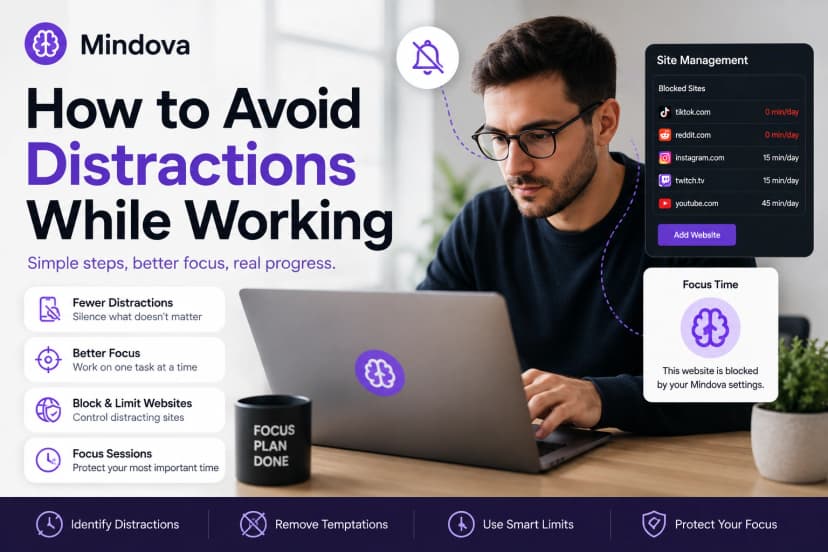
How to Avoid Distractions While Working: 10 Practical Strategies
Learn how to avoid distractions while working by reducing digital triggers, managing notifications, limiting distracting websites, and protecting focused work time.
Comments
Be the first to comment.
Ready to protect your focus?
Block distracting sites, set daily limits, and run focus sessions. Mindova is free.