Build Focus Habits With the Cue-Reward Loop
Written by Mindova Team
Admin
Published February 5, 2026 · Updated July 7, 2026

You already know what you should be doing. The hard part is doing it on the days you don't feel like it. That gap between knowing and doing is exactly where the habit loop works, and it's why James Clear's framework in Atomic Habits is so useful for building focus that doesn't run on motivation.
Clear breaks every habit into four stages: cue, craving, response, and reward. A cue triggers the behavior, the craving is the wanting, the response is the action itself, and the reward is the payoff that tells your brain to remember this for next time. Distractions run on the same loop, which is why they're so sticky. The good news is you can build a focus habit on the same machinery.
Make the cue obvious
A habit needs a trigger you can't miss. Vague intentions like "I'll focus more this week" fail because nothing actually starts them. Pin your focus to a specific, visible cue instead.
The cleanest cue is time and place. "At 9 a.m. at my desk, I start my first deep work block" gives your brain a concrete signal. You can also stack the cue onto an existing routine: after you finish your morning coffee, you open the one document that matters and start a focus session.
Your environment is part of the cue too. A phone face-down in a drawer sends a different signal than one buzzing beside your keyboard. Set up the space so the obvious thing to do is the thing you intended.
Make the focused choice easy and the distracting one hard
The third stage, the response, is where most focus plans fall apart. You sit down to work, but the path to a distraction is one click shorter than the path to concentration, so the distraction wins.
Clear's Two-Minute Rule helps you start: shrink the habit until beginning takes under two minutes. "Write the report" becomes "open the document and write one line." Starting is the part people resist, and once you're moving, continuing is easy.
Then flip the friction for everything you're trying to avoid. The harder it is to reach a distraction, the less it pulls at you. This is where a blocker earns its place. A locked focus session that blocks your usual sites and apps adds just enough friction that opening a feed stops being automatic. You can still get to it later, but not in the impulsive half-second when your willpower is lowest. You've made the focused path the easy one.
Shape the craving
A craving is the wanting behind the action, and you can shape it. Pair focus with something you genuinely look forward to: a specific playlist that only plays during deep work, or a good coffee you only drink while concentrating. Over time the cue starts to pull you toward the work instead of away from it.
Make it satisfying so it repeats
The reward closes the loop. Your brain repeats what feels good immediately, and focused work often pays off too slowly to register. So add a reward you can feel now.
The simplest one is visible progress. Crossing a day off a calendar or watching a focus streak grow gives an immediate hit of satisfaction. Productivity analytics that show your focused hours adding up turn invisible effort into something you can see, which makes you want to keep the chain going.
When you miss, don't miss twice
You'll have off days. Clear's rule is that missing once is an accident, but missing twice starts a new, worse habit. Skip a session and the streak isn't ruined; just don't let one skip become two. Come back to the identity you're building. You're becoming the kind of person who shows up, and one bad afternoon doesn't change that.
Put the loop to work
Pick one focus habit. Give it an obvious cue, make starting take under two minutes, raise the friction on whatever distracts you, and reward yourself with visible progress. Run that loop daily and concentration stops being a battle of willpower. It becomes the default your system quietly produces.
Put this into practice with Mindova
Mindova is a website and app blocker that turns these ideas into daily habits — set focus schedules, block distracting sites and apps, and track your progress across every device.
- Block distracting websites and apps in seconds
- See pricing — start free, no credit card required
- Get started free and reclaim your focus today
- Block specific apps: Block YouTube
Mindova Team
Admin
Passionate about helping people achieve peak mental performance through evidence-based strategies and mindful technology use.
Related Articles

Distraction-Free Writing: A Setup for Focus
How to build a distraction-free writing setup and the habits that protect your drafting time from pings, tabs, and the urge to check.
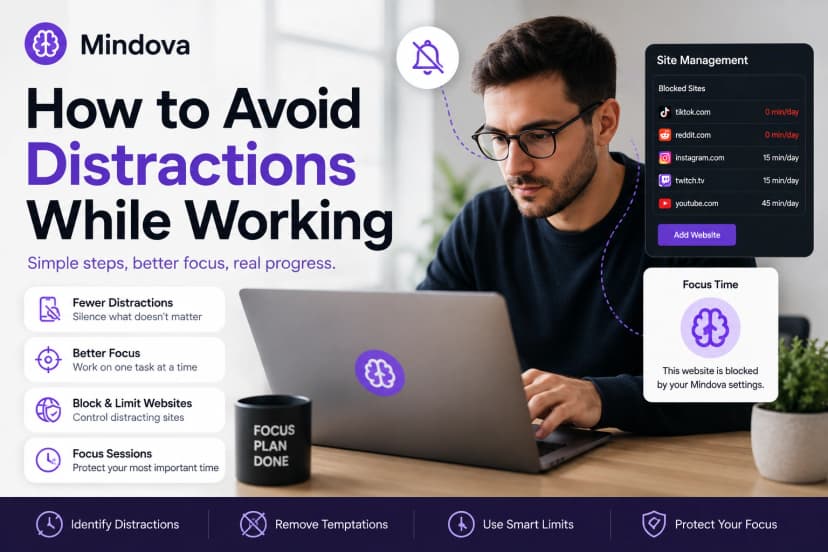
How to Avoid Distractions While Working: 10 Practical Strategies
Learn how to avoid distractions while working by reducing digital triggers, managing notifications, limiting distracting websites, and protecting focused work time.
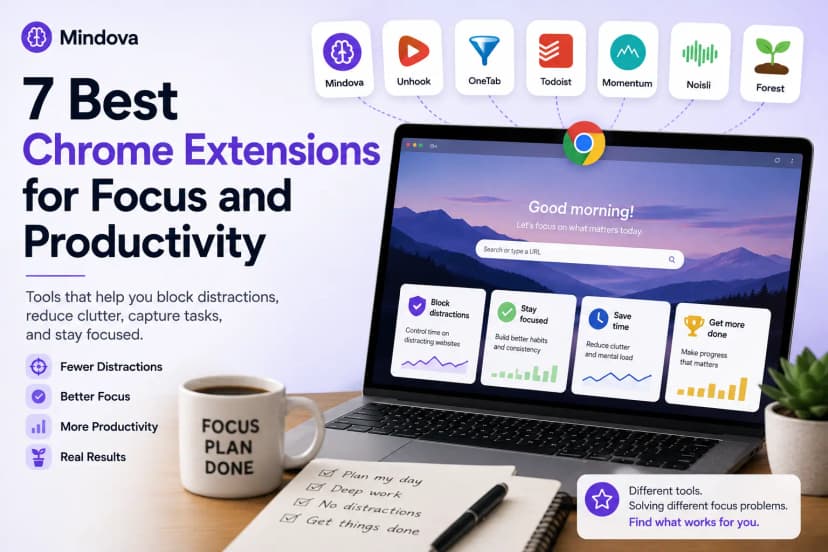
7 Best Chrome Extensions for Focus and Productivity in 2026
Seven Chrome extensions that solve different focus problems, from distracting websites and YouTube recommendations to tab overload, unfinished tasks, and noisy work environments
Comments
Be the first to comment.
Ready to protect your focus?
Block distracting sites, set daily limits, and run focus sessions. Mindova is free.