Pomodoro Technique: How It Works and How to Use It 2026
Written by Mouhsine
Productivity Expert
Published August 28, 2026
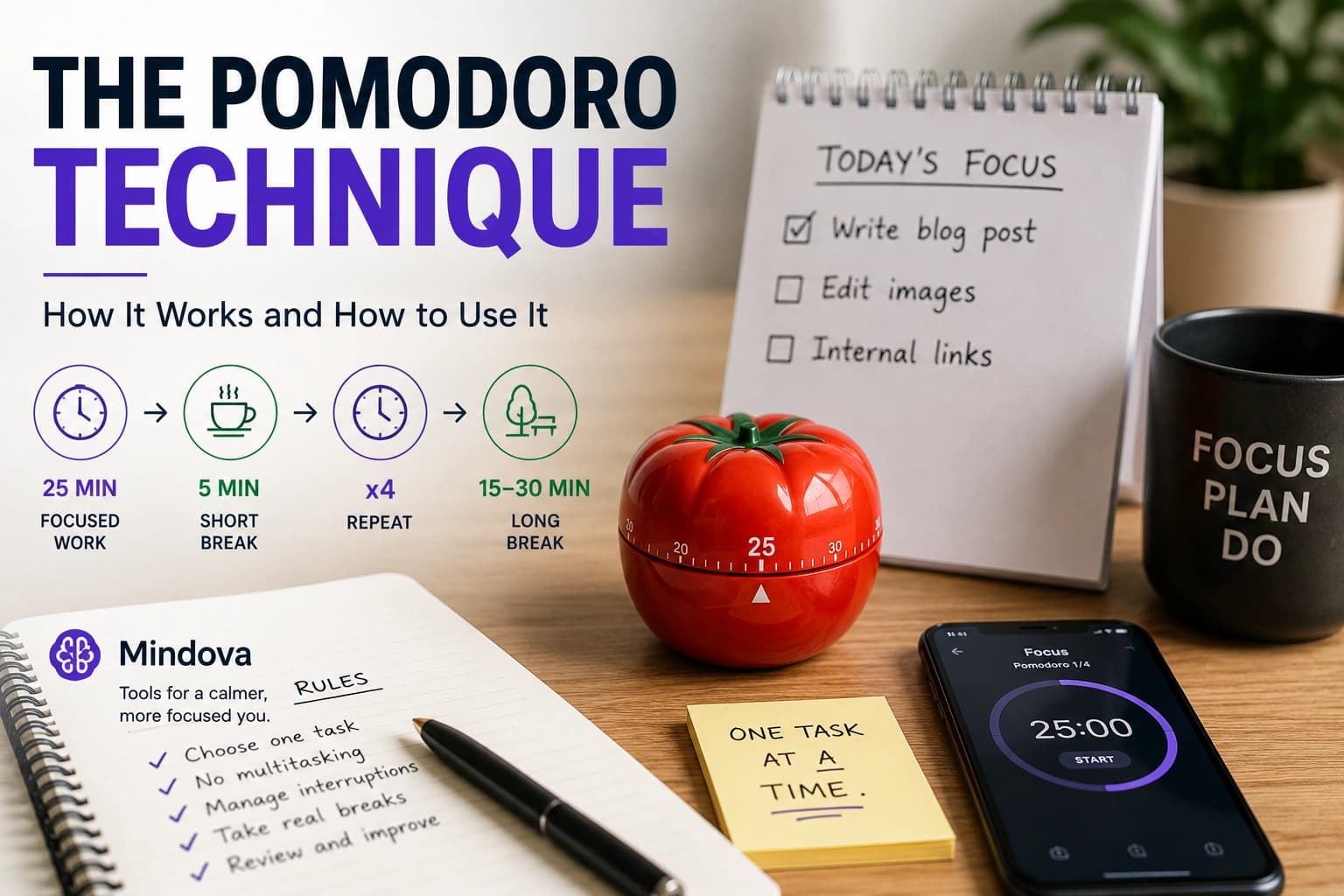
The Pomodoro Technique: How It Works and How to Use It
A task can feel difficult before you have done a single minute of it.
“Finish the report” sounds large.
“Study chemistry tonight” has no clear ending.
“Work on the presentation” could mean twenty minutes or four hours.
The Pomodoro Technique gives that work a smaller boundary.
Instead of committing to the entire task, you choose one thing to work on, set a timer — traditionally for 25 minutes — and focus on it until the interval ends. Then you take a short break and begin another interval if you want to continue.
The familiar pattern is:
25 minutes of focused work → 5-minute break → repeat four times → take a longer break.
But that timer loop is only the most visible part of the method.
The fuller Pomodoro approach also involves choosing work deliberately, managing interruptions, tracking completed intervals, and using what you learn to plan future work more realistically. Francesco Cirillo, who created the method in the 1980s, has specifically warned against reducing the entire technique to “work for 25 minutes, then take a break.” (Pomodoro® Technique)
What Is the Pomodoro Technique?
The Pomodoro Technique is a time-management method created by Francesco Cirillo while he was a university student.
Its name comes from the tomato-shaped kitchen timer he originally used — pomodoro means tomato in Italian.
The basic idea is straightforward:
- Choose a specific task.
- Set a timer, traditionally for 25 minutes.
- Work only on that task until the timer ends.
- Take a short break.
- Repeat.
- After several focused intervals, take a longer break.
One focused work interval is commonly called a pomodoro.
The timer gives your work a visible beginning and ending.
Instead of asking:
Can I concentrate until this entire project is finished?
you only have to answer:
Can I stay with this task for the next 25 minutes?
That difference is one reason people find the method useful when starting is harder than doing.
How Long Is a Pomodoro?
The classic work interval is:
25 minutes of work
followed by approximately:
5 minutes of break
After four work intervals, the traditional pattern includes a longer break, often around 15 to 30 minutes.
So a common Pomodoro cycle looks like this:
25 work → 5 break
25 work → 5 break
25 work → 5 break
25 work → longer break
But there is an important point that many simplified guides miss:
25 minutes is a method, not a biological law.
You do not suddenly stop being productive at minute 26.
And research does not show that 25 minutes is a universally optimal human attention span.
Treat 25/5 as a useful starting structure rather than a magic ratio.
How to Use the Pomodoro Technique
You can try the basic method with almost no setup.
1. Choose one specific task
Avoid starting with something vague such as:
Work on website.
Make the next step concrete:
Write the introduction to the landing page.
Instead of:
Study biology.
Try:
Review chapter 6 and answer the practice questions.
A timer can structure your time, but it cannot decide what deserves your attention.
That decision comes first.
2. Prepare before you start the timer
Open the files, notes, tabs, or tools you actually need.
Then reduce the things that can pull you somewhere else.
That may mean:
- putting your phone away;
- silencing unnecessary notifications;
- closing unrelated tabs;
- blocking the websites you habitually open when work becomes uncomfortable.
If browser distractions are the bigger problem, see our guide to blocking digital distractions.
The goal is simple:
When the timer starts, you should already know what you are doing.
3. Set the timer for 25 minutes
Now start.
For the next interval, work on the chosen task rather than asking yourself every few minutes whether you still feel motivated.
If you are new to the method, use the traditional 25 minutes first.
You can adjust the interval later after you know what actually interrupts your work.
4. Work on one thing
A Pomodoro is not simply 25 minutes during which you happen to be at your desk.
The interval is meant to be focused on the task you selected.
That means avoiding unnecessary switching between:
- email;
- messages;
- social feeds;
- unrelated research;
- another task that suddenly feels easier.
If you remember something important, you do not necessarily need to act on it immediately.
Write it down and return to the task.
That leads to one of the most useful — and most frequently ignored — parts of the method.
What Should You Do When You Get Interrupted?
Cirillo's fuller method distinguishes between internal and external interruptions. His current official program still treats interruption management as a core part of the system rather than an optional extra.
Internal interruptions
These come from you.
For example:
- “I should check my email.”
- “I wonder what happened on Reddit.”
- “I need to order that thing.”
- “I should look something up before I forget.”
Instead of following the thought immediately, record it somewhere.
Then continue.
You are not telling yourself:
Never do this.
You are saying:
Not during this interval.
External interruptions
These come from somewhere else:
- a coworker;
- a phone call;
- a message;
- a family member;
- an unexpected request.
If it can wait, defer it.
If it genuinely cannot wait, deal with it.
The original method treats a substantially interrupted Pomodoro as incomplete rather than pretending fragmented time was uninterrupted focus.
You do not need to become obsessive about counting.
The useful part is learning what repeatedly breaks your attention.
Take the Break
When the interval ends, step away from the task for a few minutes.
A short break might mean:
- standing up;
- stretching;
- getting water;
- walking around;
- looking away from the screen;
- simply doing nothing for a few minutes.
You do not need to optimize every second of the break.
In fact, immediately filling five minutes with another stream of information can defeat the practical purpose of having a stopping point.
Be particularly careful with feeds.
Opening TikTok, Reddit, Instagram, YouTube Shorts, or X during a five-minute break can make the break much harder to end after five minutes.
Do Short Breaks Actually Help?
There is evidence that short breaks can help with fatigue and well-being, but the science is more nuanced than many productivity articles suggest.
A 2022 systematic review and meta-analysis covering 22 study samples and 2,335 participants found that micro-breaks had small positive effects on vigor and reducing fatigue.
However, they did not produce a statistically significant overall improvement in performance across tasks. Longer breaks appeared more helpful for performance after more cognitively demanding work.
So we should not say:
Five-minute Pomodoro breaks are scientifically proven to make you more productive.
A better conclusion is:
Short breaks can help manage fatigue, but their effect on actual performance depends on the task, break, person, and context.
Does the Pomodoro Technique Actually Work?
It can be useful.
That is different from saying it is universally superior.
Direct research comparing fixed Pomodoro-style breaks with other break strategies is increasingly showing a mixed picture.
A 2026 experiment involving 176 university students compared predetermined systematic breaks with self-regulated breaks.
There was no significant difference in learning performance between the two conditions. Students using self-regulated breaks reported better results on several subjective measures, including energy, concentration, motivation, and distraction.
Another study comparing Pomodoro, Flowtime, and self-regulated breaks found no overall differences in productivity, task completion, or flow. The Pomodoro group showed a faster increase in fatigue and the structured-break groups showed a faster decline in motivation than the self-regulated condition, although overall levels did not ultimately differ between groups. (MDPI)
That does not mean Pomodoro is useless.
It means there is no good reason to market it as:
The scientifically optimal way to work.
Its strongest practical value may be simpler:
It gives you a clear structure when your work otherwise has none.
Why the Pomodoro Method Can Still Be Useful
The timer solves several practical problems without needing a complicated neuroscience story.
It makes starting smaller
Compare:
I need to finish this project.
with:
I am going to work on this for 25 minutes.
The second commitment has a clear endpoint.
For someone procrastinating on a large or unpleasant task, that can make beginning easier.
It defines what “working now” means
For the next interval, you have one job.
Other things can wait.
That reduces repeated decisions about whether to answer a message, check something, or switch tasks.
It exposes interruptions
If you repeatedly write down the same distraction during your work intervals, you have learned something useful.
Maybe Slack is the problem.
Maybe YouTube is.
Maybe the task is badly defined.
Maybe you are trying to work during a part of the day full of interruptions.
The timer turns vague feelings like:
“I couldn't focus today.”
into something more observable.
It gives breaks a place
Many people work without deliberately deciding when to rest.
They work until attention falls apart, then drift into an accidental break.
Pomodoro puts a boundary around both work and rest.
Does a Pomodoro Have to Be 25 Minutes?
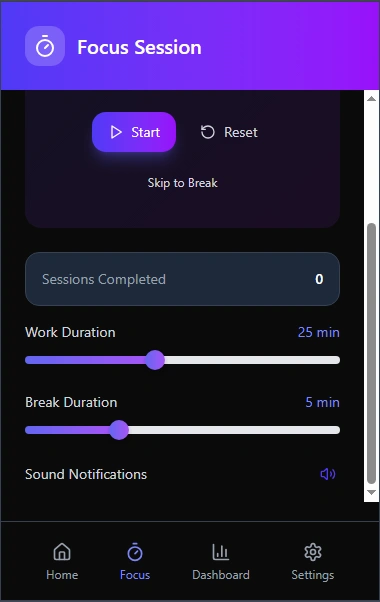
If you want to try the classic technique, start with 25 minutes.
Then pay attention to what happens.
If you repeatedly reach the timer feeling relieved that the interval is finally over, 25 minutes may already be demanding enough.
If the timer repeatedly interrupts you just as you become absorbed in writing, coding, designing, or solving a complex problem, a longer interval may fit your work better.
Possible experiments include:
15/5 — when getting started is particularly difficult.
25/5 — the classic pattern and a sensible starting point.
45/10 or 50/10 — potentially more comfortable for work that needs more setup and continuity.
The important thing is not to invent a new ratio every day.
Use one long enough to observe whether it works.
Then adjust based on your actual work rather than a productivity rule you found online.
Is Pomodoro Good for Deep Work?
Sometimes.
But this is one area where a rigid 25-minute bell can work against you.
Writing, programming, analysis, design, and difficult problem-solving can require time simply to load the problem into your head.
If you finally become deeply engaged at minute 22 and force yourself to stop at minute 25, the timer may create the interruption you were trying to avoid.
In that situation you have several options:
- use a longer interval;
- use Pomodoro only to overcome the initial resistance to starting;
- stop using the timer once the task is moving well;
- choose another focus method for work requiring long uninterrupted immersion.
A focus technique should serve the work.
The work should not exist to satisfy the timer.
How to Use Pomodoro for Studying
Pomodoro is especially popular with students because “study for 25 minutes” is much easier to define than:
Study all afternoon.
But the timer itself does not determine whether you learn anything.
A poor study technique inside a perfectly timed Pomodoro is still poor studying.
Instead of defining the interval as:
Study history
give it an outcome:
Read section 4 and write five recall questions.
Or:
Solve problems 10–15 without looking at the answers.
Or:
Recall the major concepts from chapter 3 before checking my notes.
The timer structures the session.
Your learning strategy determines what happens inside it.
This distinction is particularly important because the evidence directly supporting Pomodoro as a superior learning method remains limited and mixed.
How to Use Pomodoro for Work
The method can work well for tasks that are easy to postpone or allow too much context switching.
Examples include:
Writing
Choose a narrow target:
Draft the introduction.
Not:
Write article.
Administration
Batch several small tasks into one interval:
- expense report;
- invoices;
- email follow-ups;
- filing.
Research
Define what you are looking for before starting.
Otherwise research can turn into twenty-five minutes of opening interesting tabs.
Coding
Pomodoro can be useful for getting started or handling smaller implementation tasks.
For difficult debugging or architecture work, a longer interval may be less disruptive.
Studying
Choose one concrete learning outcome per block rather than simply measuring how long you sat at the desk.
Pomodoro vs Time Blocking
Pomodoro and time blocking solve different problems.
Time blocking answers:
When will I work on this?
You reserve a period on your day or calendar.
Pomodoro answers:
How will I structure the work once I begin?
For example:
9:00–11:00 — write report
could be your time block.
Inside that period, you might use:
25 minutes focus → short break → 25 minutes focus → short break.
The two methods can therefore work together rather than competing.
Common Pomodoro Mistakes
Treating 25 minutes as a law
It is a starting structure, not a universal attention limit.
Starting without choosing the task
A timer does not fix unclear priorities.
Decide what the interval is for first.
Multitasking inside the interval
Twenty-five minutes split between email, writing, Slack, and browsing is still fragmented work.
Turning every break into scrolling
A five-minute feed break can easily become twenty minutes.
Choose breaks that are easy to end.
Skipping every break
If you repeatedly skip the recovery part, you are no longer really testing the work-rest structure you intended to test.
Stopping useful concentration just because the timer rang
If the timer consistently destroys your best work, adapt the method.
Obsessing over the number of completed Pomodoros
More Pomodoros do not automatically mean more useful work.
Four intervals spent on the wrong thing are still time spent on the wrong thing.
How Mindova Fits Into a Pomodoro-Style Workflow
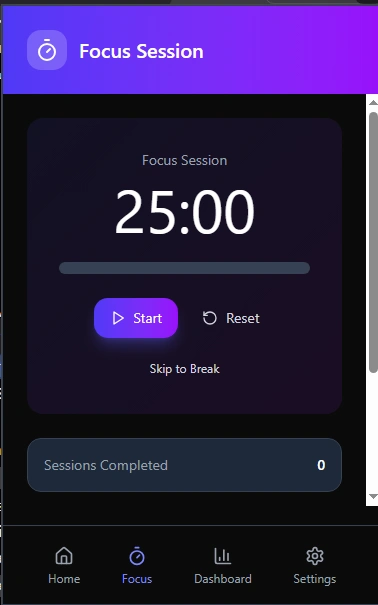
A timer can define the work interval.
It cannot stop you from spending that interval on a distracting website.
That is where a browser focus tool can complement the method.
Mindova currently includes timed Focus Sessions, website blocking, Individual Site Limits, browsing/focus insights, and optional AI Nudges as part of its desktop browser focus system.
A simple workflow is:
- Decide what you want to accomplish.
- Add or classify the websites that regularly distract you.
- Start a timed Focus Session for your chosen work interval.
- Work on the task.
- When your work interval ends, take your break.
- Start another session if you want another focused round.
Mindova does not currently need to be described as an automatic full Pomodoro system.
It does not need recurring schedules or a Locked Mode to be useful here.
Its role is narrower:
protect the browser side of the work interval from distracting websites.
If one particular website still needs some access during the rest of your day, an Individual Site Limit can give it a daily allowance instead of blocking it permanently.
You can see how the current controls work in the Mindova setup guide.
What If Blocking Feels Too Strong?
Not every distraction requires a wall.
Sometimes simply noticing that you automatically opened another feed is enough to change what happens next.
That is where a lighter intervention such as a focus nudge may make more sense.
The difference matters:
- a timer defines the work period;
- a nudge creates awareness around a distraction;
- a site limit controls how much access you allow;
- a block removes access when you already know you do not want it.
See what a focus nudge is and when to use one for the lighter side of that system.
Frequently Asked Questions
What is the Pomodoro Technique?
The Pomodoro Technique is a time-management method developed by Francesco Cirillo. The commonly used version involves working on one task for 25 minutes, taking a short break, and repeating the cycle, with a longer break after several intervals.
Why is it called Pomodoro?
Pomodoro means tomato in Italian. Cirillo named the method after the tomato-shaped kitchen timer he used while developing it as a university student.
How long is one Pomodoro?
The traditional interval is 25 minutes of focused work followed by a short break.
How long should a Pomodoro break be?
The classic pattern uses about a five-minute short break and a longer break after several work intervals.
Short breaks can help with fatigue and vigor, although research does not show that a five-minute break automatically improves performance on every kind of task.
Does the Pomodoro Technique have to be 25 minutes?
Twenty-five minutes is the classic format, but it is not a scientifically established universal optimum.
If the interval repeatedly interrupts productive concentration or feels too difficult to sustain, experiment with a different work/break structure.
Is 50/10 still Pomodoro?
It is better described as a Pomodoro-style variation rather than pretending it is identical to the classic 25/5 format.
It keeps the broad principle of a bounded focus period followed by a deliberate break.
How many Pomodoros should you do per day?
There is no universal target.
Even Cirillo's current explanation pushes back against treating the number of completed Pomodoros as the objective. The method is meant to improve awareness and management of time and interruptions, not create another daily score to maximize. (Pomodoro® Technique)
What happens if I get interrupted during a Pomodoro?
If the interruption can wait, record it and return to the task.
If it genuinely breaks the interval, the original method treats that Pomodoro as interrupted rather than pretending it was uninterrupted focus.
The useful part is recording what disrupted you so you can reduce recurring interruptions later.
Is Pomodoro good for studying?
It can provide useful structure, particularly when the hardest part is beginning or when an open-ended study session feels overwhelming.
But the timer itself is not a learning technique. What you do during the interval — retrieval practice, solving problems, explaining concepts, writing, or another study activity — still matters.
Is the Pomodoro Technique scientifically proven?
Not in the sense that everyone should expect better performance from 25/5 intervals.
Recent direct comparisons have found mixed results. In a 2026 experiment, systematic Pomodoro-style breaks did not outperform self-regulated breaks on learning performance, while self-regulated breaks produced better scores on several subjective experience measures.
Is Pomodoro good for ADHD?
Some people may find an external timer and a smaller commitment useful; others may find a forced interruption particularly frustrating once they have finally become engaged.
Pomodoro is a time-management strategy, not a treatment for ADHD. Adjust or abandon the method if the fixed structure makes your work harder rather than easier.
Is Pomodoro good for deep work?
It can help you start, but a strict 25-minute interval may interrupt tasks that require long periods of immersion.
For those tasks, experiment with longer focus intervals or another structure that preserves concentration.
Start With One Interval
You do not need to redesign your entire workday around a tomato timer.
Pick one task.
Make the task specific.
Remove the distractions you already know will compete with it.
Set a timer for 25 minutes.
Then work on that one thing.
When the timer ends, take the break and notice what happened.
Did starting feel easier?
What interrupted you?
Was 25 minutes too short?
Did the break help?
Would a longer interval fit this kind of work better?
That feedback is more valuable than blindly completing as many Pomodoros as possible.
The Pomodoro Technique works best when the timer becomes a way to understand and protect your attention — not another rule you have to obey.
Editorial attribution: The Pomodoro® Technique was created by Francesco Cirillo. Mindova is not affiliated with, associated with, or endorsed by Francesco Cirillo or the Pomodoro® Technique. (Pomodoro® Technique)
Mouhsine
Productivity Expert
Passionate about helping people achieve peak mental performance through evidence-based strategies and mindful technology use.
Related Articles

How to Focus on Writing Without Digital Distractions
Learn how to stay focused while writing by separating drafting from research, reducing digital distractions, and keeping the online tools you actually need
Creative Block: How to Get Unstuck and Start Creating Again
Feeling creatively stuck? Learn what creative block can look like, how to identify what is stopping you, and practical ways to generate ideas and move forward
How to Avoid Distractions While Working: 10 Practical Strategies
Learn how to avoid distractions while working by reducing digital triggers, managing notifications, limiting distracting websites, and protecting focused work time.
Comments
Be the first to comment.
Ready to protect your focus?
Block distracting sites, set daily limits, and run focus sessions. Mindova is free.