Digital Detox Retreats: Cost, Benefits, and Are They Worth It?
Written by Mouhsine
Admin
Published September 2, 2026

A cabin with no Wi-Fi. Your phone sealed in a box at check-in. Long walks, shared meals, yoga, books, silence, and several days without notifications.
That is the image most people have when they hear digital detox retreat.
But the label covers very different experiences. Some retreats genuinely remove internet access and ask guests to hand over their devices. Others are ordinary wellness retreats where phone use is simply discouraged. Some last a weekend; others run for a week or more. Current prices range from a few hundred dollars for a short group retreat to several thousand for more luxurious or remote programs.
So before paying for one, it helps to answer three questions:
What are you actually buying? What evidence supports the idea of a digital detox? And could you create enough of the same structure without going away?
What Is a Digital Detox Retreat?
A digital detox retreat is a temporary stay designed to reduce or remove access to phones, social media, email, news feeds, and other digital distractions.
There is no universally accepted definition of “digital detox.” Research uses the term for interventions ranging from completely avoiding smartphones or social media to simply reducing usage for a period of time.
Retreats add an environmental layer to that idea.
Instead of trying to disconnect while your normal devices, Wi-Fi, work, and routines remain around you, you leave that environment for somewhere designed to make digital use less central.
That may involve:
- no Wi-Fi or weak cellular coverage;
- surrendering phones on arrival;
- designated phone-free periods;
- yoga or meditation;
- hiking and nature activities;
- journaling;
- communal meals;
- workshops;
- silent periods;
- limited or scheduled internet access.
But do not assume the words digital detox retreat automatically mean “no phone.”
One current retreat on the Isle of Sark explicitly says guests keep their phones and still have access to Wi-Fi and mobile signal, while a Sahara retreat in Morocco stores phones and operates where there is no normal internet connectivity.
The policy matters more than the label.
What Actually Happens at a Digital Detox Retreat?
There is no single program, but most retreats combine some version of four things.
1. Less access to your usual digital triggers
This is the most obvious part.
At a strict retreat, access may genuinely disappear.
At a lighter retreat, you might keep your phone but agree to use it only at certain times.
That distinction can completely change the experience.
If your main problem is repeatedly overriding your own limits, a retreat where Wi-Fi is still available may not provide the external boundary you were expecting.
2. A different physical environment
Retreats often take place in places deliberately separated from normal routines:
- forests;
- mountains;
- deserts;
- islands;
- rural farms;
- wellness resorts.
The point is not that nature magically repairs attention.
The practical advantage is that your usual cues may no longer be present.
Your desk is gone.
Your second monitor is gone.
The sofa where you normally scroll for an hour is gone.
The commute, office chat, home chores, and familiar routines may also disappear temporarily.
3. Offline activities replace screen time
A good retreat does not merely remove a device and leave you staring at the wall for four days.
It gives your time somewhere else to go.
Programs currently marketed as digital-detox retreats include activities such as hiking, yoga, meditation, breathwork, creative work, shared meals, nature excursions, and periods of quiet or reflection.
That replacement matters.
“Do not check your phone” is much harder to follow when nothing else changes.
4. Someone else creates the boundary
At home, you are usually both the person who creates the rule and the person who can cancel it.
A retreat can separate those two roles.
The environment or program makes the decision in advance.
That may be part of what you are paying for.
Types of Digital Detox Retreats
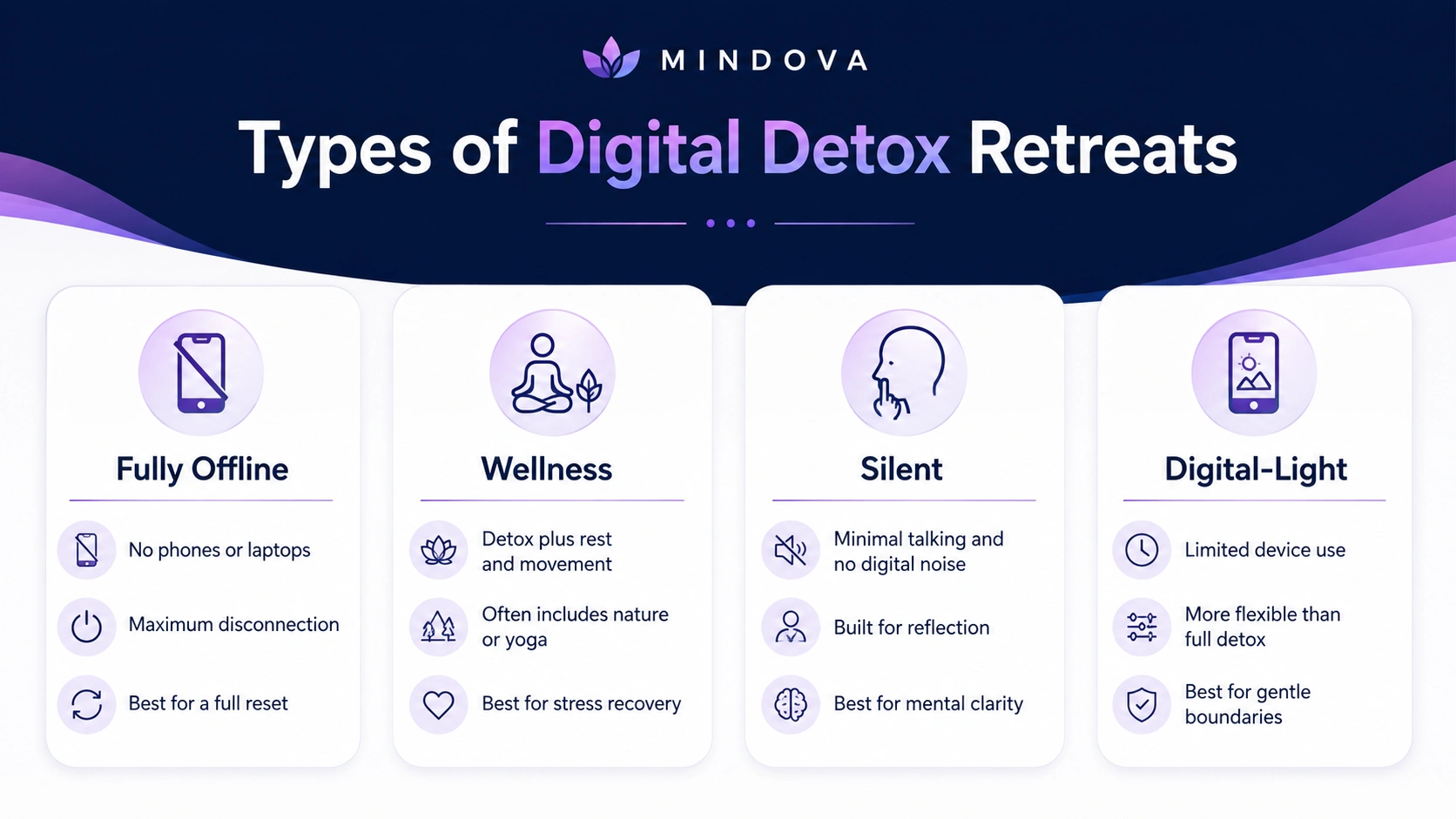
It is useful to separate retreats into a few broad categories before comparing prices.
Fully disconnected retreats
These are the closest to the stereotypical digital detox.
There may be:
- no Wi-Fi;
- no phone signal;
- device surrender;
- strict phone-free spaces.
This gives you the strongest external boundary.
It also gives you the least flexibility if you need to remain reachable.
Wellness retreats with a digital-detox policy
These combine reduced device use with activities such as:
- yoga;
- meditation;
- spa treatments;
- coaching;
- healthy meals;
- outdoor activities.
Some are strict about devices. Others merely encourage guests to disconnect.
Always check.
Silent or contemplative retreats
Digital disconnection may be part of a broader retreat centered on silence, meditation, or reflection rather than the main product itself.
The experience may be much more intensive than simply “taking a break from Instagram.”
Digital-light retreats
These are not fully offline.
You may still have:
- Wi-Fi;
- scheduled work periods;
- calls;
- limited phone access.
For someone who works remotely and cannot disappear completely, this may be more realistic than full abstinence.
A current two-week retreat in Tenerife, for example, describes itself as digital-light and includes coworking space for participants who still need to work online.
How Much Does a Digital Detox Retreat Cost?
There is no standard price.
Current 2026 listings show a very wide range.
BookRetreats currently lists European digital-detox retreats ranging from several hundred dollars for shorter stays to well over $3,000 for some multi-day packages. Retreat Guru similarly shows 2026 European options around €799, €1,650, €1,800, €2,300, €2,600 and above depending on duration and program.
More specific examples illustrate the variation:
- a four-night ocean wellness digital-detox package in Portugal is currently listed at €2,049;
- a Morocco Sahara retreat lists 2026/27 packages from about €1,550–€2,900, depending on dates and booking tier;
- a digital-light two-week community retreat in Tenerife has been advertised from €1,150.
These are examples, not a universal market price, and retreat pricing changes.
What matters is what the fee actually includes.
Before comparing two prices, check whether you are paying for:
- accommodation;
- meals;
- airport or local transport;
- guided activities;
- yoga or meditation;
- spa treatments;
- coaching;
- private versus shared rooms;
- excursions;
- device storage;
- emergency contact arrangements.
A €700 stay and a €2,500 stay may not be comparable products.
Do Digital Detox Retreats Actually Work?
This question needs a more careful answer than most retreat marketing gives it.
We have research on digital disconnection
Researchers have studied interventions that reduce or temporarily stop smartphone and social-media use.
Some reviews report benefits for certain outcomes.
For example, a 2024 meta-analysis found small improvements in measures of subjective and psychological well-being across digital-detox interventions.
Another meta-analysis found a reduction in depressive symptoms, but did not find statistically significant improvements in stress, life satisfaction, or overall mental well-being.
But other research finds little or no effect
A 2025 preregistered systematic review and meta-analysis covering 10 studies and 4,674 participants found no significant overall effects of temporary social-media abstinence on positive affect, negative affect, or life satisfaction.
A broader review published in Pediatrics concluded that the evidence is inconsistent and that reducing social-media or smartphone use may sometimes be more useful than complete abstinence. It also emphasized that outcomes vary by person, context, duration, and intervention.
And this research is not the same as retreat research
This is the most important limitation.
Most of these studies examine things like:
- deleting an app;
- stopping social media for a week;
- reducing smartphone use;
- restricting access for a defined period.
They do not directly test whether paying $2,000 to spend five days in a retreat produces better outcomes than creating a similar period of reduced device use at home.
So we should not claim:
Digital detox retreats are scientifically proven to reset your brain.
They are not.
The more defensible conclusion is:
Reducing digital exposure can affect some people positively, but results are mixed, and there is limited evidence showing that a commercial retreat itself produces unique or lasting benefits.
Then What Are You Actually Paying For?
You may not be paying for a scientifically unique “detox.”
You may be paying for structure.
A boundary that is harder to negotiate with
At home:
I will not check Instagram today.
Five minutes later:
I'll just check one message.
At a strict retreat with no signal, there may be no second decision.
That can matter if your main difficulty is repeatedly overriding your own intentions.
Distance from normal obligations
A home detox still happens inside normal life.
There may be:
- dishes;
- errands;
- family responsibilities;
- work requests;
- email;
- familiar habits.
At a retreat, many of those responsibilities are temporarily removed.
That is different from simply putting your phone in a drawer.
Pre-planned offline activities
Instead of figuring out what to do with suddenly empty time, your day may already contain:
- meals;
- walks;
- yoga;
- discussions;
- workshops;
- rest periods.
Social permission to be unavailable
This is easy to underestimate.
If everyone knows you are away, you may feel less pressure to explain why you have not replied for six hours.
The retreat creates a socially understood boundary.
Who Might Find a Digital Detox Retreat Worth It?
A retreat may be worth considering if several of these are true.
You have repeatedly tried to disconnect and immediately undone the rule
External structure may be valuable precisely because you do not control it moment by moment.
You want a real break from your normal environment
Maybe the main problem is not one particular app.
It is the entire routine surrounding work, notifications, screens, and constant availability.
You value the retreat itself
You may genuinely want:
- hiking;
- meditation;
- nature;
- silence;
- wellness activities;
- group connection.
In that case, digital disconnection is one part of a trip you already value.
The cost is comfortable for you
A retreat becomes harder to justify if paying for it creates another source of stress.
You should not need an expensive trip simply to prove that you are serious about using your phone less.
Who Probably Does Not Need a Retreat?
You may not need one if your main problem is much narrower.
For example:
I lose an hour to Reddit when I'm supposed to work.
or:
I check YouTube too often while studying.
or:
I want one phone-free evening every week.
Those problems may be better addressed with recurring habits and practical boundaries than with a flight and a four-night stay.
Likewise, if your goal is specifically to take a temporary break from social platforms rather than disconnect from technology generally, start with our social media detox guide.
Downsides of Digital Detox Retreats
The marketing usually emphasizes calm, nature, and clarity.
The trade-offs deserve equal attention.
They can be expensive
Travel, accommodation, meals, and program fees add up quickly.
Disconnecting may be difficult rather than peaceful
For some people, losing normal contact with work, friends, family, or news can create stress rather than reduce it.
Digital-disconnection research does not show uniformly positive outcomes for everyone.
Your normal environment is waiting when you return
A retreat can change your environment for five days.
It does not automatically change:
- your notifications;
- your workload;
- your browser habits;
- your social-media feeds;
- your workplace expectations;
- the phone beside your bed.
Re-entry matters.
Some “digital detox” retreats are barely digital detoxes
As the current market shows, one retreat may remove phones entirely while another leaves Wi-Fi available and makes disconnection voluntary.
That is not necessarily bad.
But you should know which experience you are buying.
How to Choose a Digital Detox Retreat
Before booking, ignore the photos for a moment and ask practical questions.
What is the actual phone policy?
Is device surrender:
- mandatory;
- optional;
- limited to certain hours?
Is there Wi-Fi?
If yes:
- where?
- when?
- is it freely available in your room?
Is there mobile signal?
A “phone-free retreat” with full 5G coverage still depends partly on your cooperation.
How can someone contact you in an emergency?
A well-designed retreat should have a clear answer.
What does a normal day actually contain?
Do not assume “digital detox” means rest.
Some retreats have tightly scheduled programs from early morning to evening.
Others leave most of the day open.
Choose the version you actually want.
Is the retreat primarily about digital habits?
Or is “digital detox” just a label placed on:
- yoga;
- spa;
- fitness;
- meditation;
- luxury travel?
Again, neither is automatically wrong.
But the experience should match the reason you are booking.
What is included in the price?
Check:
- room type;
- meals;
- transfers;
- activities;
- taxes;
- equipment;
- cancellation policy.
What happens after the retreat?
This may be the most useful question.
Does the program help you decide what you want to change when normal connectivity returns?
A detox with no re-entry plan risks becoming a pleasant interruption rather than a useful experiment.
Can You Do a Digital Detox at Home Instead?
Yes — at least in the sense that you can recreate several of the structural elements yourself.
That does not mean research has shown that an at-home detox is equivalent to a commercial retreat.
It simply means many components do not require travel.
You can create:
A defined period
Start smaller than a week.
Try:
- one evening;
- one afternoon;
- one Sunday;
- one work block.
A clear rule
For example:
No social feeds until 6 PM.
Or:
No news websites during this work session.
Or:
Phone stays outside the bedroom tonight.
Physical distance
Putting a phone in another room changes the effort required to check it.
Something offline to do
Plan the replacement before removing the screen:
- walk;
- book;
- cooking;
- exercise;
- journaling;
- meeting someone;
- hobby;
- time outdoors.
A notification boundary
Turn off alerts that do not require immediate attention.
Website boundaries
If the problem happens primarily in your desktop browser, blocking or limiting specific websites can add friction without requiring total internet abstinence.
If your broader goal is to use technology more deliberately over the long term rather than temporarily disconnect from it, that is closer to digital minimalism.
A Simple One-Day Digital Detox Experiment
Before spending money on a retreat, you can run a smaller experiment.
The evening before:
- Decide what you will and will not use.
- Tell anyone who needs to know when you will be reachable.
- Turn off unnecessary notifications.
- Prepare offline activities.
- Remove the websites or devices that usually derail the plan.
During the day:
- avoid open-ended feeds;
- do not replace phone scrolling with laptop scrolling;
- notice which moments make you want to check;
- write those triggers down;
- stay reachable for genuine needs if that matters to you.
At the end, ask:
What did I miss because I genuinely needed it?
and:
What did I reach for simply because it was familiar?
That distinction is more useful than treating technology as universally good or bad.
How Mindova Can Help With the Return to Normal Life
A retreat temporarily changes your environment.
Mindova is more relevant when the normal environment comes back.
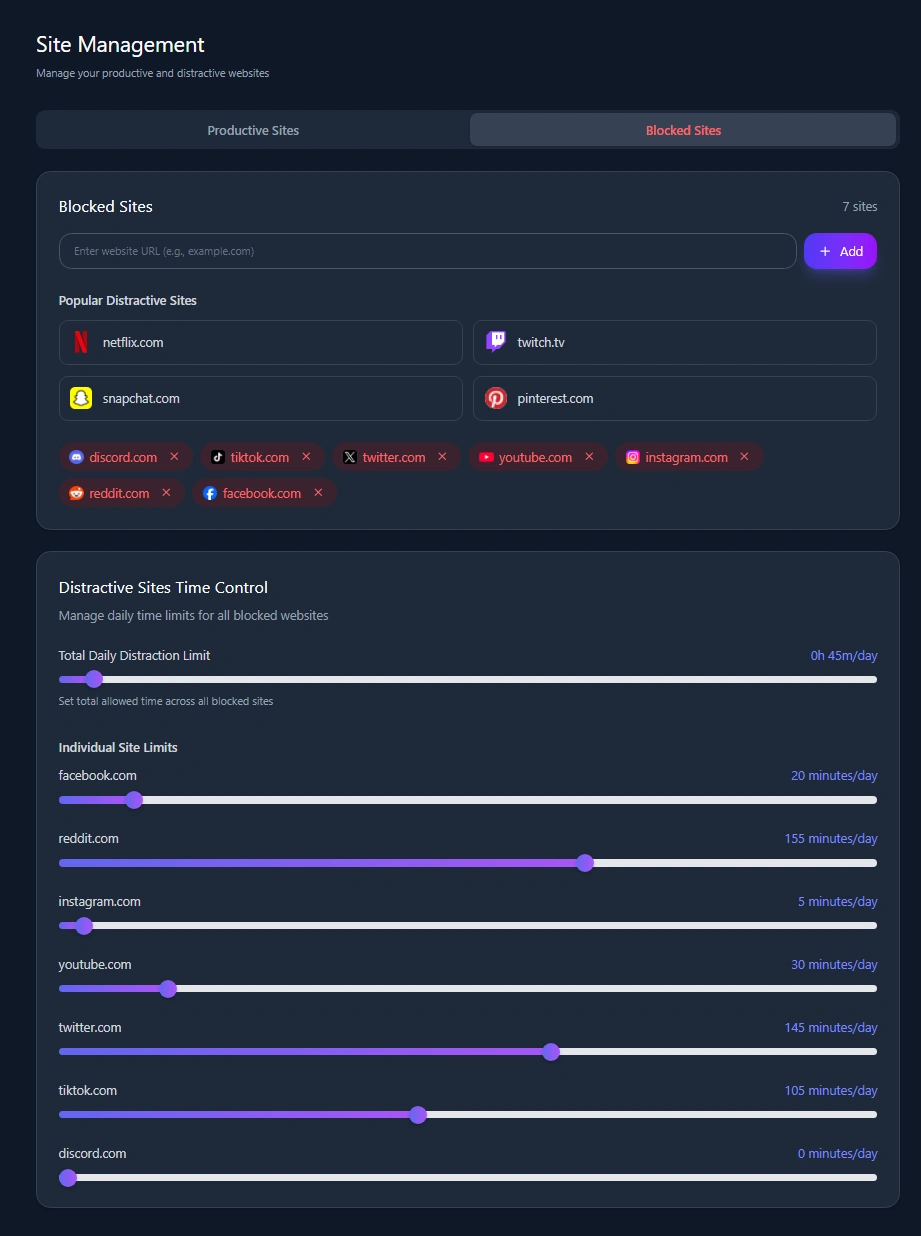
Mindova currently works as a free website blocker and focus extension for supported desktop browsers including Chrome, Edge, Brave, Opera, and Vivaldi. It can block selected websites, set per-site daily limits, start timed Focus Sessions, show browsing insights, and provide contextual AI Nudges.
For example, after a detox you might decide:
I do not need Reddit during focused work.
You can block it.
Or:
YouTube is useful, but I do not want unlimited access.
A per-site daily limit may fit better.
Or:
I want the first 45 minutes of writing to be feed-free.
A timed Focus Session can create that browser boundary. (Mindova)
Mindova currently blocks websites inside supported desktop browsers. It does not block native iPhone or Android apps.
That means it should not be described as a substitute for handing over your phone at a retreat.
Its role is more practical:
help preserve some of the boundaries you chose once you return to normal browsing.
For the current product workflow, see the Mindova setup guide.
Digital Detox Retreat vs Social Media Detox vs Digital Minimalism
These ideas are related, but they are not interchangeable.
Digital detox retreat
A temporary change of environment, often involving reduced or removed device access.
Social media detox
A temporary break specifically from social platforms.
Read: How to Take a Social Media Break.
Digital minimalism
A longer-term approach to deciding which technologies deserve your time and how you want to use them.
Read: Digital Minimalism: A Practical Guide.
And if the specific problem is repeatedly consuming distressing news rather than general screen use, see our guide to doomscrolling and how to stop it.
Frequently Asked Questions
What is a digital detox retreat?
A digital detox retreat is a temporary stay designed to reduce or remove access to phones, social media, email, news, and other digital distractions. Policies vary considerably: some retreats remove devices or operate without connectivity, while others simply encourage reduced use.
How long is a digital detox retreat?
There is no standard duration.
Current retreats range from short weekend stays to week-long programs and longer digital-light experiences.
How much does a digital detox retreat cost?
Prices vary widely according to destination, duration, room type, meals, activities, and level of luxury.
Current 2026 listings include retreats costing a few hundred dollars as well as multi-day programs costing several thousand.
Do digital detox retreats work?
There is not strong evidence proving that commercial retreats themselves produce unique benefits.
Research on reducing or temporarily stopping digital and social-media use shows mixed results: some reviews find modest benefits for certain outcomes, while others find little or no improvement in overall well-being. (Nature)
Is a digital detox good for mental health?
It may help some people, but the evidence does not support a universal mental-health benefit.
Effects vary according to the intervention, person, duration, and outcome being measured. Reducing problematic use may sometimes be more realistic than complete abstinence.
Do digital detox retreats take your phone away?
Some do.
Others let you keep it.
Always check the actual device, Wi-Fi, and emergency-contact policy before booking.
Can I do a digital detox at home?
Yes.
You can create a defined offline period, turn off notifications, move devices out of reach, block distracting websites, and plan offline activities.
What we cannot say is that research proves a DIY detox produces exactly the same outcomes as attending a retreat.
How often should you do a digital detox?
Research does not establish a universal schedule such as once a month or once every quarter.
Instead of chasing a fixed detox frequency, look at the behavior you are trying to change and decide whether temporary abstinence, reduced access, or longer-term boundaries are the better fit.
Is a Digital Detox Retreat Worth It?
A digital detox retreat can be worth paying for.
But probably not because it performs a mysterious “reset” that could only happen at a retreat.
What you are often buying is more concrete:
distance, structure, accountability, fewer obligations, offline activities, and an environment where checking a screen is less convenient or impossible.
For some people, that may be exactly what they need.
For others, the same problem is better solved with much smaller changes at home.
The useful question is not:
Do digital detox retreats work?
It is:
What problem am I trying to solve, and does this retreat actually provide the boundary I need?
If your problem disappears only when someone physically removes the option to connect, a retreat may tell you something important.
If one afternoon with your phone in another room and your distracting websites unavailable produces the same insight, that tells you something too.
Either way, the real value comes after the detox:
what you decide to change when the internet comes back.
Mouhsine
Admin
Passionate about helping people achieve peak mental performance through evidence-based strategies and mindful technology use.
Related Articles

Digital Detox: What Is It, and Does It Actually Help?
Learn what a digital detox really is, what research says about its benefits, and how to reduce distracting technology without quitting every screen.

How to Temporarily Deactivate Facebook Without Deleting Your Account
Learn how to temporarily deactivate Facebook on mobile or desktop, what happens to your profile and Messenger, and how to reactivate your account later.

Dopamine and Social Media: Why Checking Becomes Compulsive
Learn what dopamine really has to do with social media, why checking can become habitual, and practical ways to reduce compulsive scrolling.
Comments
Be the first to comment.
Ready to protect your focus?
Block distracting sites, set daily limits, and run focus sessions. Mindova is free.