Habit Stacking: How to Build Habits That Fit Your Routine
Written by Mouhsine
Admin
Published September 6, 2026
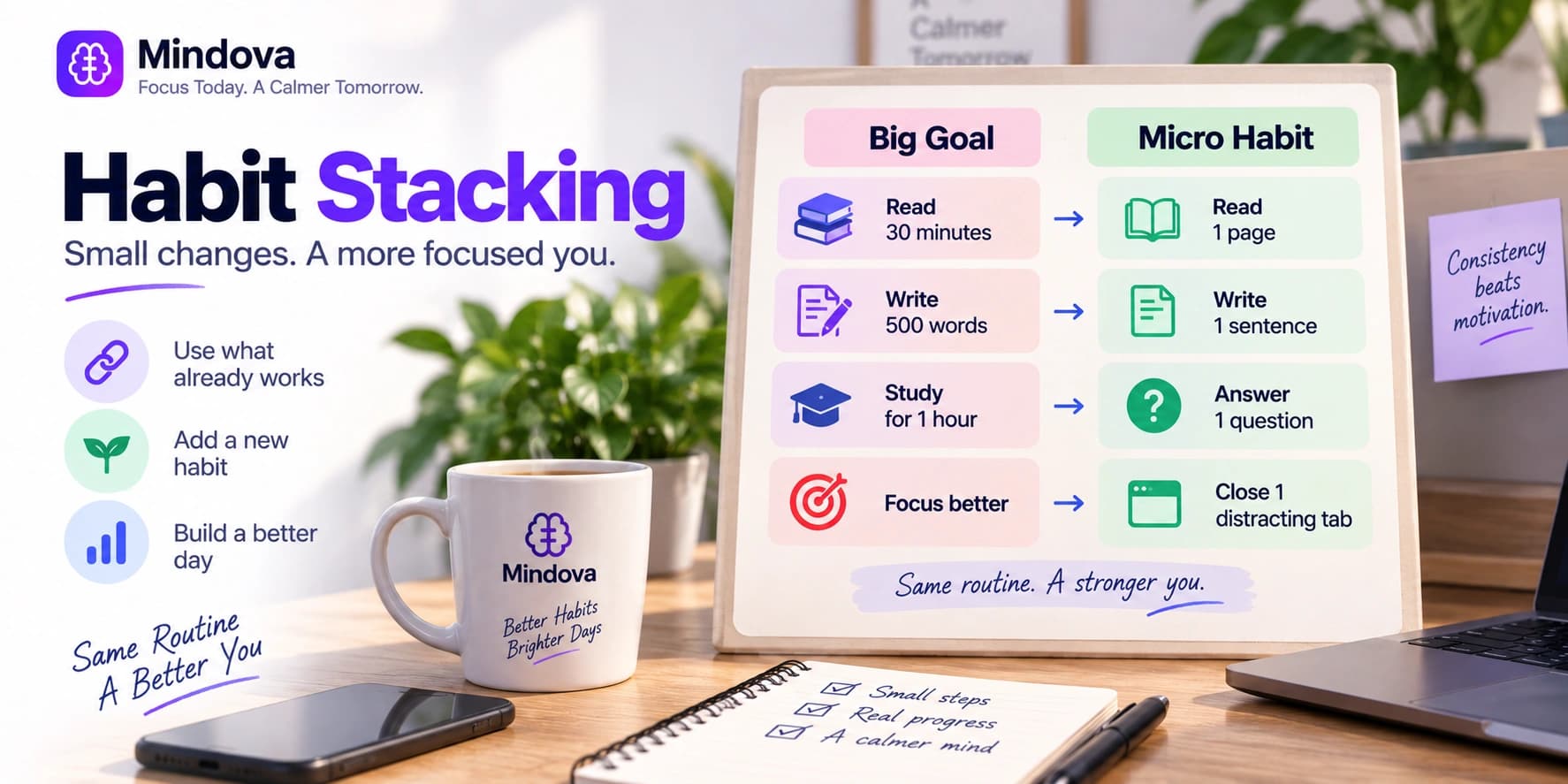
You decide to start a new habit.
Read every day.
Plan tomorrow before finishing work.
Stretch more.
Start focused work before checking social media.
The intention is clear. The problem is often remembering to do the behavior at the right moment.
Habit stacking solves that problem by attaching a new behavior to something you already do reliably.
Instead of:
I'll plan my day every morning.
you make the cue explicit:
After I pour my morning coffee, I will write down my top priority for the day.
The existing routine gives the new behavior a clear place to happen.
What Is Habit Stacking?
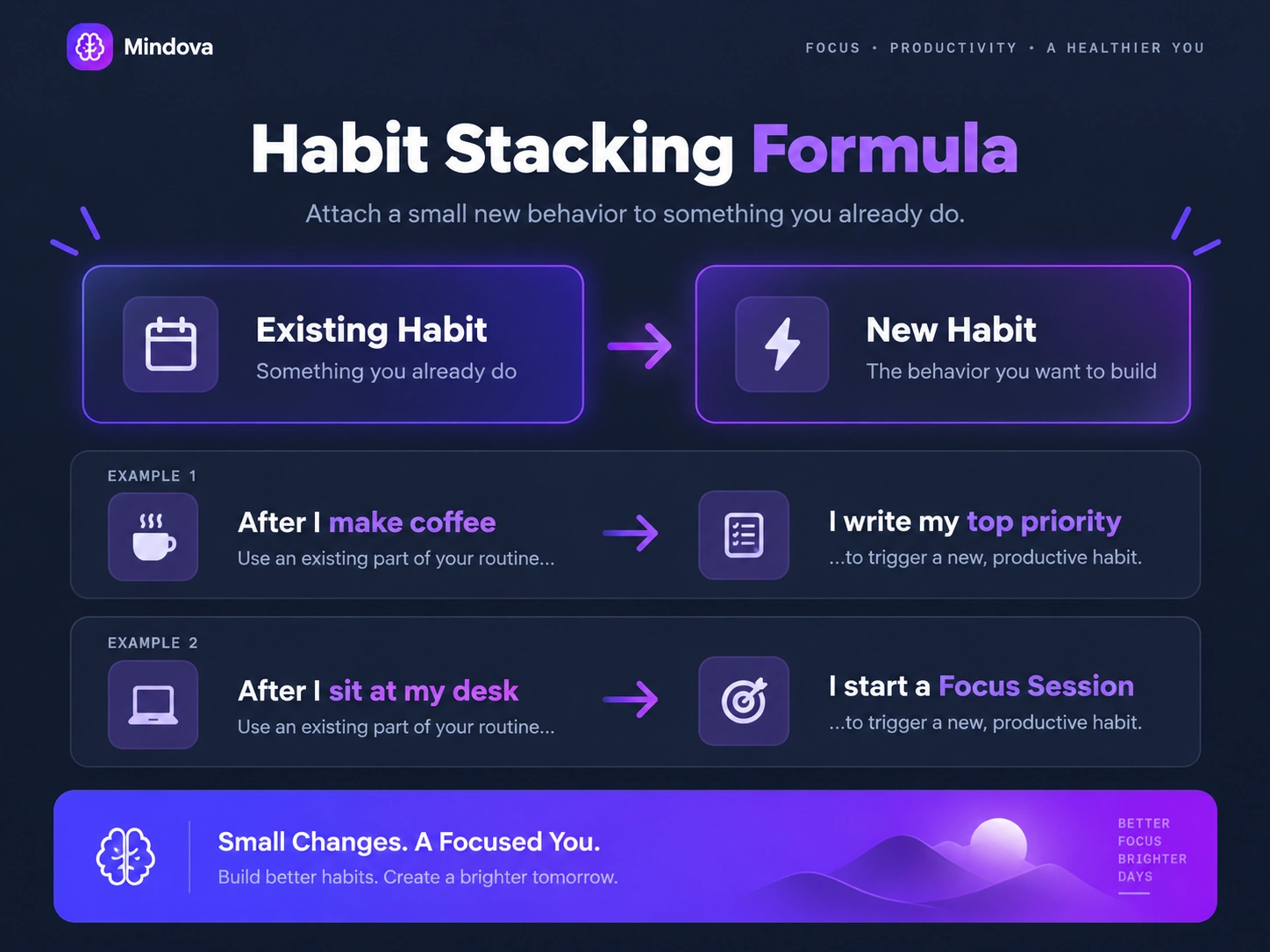
Habit stacking is a behavior-change technique where you connect a new behavior to an existing routine.
A common formula is:
After I [CURRENT HABIT], I will [NEW HABIT].
For example:
After I pour my morning coffee, I will write my top task for the day.
After I brush my teeth at night, I will prepare tomorrow's clothes.
After I sit down at my desk, I will start a Focus Session before checking social media.
After I close my laptop for lunch, I will stand up and walk for a few minutes.
James Clear popularized habit stacking in Atomic Habits and describes it as a form of implementation intention. He also credits BJ Fogg's earlier work on anchoring behaviors.
The useful principle is simple:
Do not leave the new behavior floating somewhere in your day. Give it a reliable cue.
Why Can Habit Stacking Help?
Knowing that you want to do something does not automatically tell you when to do it.
Compare:
I want to read more.
with:
After I put my breakfast plate in the sink, I will read one page.
The second version defines:
- the cue;
- the behavior;
- the order.
Research on implementation intentions supports the broader idea of linking a specific situation or cue with a planned response.
A 2024 meta-analysis covering hundreds of tests found positive effects from implementation-intention planning across a range of outcomes, particularly when the cue-response relationship was clearly specified.
That does not mean every habit stack will work.
It means that deciding when a specific cue occurs, I will perform this specific behavior is more concrete than relying on a vague intention.
How to Create a Habit Stack
1. Choose the New Behavior First
Start with something specific.
Not:
Be more productive.
Try:
Write tomorrow's first task before ending work.
Not:
Focus more.
Try:
Start one Focus Session before opening social media.
Not:
Read more.
Try:
Read one page.
You need to know exactly what behavior the anchor is supposed to trigger.
2. Find Something You Already Do Reliably
Now look for an action or event that already happens predictably.
For example:
- making coffee;
- brushing your teeth;
- sitting down at your desk;
- closing your laptop for lunch;
- finishing dinner;
- returning from a meeting;
- plugging in your phone at night.
The anchor does not need to be a perfect automatic habit.
It simply needs to happen reliably enough that you can recognize it.
3. Connect the Two
Use the formula:
After I [anchor], I will [new behavior].
Examples:
After I open my laptop in the morning, I will write my most important task.
After I finish lunch, I will take a short walk.
After I sit down at my desk, I will start a Focus Session.
The sentence should tell you exactly when the new behavior begins.
How to Choose a Good Anchor
The formula is simple.
Choosing the right cue is usually the harder part.
Make the Anchor Specific
This:
After lunch, I will stretch.
can still be vague.
When exactly is “after lunch”?
Compare it with:
After I put my lunch plate in the sink, I will stretch for one minute.
Now the cue is observable.
Match the Frequency
If you want the new behavior to happen every workday, attach it to something that also happens every workday.
For example:
After my Monday team meeting, I will review today's priorities.
would not provide a daily cue.
The frequency of the anchor should roughly match the frequency you want for the new behavior.
Keep the Anchor and Behavior Close Together
A useful stack usually has little delay between the cue and the action.
For example:
After I close my laptop for lunch, I will stand up and leave my desk.
The transition is immediate.
Compare that with:
After breakfast, I will exercise tonight.
That is closer to a reminder about a later intention than a tight habit stack.
Keep the New Habit Small Enough to Start
Habit stacking tells you when to act.
It does not solve a behavior that is still too large.
Suppose your stack is:
After I pour my morning coffee, I will write for two hours.
The cue may be reliable.
The behavior may still feel too demanding.
A smaller version could be:
After I pour my morning coffee, I will open my draft and write one sentence.
Now you are combining two different tools:
- Habit stacking provides the cue.
- A micro habit reduces the size of the behavior.
For the second technique, see Micro Habits: How to Start Small and Build Better Habits.
Habit Stacking Examples
Use these as templates rather than rules.
Morning
After I pour my coffee, I will write today's top priority.
After I brush my teeth, I will drink a glass of water.
After I open my laptop, I will review the task I want to finish first.
Work
After I sit down at my desk, I will start a Focus Session before checking social media.
After I finish a meeting, I will write down the next action.
After I finish one important task, I will decide what comes next before opening another tab.
Studying
After I sit down to study, I will answer one question from memory before rereading my notes.
After I finish one study block, I will write down what I still do not understand.
Evening
After I close my laptop for the day, I will write tomorrow's first task.
After I plug in my phone at night, I will read one page.
The best habit stack is not the cleverest one.
It is the one that fits something that actually happens in your routine.
What If Your Habit Stack Does Not Work?
Do not immediately conclude that you lack discipline.
Debug the stack.
Problem 1: You Keep Forgetting It
Check the anchor.
Is it specific?
Does it happen reliably?
Can you clearly identify the exact moment it occurs?
Weak:
After my morning routine...
Better:
After I put my coffee mug on my desk...
Problem 2: You Remember, but Avoid the New Habit
The cue may be fine.
The behavior may still be too large.
Instead of:
After I sit down, I will study for an hour.
try:
After I sit down, I will answer one practice question.
Problem 3: The Anchor Does Not Happen Often Enough
Choose another anchor.
Do not attach a daily behavior to something that only happens occasionally.
Problem 4: Something Else Already Occupies That Moment
Suppose:
After I sit down at my desk, I will plan my day.
But every morning you immediately join a meeting.
The anchor is reliable, but the moment is already occupied.
Move the behavior somewhere it can realistically happen.
Problem 5: The Stack Works on Some Days but Not Others
Look at what changes.
Maybe:
- weekdays are predictable but weekends are not;
- you work from different places;
- travel breaks the anchor;
- meetings change your normal sequence.
You may need different cues for different contexts.
A habit system should fit your actual life rather than pretending every day is identical.
Should You Stack Several Habits Together?
You can eventually create a sequence.
For example:
After I pour my coffee, I write today's top task.
After I write the task, I open the document I need.
After I open the document, I start a Focus Session.
That creates a chain.
But starting with a six-step morning routine can create more failure points than necessary.
If you are new to the method:
Start with one anchor and one new behavior.
Once you know whether that pairing works, decide whether another step would genuinely help.
Habit Stacking vs Micro Habits
These techniques solve different problems.
Habit Stacking
Answers:
When should the behavior happen?
Example:
After I make coffee, I read one page.
Micro Habits
Answers:
How small should the starting behavior be?
Example:
Read one page.
You can combine them.
If you remember the behavior but avoid starting it, shrinking the action may help.
If the action is easy but you repeatedly forget it, improving the cue may be more useful.
Habit Stacking vs Implementation Intentions
An implementation intention is a broader if-then plan.
For example:
If it is 9 a.m. and I am at my desk, then I will start writing.
The cue might be:
- a time;
- a place;
- an event;
- a situation.
Habit stacking typically uses another behavior or routine as the cue.
For example:
After I put my coffee on my desk, I will start writing.
So habit stacking can be understood as a practical version of the broader cue-response planning principle.
How Long Does Habit Stacking Take to Work?
There is no universal number of days.
Do not assume that a habit stack becomes automatic after:
- seven days;
- 21 days;
- 30 days;
- 66 days.
Habit formation varies according to:
- the behavior;
- the person;
- the context;
- repetition;
- cue stability.
A more useful question is:
Am I beginning to notice the cue and perform the behavior with less deliberate remembering?
If not, adjust the stack.
Use Feedback Instead of Protecting a Bad Stack
A habit stack is a design.
Designs can fail.
Suppose:
After I finish lunch, I will write for 20 minutes.
You repeat the plan, but it rarely happens.
Do not protect the stack just because you already chose it.
Ask why.
Maybe lunch happens at different times.
Maybe afternoon writing is a poor fit.
Maybe the action is still too large.
Then change the design.
This is where a simple feedback loop helps: observe what happened, change one useful thing, and test again.
See How to Use Feedback Loops for Personal Productivity.
Where Mindova Fits
Mindova does not automatically create or schedule habit stacks for you.
Its role is relevant when the new behavior involves protecting focused work in your browser.
For example:
After I sit down at my desk, I will start a Mindova Focus Session before opening distracting websites.
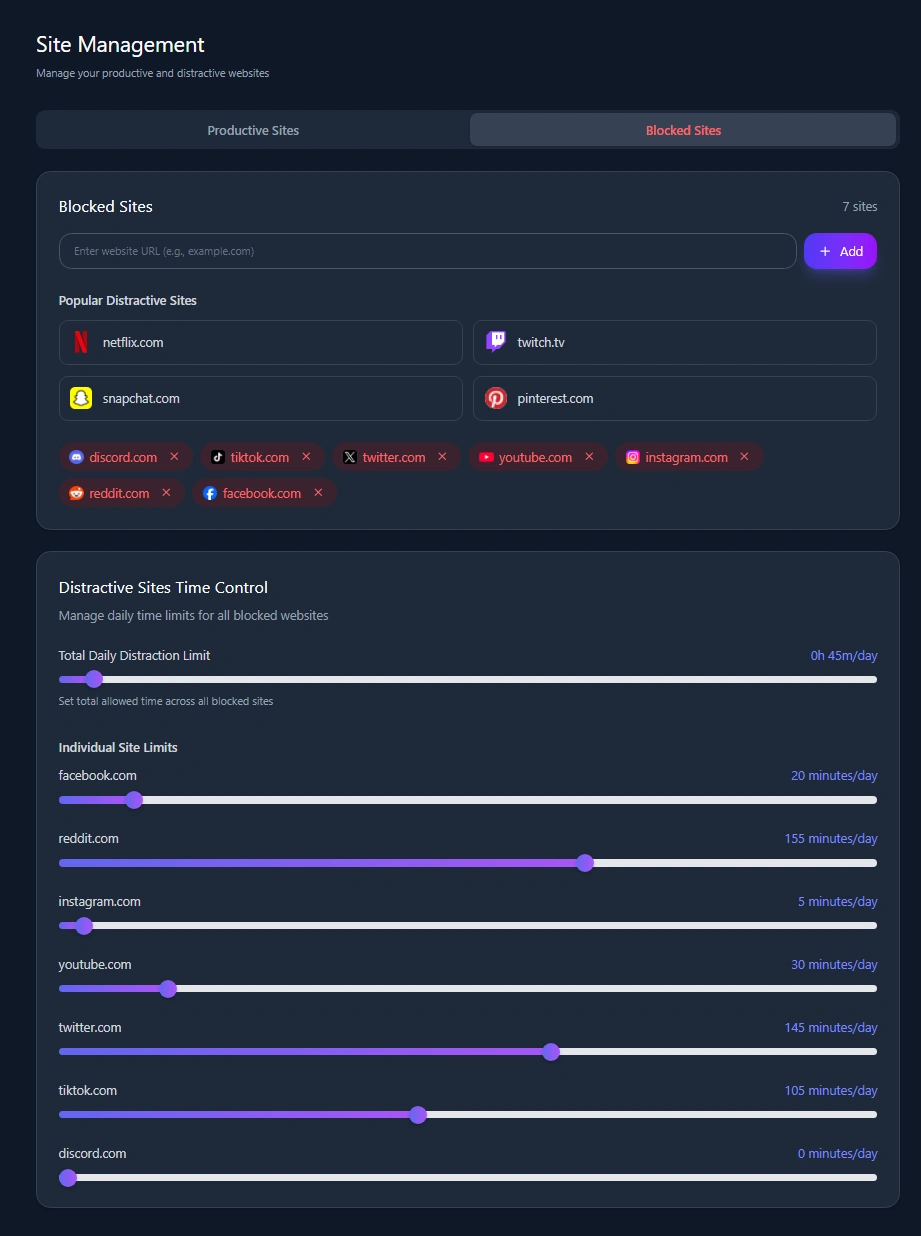
Mindova currently supports:
- website blocking;
- Individual Site Limits;
- an overall distraction limit;
- timed Focus Sessions;
- browsing and focus insights;
- optional AI Nudges.
Another example:
After I open my writing document, I will start a Focus Session and keep Reddit unavailable until the session ends.
The habit stack provides the cue.
Mindova provides the browser boundary.
For the broader setup, see How to Block Distracting Websites.
Mindova does not currently provide recurring schedules, Locked Mode, native iPhone or Android app blocking, or cross-device blocking enforcement.
Frequently Asked Questions
What is habit stacking?
Habit stacking means linking a new behavior to an existing routine so that the existing action becomes the cue for what comes next.
What is the habit stacking formula?
A common formula is:
After I [CURRENT HABIT], I will [NEW HABIT].
What is an example of habit stacking?
After I pour my morning coffee, I will write down today's most important task.
Coffee is the anchor.
Writing the task is the new behavior.
Does habit stacking actually work?
The exact branded technique has less direct research than the broader principle behind it.
Research on implementation intentions supports linking clear cues with planned responses, but that does not guarantee that every habit stack will succeed.
What makes a good habit-stacking anchor?
A useful anchor is:
- specific;
- reliable;
- easy to recognize;
- reasonably close in time and context to the new behavior.
Can I stack several habits together?
Yes.
But starting with one new behavior makes the system easier to troubleshoot.
Once the first pairing works reliably, add another step only if it serves a useful purpose.
What if habit stacking does not work for me?
Check whether:
- the cue is specific;
- the anchor happens reliably;
- the behavior is too large;
- something else competes for the same moment;
- the routine changes too much between contexts.
Then redesign the pairing.
Is habit stacking the same as Atomic Habits?
No.
Atomic Habits is James Clear's broader habit-building framework and book.
Habit stacking is one technique discussed within that framework.
Start With One Reliable Moment
You do not need to redesign your entire routine.
Pick one behavior you want to repeat.
Find one moment that already happens reliably.
Connect them:
After this, I will do that.
Make the action specific.
Keep it manageable.
Try the stack long enough to see whether the cue actually works.
If it does, keep it.
If it does not, change the design instead of blaming yourself.
A good habit stack is not impressive.
It simply makes the moment for the next action easier to recognize.
Sources
The When and How of Planning — Meta-analysis of Implementation Intentions
Mouhsine
Admin
Passionate about helping people achieve peak mental performance through evidence-based strategies and mindful technology use.
Related Articles

How to Focus on Writing Without Digital Distractions
Learn how to stay focused while writing by separating drafting from research, reducing digital distractions, and keeping the online tools you actually need
Creative Block: How to Get Unstuck and Start Creating Again
Feeling creatively stuck? Learn what creative block can look like, how to identify what is stopping you, and practical ways to generate ideas and move forward
How to Avoid Distractions While Working: 10 Practical Strategies
Learn how to avoid distractions while working by reducing digital triggers, managing notifications, limiting distracting websites, and protecting focused work time.
Comments
Be the first to comment.
Ready to protect your focus?
Block distracting sites, set daily limits, and run focus sessions. Mindova is free.