Feedback Loops for Productivity: How to Measure and Improve
Written by Mouhsine
Admin
Published September 3, 2026 · Updated September 4, 2026
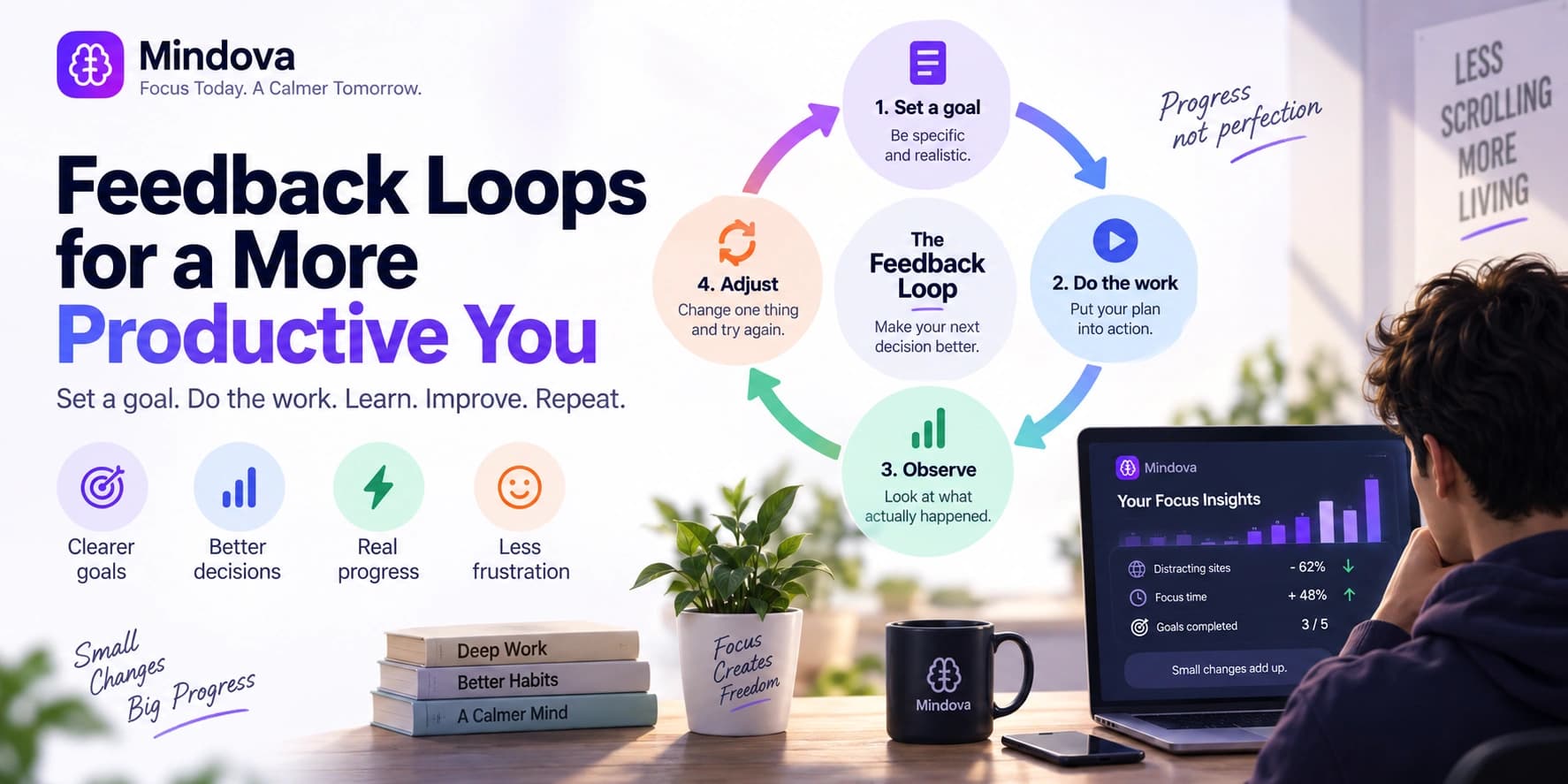
You finish a busy week and ask yourself:
Did I actually improve anything?
You worked. You answered messages. You completed tasks. Maybe you even felt productive.
But without some way to compare what you intended to do with what actually happened, it is easy to repeat the same system without knowing whether it works.
That is where a feedback loop becomes useful.
For personal productivity, the basic idea is simple:
Set a goal → do the work → observe what happened → make an adjustment → repeat.
You do not need a complicated dashboard.
You need enough information to make your next decision better.
What Is a Productivity Feedback Loop?
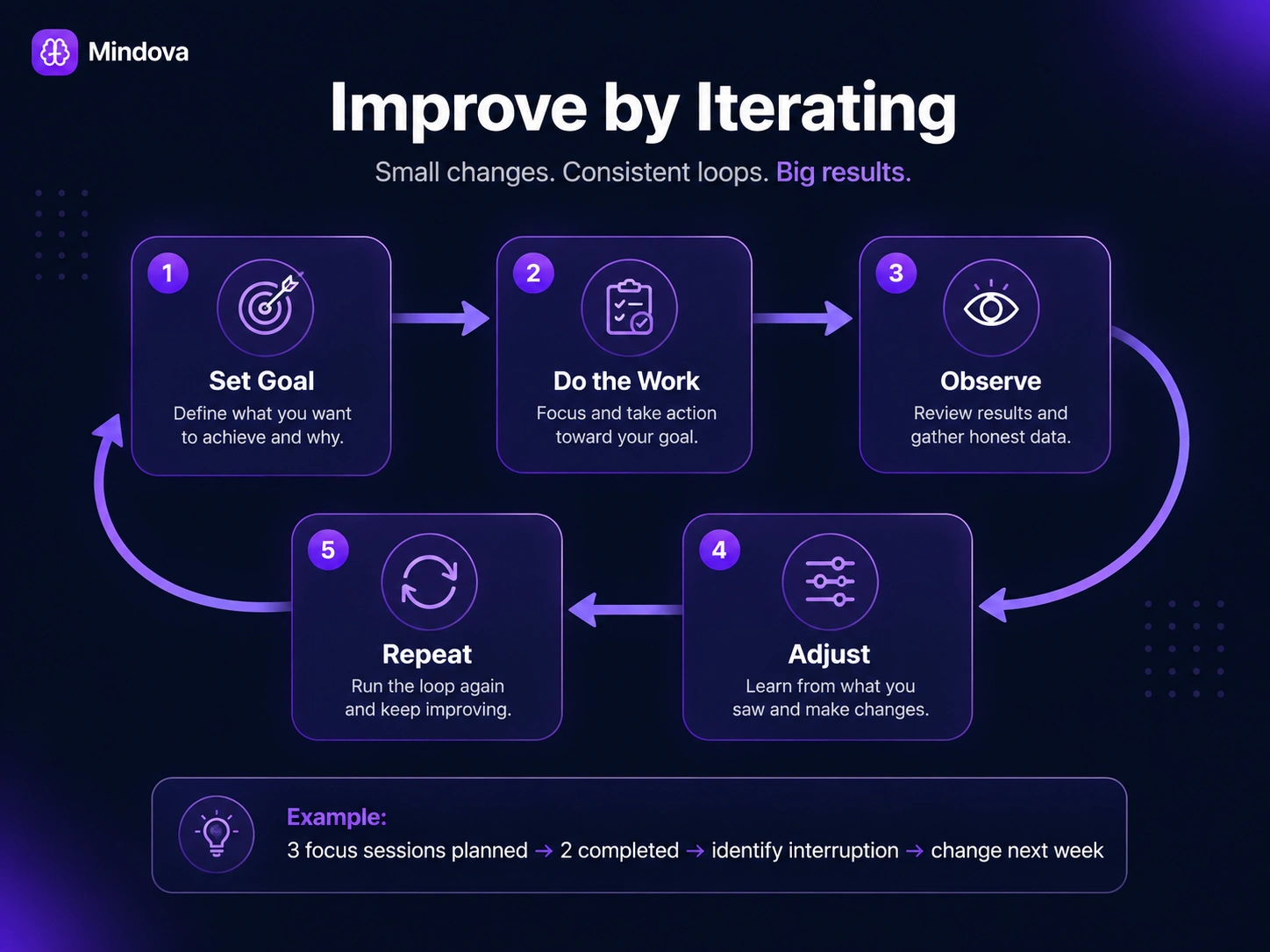
A feedback loop is a process where the result of an action informs what you do next.
Suppose your goal is to protect five focused work sessions this week.
You plan five.
You complete two.
That number alone is not yet a useful feedback loop.
The loop begins when you ask:
Why did three sessions not happen?
Maybe meetings replaced them.
Maybe you chose unrealistic times.
Maybe the task was too vague.
Maybe you repeatedly switched to distracting websites when the work became difficult.
You then make an adjustment:
Next week, I will protect three realistic sessions instead of planning five that rarely happen.
Then you observe what happens next week.
That is the loop:
Plan → Act → Observe → Adjust → Repeat.
Tracking Is Not the Same as a Feedback Loop
You can track dozens of numbers without learning anything useful.
For example:
I worked nine hours today.
That is data.
But it does not tell you whether those hours produced the result you wanted.
Likewise:
I completed four focus sessions.
That may be useful information, but only if those sessions were connected to meaningful work.
A feedback loop uses measurement to help you make a decision.
A useful question is:
What would I change if this number went up or down?
If the answer is “nothing,” you probably do not need to track it.
Why Monitoring Progress Can Help
Research suggests that monitoring progress toward a goal can help.
A meta-analysis covering 138 studies and 19,951 participants found that interventions designed to increase progress monitoring improved goal attainment on average. Effects were stronger when progress was physically recorded or reported.
But more feedback is not automatically better.
A major meta-analysis of feedback interventions found an average improvement in performance, while also finding that more than one-third of the interventions reduced performance.
How feedback is designed and where it directs attention matter.
So the goal is not maximum feedback.
It is useful feedback.
Step 1: Start With the Goal, Not the Metric
Do not begin by asking:
What can I measure?
Start with:
What am I trying to improve?
For example:
Goal: Protect more focused work
You might observe:
- planned focus sessions completed;
- meaningful work blocks protected;
- useful output produced during those blocks.
Goal: Reduce distracting browsing
You might observe:
- whether distracting sites interrupt protected work;
- time spent on one specific distracting website;
- how often you leave a work task for unrelated browsing.
Goal: Write more consistently
You might observe:
- writing sessions completed;
- sections drafted;
- meaningful revisions finished.
The metric should serve the goal.
Not the other way around.
Step 2: Distinguish Activity From Outcome
This is one of the easiest productivity mistakes to make.
Activity metrics tell you what you did
Examples:
- hours worked;
- Focus Sessions started;
- study sessions completed;
- pages drafted.
Outcome metrics tell you what changed
Examples:
- proposal completed;
- bugs fixed;
- practice questions answered correctly;
- project milestone shipped.
Both can be useful.
But an activity metric should not replace the result you actually care about.
Imagine:
Week 1: 8 focus sessions, project barely moved.
Week 2: 5 focus sessions, important draft completed.
If you optimize only for the number of sessions, Week 1 looks better.
It probably was not.
Step 3: Keep Measurement Small
You rarely need ten productivity metrics.
Start with one or two pieces of information that could genuinely change what you do next.
For example:
Goal: Finish a research draft.
Track:
- Did the planned writing block happen?
- What meaningful part of the draft moved forward?
That may be enough.
A productivity system becomes less useful when recording the work takes almost as much attention as doing the work.
A good rule is:
Track only information that could influence a future decision.
Step 4: Review at the Right Frequency
Faster feedback is not always better.
Some information is useful immediately.
Other patterns need time.
Immediate feedback
Useful when the result becomes clear quickly.
For example:
- code works or fails;
- answer is correct or incorrect;
- task was completed or not.
Daily review
Can work for simple behaviors:
- Did today's planned focus session happen?
- What interrupted it?
Weekly review
Often works better for broader productivity patterns:
- Which planned work blocks actually happened?
- What repeatedly displaced them?
- Which websites consumed more attention than intended?
- What important output moved forward?
Longer reviews
Can make more sense when daily variation tells you very little.
The goal is to review often enough to learn, but not so often that ordinary variation looks like a trend.
One poor afternoon does not necessarily require a new productivity system.
Step 5: Look for the Gap
A useful review compares:
What did I intend?
with:
What actually happened?
Suppose you planned:
Three 60-minute deep-work blocks.
What happened:
One completed. Two abandoned.
Now investigate the gap.
Maybe:
- meetings expanded;
- the sessions were placed at bad times;
- the task was too vague;
- you began with email instead;
- distracting websites repeatedly interrupted the work.
The useful conclusion is not:
I failed this week.
It is:
My current setup did not protect these sessions. What should I change?
That keeps feedback focused on the process instead of turning every result into a judgment about yourself.
Step 6: Change Something You Can Test
After reviewing, choose a practical adjustment.
For example:
Observation
I repeatedly leave my writing block to check YouTube.
Adjustment
Make YouTube unavailable during the next writing session.
Or:
Observation
I skip my 4 p.m. focus block most days.
Adjustment
Try doing the demanding work at 10 a.m. next week.
Or:
Observation
My planned 90-minute sessions rarely happen.
Adjustment
Try realistic 45-minute blocks instead.
When practical, changing one important variable at a time can make the result easier to interpret.
But it is a heuristic, not a law.
Sometimes several obvious problems need fixing together.
Example: A Feedback Loop for Focus
Suppose you want to spend more time writing.
Goal
Complete three focused writing sessions this week.
Measure
After each session, note:
- whether it happened;
- what part of the draft moved forward;
- what caused any major interruption.
Review
Friday:
Planned: 3
Completed: 2
One session was lost because you opened email first and stayed there.
Adjust
Next week:
Open the draft before checking email.
Repeat
At the next review, ask:
Did that change help?
If yes, keep it.
If not, investigate again.
That is a feedback loop.
No complicated productivity score required.
Example: Reducing Digital Distractions
Feedback loops also work well when a distraction feels vague.
Instead of:
I need to stop wasting time online.
define the problem:
During focused work, I repeatedly open Reddit.
Now the loop becomes:
Goal: Stay with the work during a Focus Session.
Observe: When do I attempt to visit Reddit?
Interpret: Does it happen when the task becomes difficult, during breaks, or simply out of habit?
Adjust: Block Reddit during the next session or give it a tighter Site Limit.
Review: Did the change protect the work, or did the distraction simply move somewhere else?
The objective is not a perfect score.
It is to learn something useful about the behavior.
For broader strategies, see How to Avoid Digital Distractions While Working.
Feedback Loops and Deep Work
Feedback can also help you improve how you protect demanding work without turning Deep Work into a numbers game.
Instead of tracking:
Total deep-work hours forever.
you might ask:
Which conditions made my important work sessions more likely to happen this week?
Maybe morning sessions worked better.
Maybe vague tasks failed more often.
Maybe unnecessary browsing repeatedly broke your concentration.
That information can improve your next plan.
For the broader method, see What Is Deep Work and How Do You Practice It?.
Habit Tracking vs Feedback Loops
These concepts overlap, but they are not the same.
Suppose you mark:
✓ Wrote today.
That is habit tracking.
It becomes part of a feedback loop when you use the information:
I wrote on four of seven days. The three missed sessions all happened after late meetings. Next week I will move writing earlier.
Now the tracking has informed an adjustment.
A simple way to remember the difference:
Tracking records what happened.
A feedback loop uses what happened to change what you do next.
Common Feedback Loop Mistakes
Tracking Too Much
If your productivity review requires maintaining a complicated dashboard, the tracking system may become another task competing with the work.
Start smaller.
Choosing Vanity Metrics
A metric can improve while the real goal does not.
More:
- hours;
- Focus Sessions;
- streaks;
- checkboxes
do not automatically mean better work.
Reacting to One Bad Day
One data point may simply be noise.
Look for patterns before rebuilding your system.
Changing Everything at Once
If you simultaneously change your schedule, focus duration, blocker setup, task system, workspace, and morning routine, it becomes difficult to know what helped.
When possible, make the next experiment interpretable.
Turning Feedback Into Self-Judgment
Instead of:
I'm terrible at focusing.
try:
My current setup produces more switching than I want.
The second statement gives you something you can change.
Measuring Instead of Working
A beautifully maintained productivity tracker can become sophisticated procrastination.
If tracking does not affect your decisions, simplify it.
Where Mindova Fits

Mindova does not build a productivity strategy for you.
It also does not automatically decide what your data means.
Its role is narrower.
Mindova can help you create and observe browser boundaries through:
- website blocking;
- Individual Site Limits;
- an overall distraction limit;
- timed Focus Sessions;
- browsing and focus insights;
- optional AI Nudges.
Suppose you intend to complete three Focus Sessions this week.
At the end of the week, your browsing and focus insights can be one input when reviewing how those sessions went.
Maybe you notice that a particular distracting website repeatedly appears around focused work.
The useful part is not simply having the data.
It is deciding:
Should I block this website during my next session, give it a Site Limit, or leave it alone?
That closes the loop.
For the practical setup, see How to Block Distracting Websites.
Mindova does not currently provide recurring focus schedules, Locked Mode, native iPhone or Android app blocking, or cross-device blocking enforcement.
Frequently Asked Questions
What is a feedback loop in productivity?
A productivity feedback loop is a repeated process of setting an intention, observing what happened, using that information to make an adjustment, and then testing the change.
What is an example of a personal feedback loop?
You plan three focus sessions, complete only one, identify that meetings repeatedly replaced the other two, move the next sessions to a more protected time, and review whether completion improves.
What should I track for productivity?
Track information connected to a specific goal.
Useful metrics might include meaningful work completed, planned sessions completed, interruptions during protected work, or another measure directly related to what you want to improve.
Is habit tracking a feedback loop?
Not by itself.
Habit tracking records whether a behavior happened.
It becomes part of a feedback loop when you review the information, learn something, adjust your approach, and observe the result.
How often should I review my productivity?
There is no universal cadence.
Simple behaviors may benefit from daily observation, while broader productivity patterns may make more sense to review weekly.
Review often enough to learn without overreacting to normal variation.
Does feedback always improve performance?
No.
Research suggests feedback can improve performance on average, but not every feedback intervention helps.
What is measured, where attention is directed, and how the feedback is used all matter.
How many productivity metrics should I track?
There is no required number.
Start with the smallest amount of information that helps you make a better decision.
Stop Guessing, But Do Not Measure Everything
A feedback loop is not a dashboard.
It is not a streak.
And it is not a productivity score.
It is a simple process for learning from what actually happened.
Choose something you want to improve.
Measure enough to see what happened.
Look for the gap.
Make a practical adjustment.
Then run the experiment again.
Over time, the goal is not to collect more data.
It is to need less guessing about what actually helps you work better.
Sources
Harkin et al. — Does Monitoring Goal Progress Promote Goal Attainment?
Kluger & DeNisi — The Effects of Feedback Interventions on Performance
Mouhsine
Admin
Passionate about helping people achieve peak mental performance through evidence-based strategies and mindful technology use.
Related Articles

How to Focus on Writing Without Digital Distractions
Learn how to stay focused while writing by separating drafting from research, reducing digital distractions, and keeping the online tools you actually need
Creative Block: How to Get Unstuck and Start Creating Again
Feeling creatively stuck? Learn what creative block can look like, how to identify what is stopping you, and practical ways to generate ideas and move forward
How to Avoid Distractions While Working: 10 Practical Strategies
Learn how to avoid distractions while working by reducing digital triggers, managing notifications, limiting distracting websites, and protecting focused work time.
Comments
Be the first to comment.
Ready to protect your focus?
Block distracting sites, set daily limits, and run focus sessions. Mindova is free.