Dopamine Detox: Does It Work? What Science Says
Written by Mouhsine
Admin
Published September 2, 2026 · Updated September 3, 2026
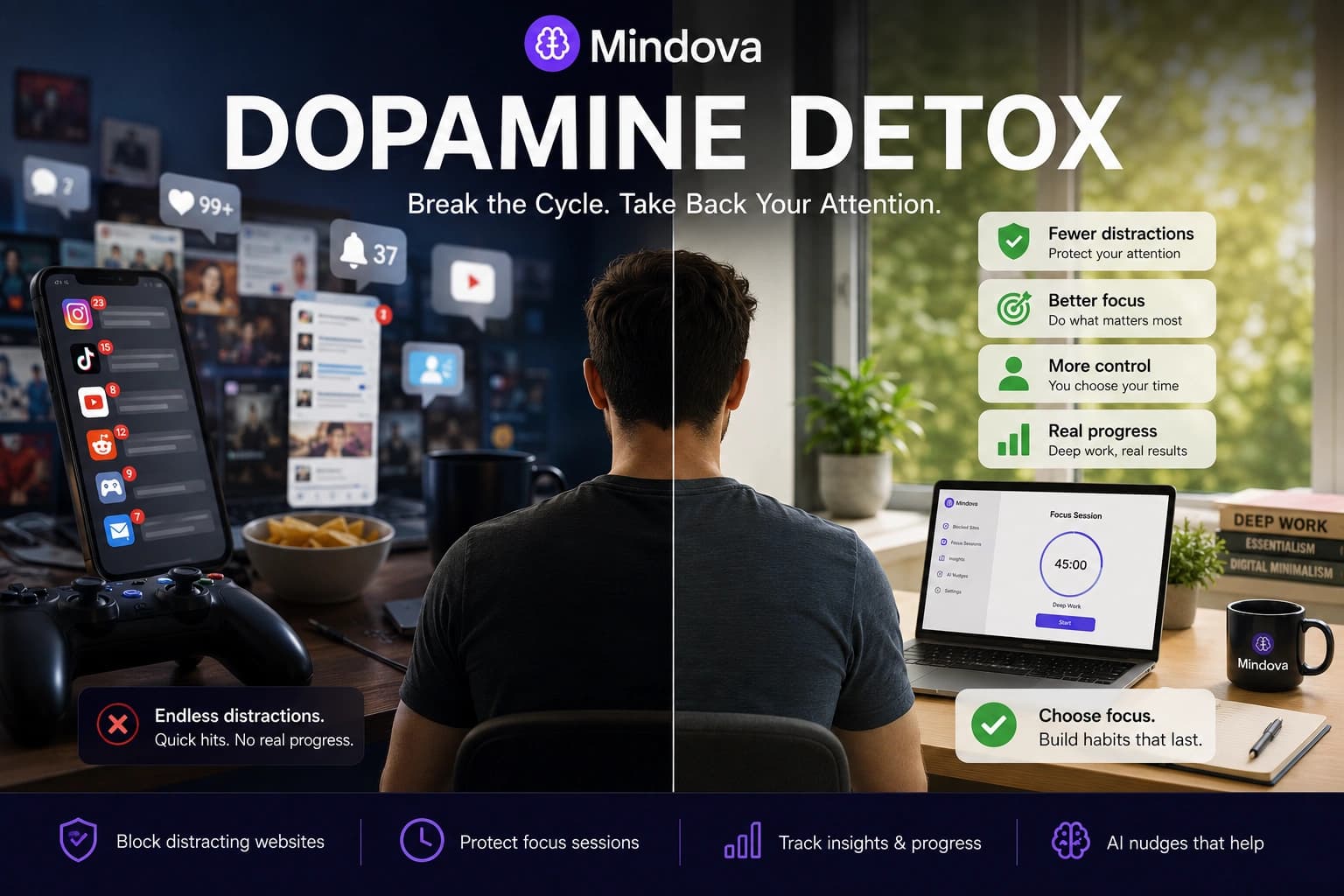
A dopamine detox sounds simple: stop social media, gaming, streaming, or other highly rewarding activities for a day or a week, and your brain supposedly “resets.”
That explanation is catchy.
It is also misleading.
You cannot detox dopamine from your brain. Dopamine is not a toxin, and your body does not need a break from producing it.
But the idea underneath the trend can still be useful.
If one behavior has become automatic — opening YouTube every time work gets difficult, checking Reddit whenever you have a spare minute, or losing an hour to short videos without intending to — stepping away from that specific behavior can help you see the pattern and build better boundaries.
So the useful version of a dopamine detox is not a brain reset.
It is a behavior experiment.
What Is a Dopamine Detox?
Online, “dopamine detox” usually means temporarily avoiding activities associated with frequent or immediately available rewards.
Common examples include:
- social media;
- short-form video;
- gaming;
- online shopping;
- streaming;
- constant phone or website checking.
More extreme versions tell people to avoid music, tasty food, exercise, conversations, or almost anything enjoyable.
That is where the idea goes off track.
Dopamine is a neurotransmitter involved in several processes, including motivation, learning, movement and reward-related behavior. It is not simply a “pleasure chemical,” and it is not something you can flush out of your brain.
A more useful question is:
Which behavior do I want to have more control over?
Does a Dopamine Detox Actually Work?
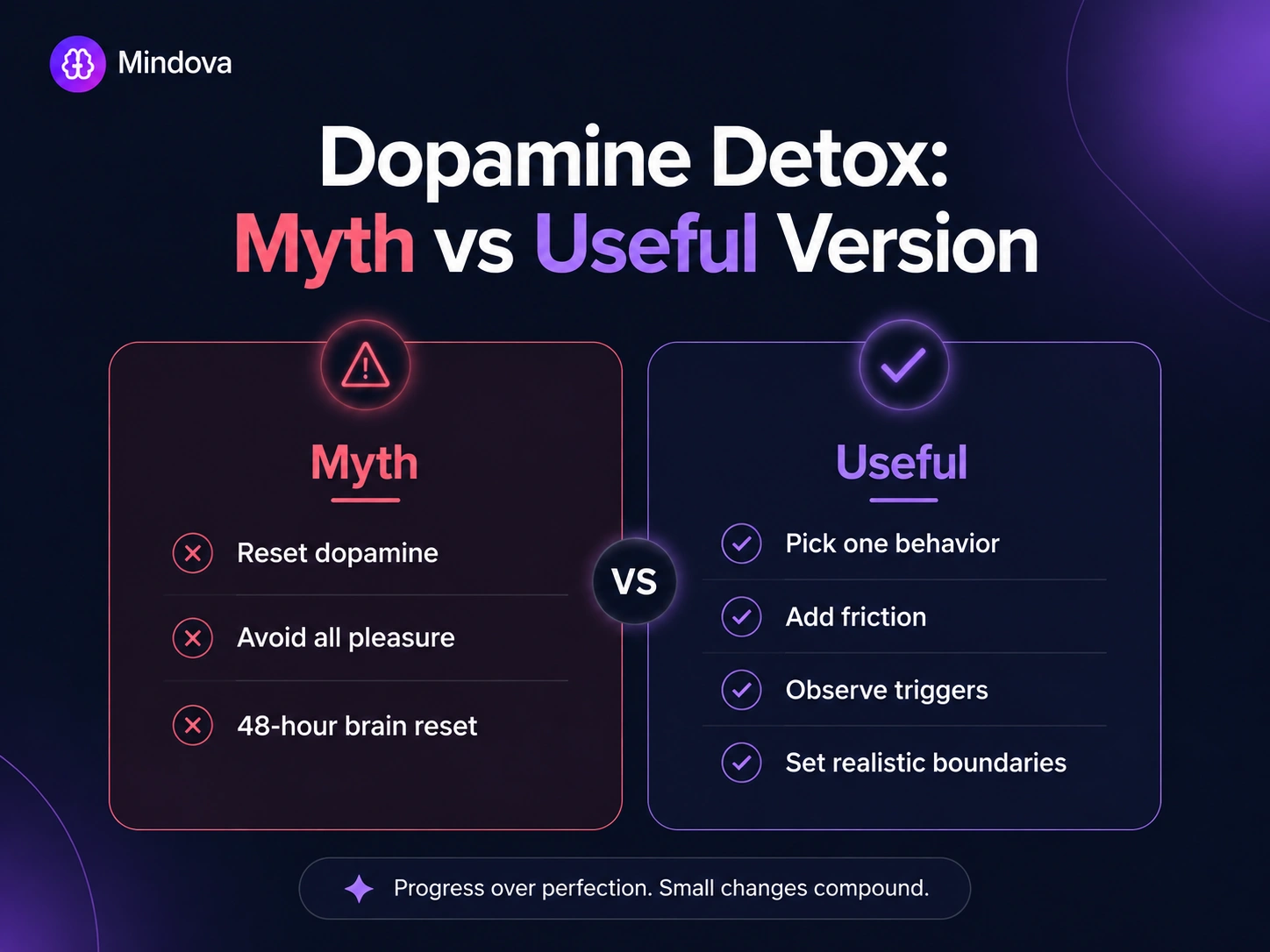
As a literal dopamine reset: no.
There is no established evidence that avoiding enjoyable activities for 24 or 48 hours resets dopamine levels, restores a universal dopamine baseline, or makes your dopamine receptors newly sensitive.
Claims such as:
“48 hours will reset your dopamine.”
or:
“Avoid cheap dopamine until your brain becomes sensitive again.”
oversimplify how dopamine works.
As a behavior experiment: it can still be useful.
Suppose you automatically open social media whenever a task becomes uncomfortable.
Taking social media away for an evening will not detox dopamine.
But it might reveal:
- how often you try to check it;
- what situations trigger the urge;
- whether boredom makes you reach for it;
- whether difficult work sends you toward an easier activity;
- what happens when the usual distraction is unavailable.
That information is useful because it gives you something concrete to change.
If social media itself is the main problem, see our guide on taking a break from social media.
You Do Not Need to Avoid Everything Enjoyable
One of the least useful versions of dopamine detoxing is deliberately making life as boring as possible.
No music.
No books.
No good food.
No conversations.
No exercise.
No entertainment.
That is unnecessary.
If Instagram is the behavior causing problems, your experiment can focus on Instagram.
If gaming keeps replacing work you intended to do, focus on gaming.
If YouTube repeatedly turns a five-minute break into an hour, focus on YouTube.
You do not need to remove every enjoyable activity because one habit needs a boundary.
How to Do a Dopamine Detox Without the Pseudoscience
1. Pick One Behavior
Avoid vague goals such as:
I need less stimulation.
Choose something observable.
For example:
I keep opening Reddit while I work.
Or:
I watch short videos for an hour before bed.
Or:
I open YouTube whenever a difficult task becomes uncomfortable.
Specific behaviors are easier to understand and change.
2. Decide What You Are Testing
Give the experiment a purpose.
For example:
I want to see how often I try to open Instagram when I'm bored.
Or:
I want to see whether blocking YouTube during work helps me stay with a difficult task.
Now you have something useful to observe.
You are not measuring your dopamine.
You are observing your behavior.
3. Choose a Realistic Window
There is no scientifically correct dopamine-detox duration.
You do not need exactly:
- 24 hours;
- 48 hours;
- seven days;
- 30 days.
Choose a period that makes sense for the behavior you are testing.
If distracting websites interfere with work, start with one focused work block.
If evening scrolling is the issue, try one or several evenings.
If the behavior dominates your weekends, a weekend experiment may tell you more.
The duration is not resetting your brain.
It is simply giving you enough time to notice the pattern.
4. Add Friction Before the Urge Arrives
Do not wait until you are already halfway through opening the distracting site.
Change the environment first.
You might:
- log out;
- close unnecessary tabs;
- remove distracting bookmarks;
- mute nonessential notifications;
- keep your phone somewhere less convenient;
- block a distracting website during focused work;
- set a limit on a website you still need occasionally.
The goal is not to prove how disciplined you are.
It is to make the unwanted action less automatic.
For browser distractions specifically, see how to block distracting websites.
5. Notice the Trigger
When you feel the urge to return to the behavior, ask:
What happened immediately before this?
Maybe you were:
- bored;
- stuck;
- tired;
- waiting;
- avoiding uncertainty;
- switching between difficult tasks;
- looking for an easy break.
You do not need to analyze every urge.
Look for repeated patterns.
If every difficult paragraph sends you to YouTube, that tells you something useful about your work environment.
If the problem is repeated consumption of negative news or feeds specifically, that may be closer to doomscrolling than a “dopamine problem.”
6. Replace the Behavior, Not All Pleasure
Removing something leaves an empty space.
Decide what belongs there instead.
If you usually scroll during a work break:
- walk for a few minutes;
- get water;
- stretch;
- step outside;
- simply rest.
If evening scrolling is the problem:
- read;
- cook;
- exercise;
- work on a hobby;
- deliberately watch something rather than entering an endless feed.
The replacement does not have to be boring to “protect your dopamine.”
It only needs to fit your goals better than the behavior you are changing.
7. Review What Happened
When the experiment ends, do not ask:
Has my dopamine reset?
You cannot determine that from how you feel.
Ask:
- Did I repeatedly try to return to the behavior?
- What triggered those attempts?
- Did removing it help the activity I wanted to protect?
- Did I actually miss the activity, or just having something easy to check?
- Would blocking, limiting, or changing the environment help long term?
This turns a trendy detox into useful information.
How Long Does a Dopamine Detox Take?
There is no evidence-based universal duration because there is no literal dopamine detox taking place.
Be skeptical of claims that a certain number of hours or days will “restore your baseline.”
The useful duration depends on the behavior.
If two focused hours without a distracting website teaches you something about your habits, that may be enough for that experiment.
If you are testing evening social media use, several evenings may tell you more.
You do not earn extra benefits simply by making the detox longer or more restrictive.
Dopamine Detox vs Digital Detox
These terms are often mixed together, but they are different ideas.
A dopamine detox is usually framed around avoiding rewarding or highly stimulating activities.
A digital detox is specifically about reducing or temporarily stepping away from digital technology.
If your problem is social media, YouTube, news sites, or repeated online checking, what you are doing may be better described as a digital break.
That is fine.
The label matters less than understanding the actual behavior you want to change.
Dopamine Detox vs Digital Minimalism
A dopamine detox is usually temporary.
Digital minimalism is a longer-term approach to deciding which technologies deserve a place in your life and how you want to use them.
If you keep needing another “reset” every few weeks, the more useful question may be:
What digital habits and boundaries should exist during my normal week?
That is closer to digital minimalism than dopamine detoxing.
Can a Dopamine Detox Improve Focus?
It can help indirectly if it removes a behavior that repeatedly interrupts your work.
But you do not need a dopamine explanation for that.
Imagine you are trying to write but switch to Reddit every few minutes.
Blocking Reddit removes one source of switching.
That does not guarantee concentration.
It does not reset your brain.
It simply creates a better environment for staying with the work.
For cognitively demanding tasks, this fits naturally with the principles in our Deep Work guide.
Where Mindova Fits

Mindova does not reset dopamine.
And it should not be presented as a tool for controlling brain chemistry.
Its role is simpler:
help reduce avoidable website distractions in your desktop browser.
Mindova currently supports:
- website blocking;
- Individual Site Limits;
- an overall distraction limit;
- timed Focus Sessions;
- browsing and focus insights;
- optional AI Nudges.
A practical experiment might look like this:
- Pick the website that distracts you most.
- Choose one task you want to protect.
- Start a timed Focus Session.
- Make the distracting website unavailable during that period.
- Notice when you try to open it.
- Review what happened afterward.
If you still need a website occasionally, an Individual Site Limit may fit better than blocking it completely.
Mindova does not currently provide recurring schedules, Locked Mode, native iPhone or Android app blocking, or cross-device blocking enforcement.
Frequently Asked Questions
Can you actually detox dopamine?
No.
Dopamine is a neurotransmitter your body produces naturally. It is not a toxin that can be removed through temporary abstinence.
Does a dopamine detox reset dopamine receptors?
There is no established evidence that a short dopamine detox resets dopamine receptors or restores a universal dopamine baseline.
What should I avoid during a dopamine detox?
Start with the specific behavior causing the problem rather than avoiding everything pleasurable.
That may be a social platform, gaming, short-form video, or a distracting website you repeatedly open.
How long should a dopamine detox last?
There is no required duration.
Choose a period appropriate for the behavior you want to observe.
Is a dopamine detox good for productivity?
It may help if it removes a behavior that repeatedly interrupts your work.
The benefit comes from changing the behavior or environment, not from cleansing dopamine.
Is dopamine detox the same as digital detox?
No.
Digital detox refers specifically to reducing digital technology use.
Dopamine detox is a broader internet trend based on temporarily avoiding rewarding activities and is often explained using inaccurate neuroscience.
Keep the Useful Part, Drop the Myth
You do not need to reset your brain before you can focus.
You do not need to remove every enjoyable part of your day.
And you do not need to spend a weekend proving how much boredom you can tolerate.
If something keeps taking more of your time or attention than you want, focus on that behavior.
Make it harder to do automatically.
Step away from it for a while.
Notice what triggers it.
Then decide what boundary would make your normal week better.
That is less dramatic than a dopamine detox.
It is also much more useful.
Sources
Mouhsine
Admin
Passionate about helping people achieve peak mental performance through evidence-based strategies and mindful technology use.
Related Articles

Digital Detox: What Is It, and Does It Actually Help?
Learn what a digital detox really is, what research says about its benefits, and how to reduce distracting technology without quitting every screen.

How to Temporarily Deactivate Facebook Without Deleting Your Account
Learn how to temporarily deactivate Facebook on mobile or desktop, what happens to your profile and Messenger, and how to reactivate your account later.

Digital Detox Retreats: Cost, Benefits, and Are They Worth It?
What happens at a digital detox retreat, how much does one cost, and is it worth paying for? Compare retreat types, evidence, downsides, and at-home alternatives.
Comments
Be the first to comment.
Ready to protect your focus?
Block distracting sites, set daily limits, and run focus sessions. Mindova is free.