Micro Habits: How to Start Small and Build Better Habits
Written by Mouhsine
Admin
Published September 4, 2026
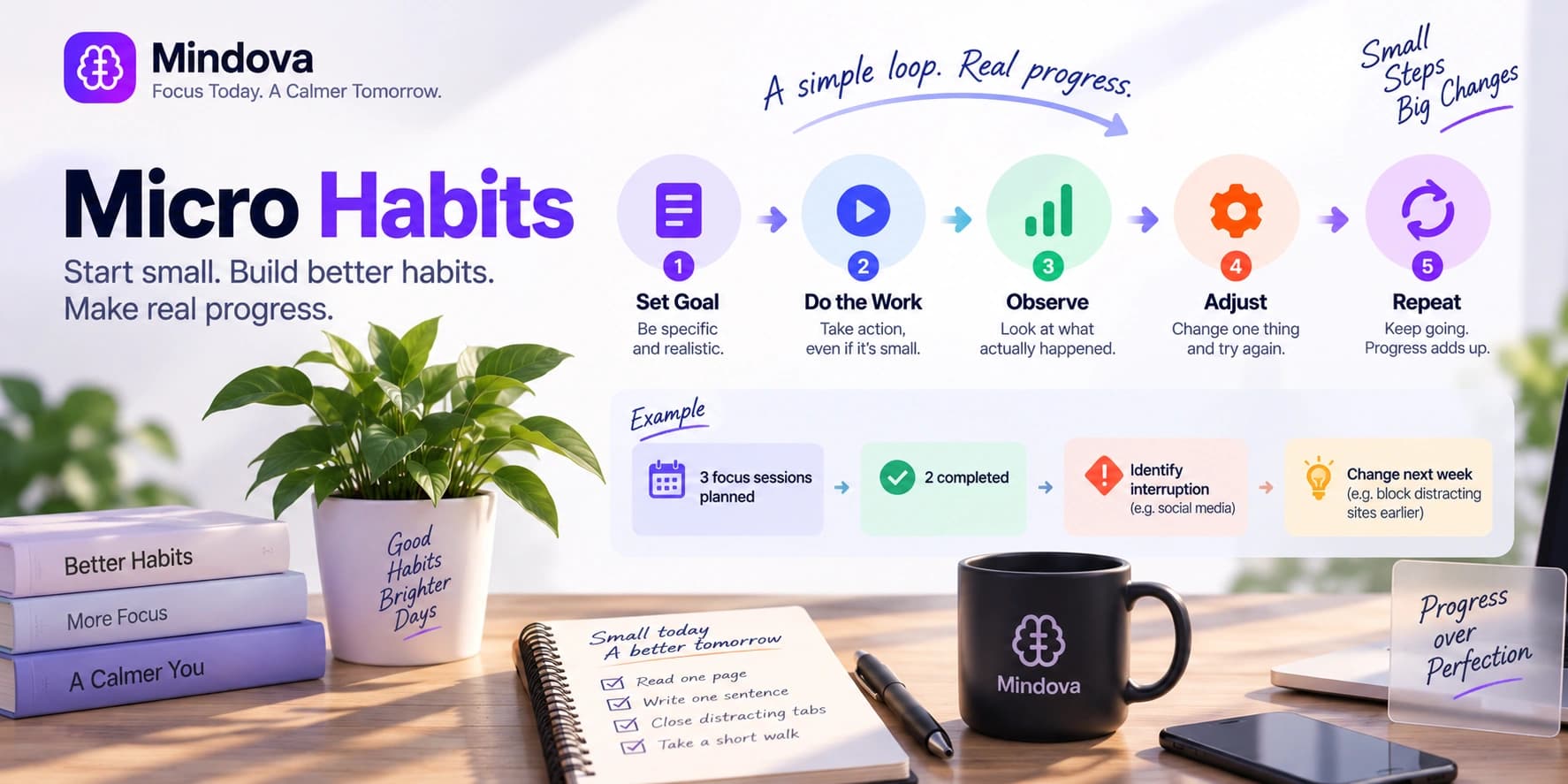
Big goals are easy to imagine.
“Write every morning.”
“Read every day.”
“Exercise consistently.”
“Stop wasting the first hour of work online.”
The difficult part is often starting the behavior repeatedly when the day gets busy, motivation drops, or the first step feels bigger than expected.
A micro habit takes a simpler approach:
Make the behavior deliberately small enough that starting requires less effort.
Instead of reading for 30 minutes, read one page.
Instead of writing 500 words, write one useful sentence.
Instead of promising yourself a perfect hour of focused work, begin with a short period you can realistically protect.
The tiny version is not the final goal.
It is a practical starting point.
What Is a Micro Habit?
“Micro habit” is a broad productivity term rather than one standardized scientific method.
In practice, it usually means a small, specific behavior designed to be easier to start and repeat.
Examples include:
- reading one page;
- writing one sentence;
- reviewing one flashcard;
- preparing tomorrow's first task;
- closing distracting browser tabs before working;
- spending a few minutes on the next step of a project.
The important part is not whether the behavior takes exactly 30 seconds, two minutes, or five minutes.
The question is:
Is the first version small enough that I can realistically repeat it?
Why Start So Small?
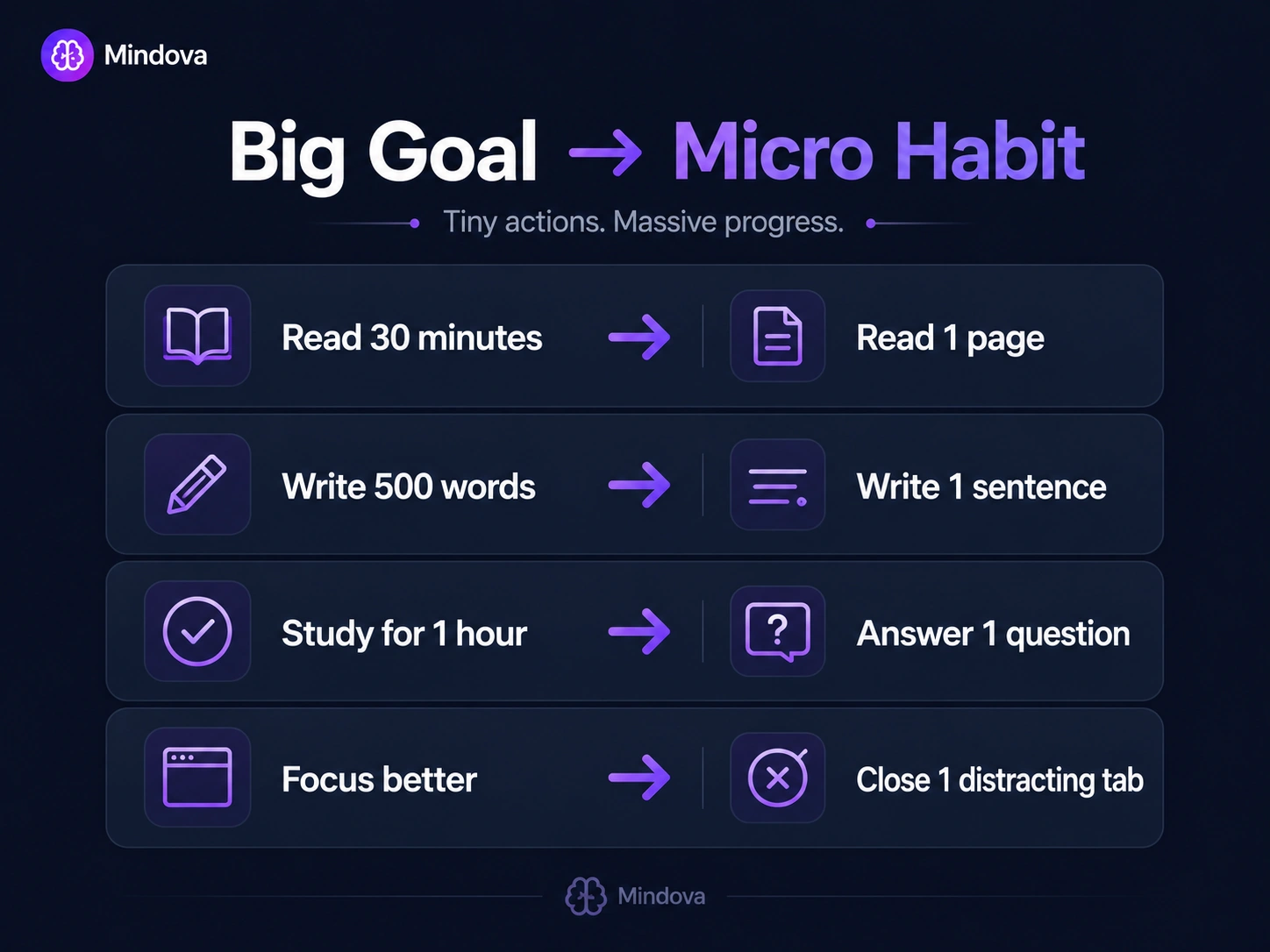
A large habit often hides several separate actions.
“Write for an hour” may require you to:
- decide what to write;
- open the document;
- remember where you stopped;
- resist unrelated browsing;
- begin a difficult section;
- continue for a long block.
That can make starting feel heavier than the goal sounds.
A micro habit reduces the first commitment.
Instead of:
Write for one hour.
try:
Open the draft and write one sentence.
You have not completed the larger goal.
But you have made the first action easier to begin.
That distinction matters because micro habits should not be sold as a trick where:
One sentence automatically turns into 1,000 words.
Sometimes you will continue.
Sometimes you will only complete the minimum.
Both are fine.
The purpose of the minimum is to make showing up easier, not to secretly force yourself into a much larger task.
Micro Habits vs the Two-Minute Rule
Micro habits overlap with James Clear's Two-Minute Rule, but they are not exactly the same thing.
The Two-Minute Rule recommends scaling a new habit down so its starting version takes less than two minutes.
Examples include:
- “Read before bed” → “Read one page.”
- “Study” → “Open my notes.”
- “Exercise” → “Put on my workout clothes.”
A micro habit uses the same broader principle of starting smaller, but it does not require a strict two-minute limit.
A better question is:
What is the smallest version of this behavior that still points toward the goal I care about?
How to Create a Micro Habit
1. Turn the Goal Into a Behavior
Goals describe an outcome.
Habits describe something you can actually do.
For example:
Goal: Become a better writer.
Too vague.
Better:
Write one sentence in the draft each morning.
Goal: Focus more.
Better:
Before starting my main task, close the unrelated websites I have open.
Goal: Read more.
Better:
Read one page before bed.
Your micro habit should be specific enough that you can clearly answer:
Did I do it or not?
2. Make the First Version Smaller
Suppose your plan is:
Work on my side project for one hour every evening.
But you repeatedly avoid starting.
Instead of immediately blaming discipline, shrink the first step.
Try:
Open the project and work on the next defined action for five minutes.
Or even:
Open the project and write down the next action.
You can always continue.
The small version simply lowers the size of the commitment required to begin.
3. Put It in a Stable Context
A tiny behavior is easier to repeat when it has a predictable place in your routine.
Compare:
I'll write one sentence sometime today.
with:
After I sit down at my desk in the morning, I'll write one sentence before opening email.
Habit research generally supports the importance of repeating behaviors in relatively stable contexts, while also showing that habit formation varies substantially between people and behaviors.
A useful cue might be:
- a time;
- a place;
- the beginning of another routine;
- the end of another activity.
The important part is that the context occurs reliably enough to remind you what comes next.
4. Reduce Friction Around the First Step
A small habit can still be difficult if the environment works against it.
If you want to read one page but the book is hidden away while your phone is already in your hand, the small behavior still has competition.
You might:
- leave the book beside the bed;
- keep the document ready;
- prepare what you need beforehand;
- close unrelated browser tabs;
- remove distracting bookmarks;
- place the tool for the habit somewhere visible.
The goal is not to create a perfect environment.
It is to remove obvious obstacles from the first action.
5. Keep the Minimum Small
One common mistake is turning a successful tiny habit into a demanding commitment too quickly.
You begin with:
Write one sentence.
A few productive days later:
Starting tomorrow, I need to write 1,000 words every morning.
Now the original barrier may be back.
It can help to separate:
Minimum
The version you want to remain realistic even on a difficult day.
Write one sentence.
Extra
Anything you choose to do after the minimum.
Today I wrote three paragraphs.
The extra can grow.
The minimum does not need to become larger every time motivation is high.
When Should You Make a Micro Habit Bigger?
There is no universal deadline.
You do not need to increase the habit after:
- seven days;
- two weeks;
- 21 days;
- 66 days.
Research on habit formation shows substantial variation in how quickly behaviors become more automatic.
The useful questions are:
- Is the current version happening reliably?
- Does it still feel realistic?
- Would a larger version actually help the underlying goal?
- Am I increasing it because the habit is ready, or because I happen to feel motivated today?
If increasing it makes sense, do it gradually.
For example:
One page → three pages.
or:
Five minutes → ten minutes.
You can also keep the minimum unchanged and simply do more when it feels appropriate.
What If You Miss a Day?
Missing one repetition does not mean the habit has collapsed.
In a well-known real-world habit-formation study by Phillippa Lally and colleagues, missing one opportunity did not materially derail the overall habit-formation process.
Lally et al. — How Are Habits Formed?
That does not mean consistency is unimportant.
It means you do not need a perfect streak.
If you miss the habit:
- Return at the next appropriate opportunity.
- Ask whether the minimum was still realistic.
- Check whether the cue was reliable.
- Notice whether the same obstacle keeps appearing.
A missed day is information.
It does not require restarting an imaginary habit clock.
8 Micro Habit Examples for Work and Focus
You do not need all of these.
Choose one that addresses a real problem.
For starting work
Write the single most important outcome for the next work block.
For writing
Write one sentence before opening research tabs.
For studying
Answer one question from memory before rereading notes.
For digital distraction
Close one unnecessary feed or social tab before beginning your main task.
For planning
Write tomorrow's first task before shutting down for the day.
For reading
Read one page before bed.
For breaks
Stand up and leave the desk when a Focus Session ends.
For reflection
At the end of the day, write one sentence about what interrupted your focus most.
That last habit can later become part of a broader productivity feedback loop.
Micro Habits vs Habit Stacking
These ideas solve different problems.
A micro habit changes the size of the behavior.
Example:
Read one page.
Habit stacking changes the cue for the behavior.
Example:
After I make coffee, I read one page.
They can also work together:
After I sit down at my desk, I write one sentence.
In that example:
after I sit downgives the behavior a cue;write one sentencekeeps the behavior small.
This distinction can help when something is not working.
If you remember the habit but repeatedly avoid starting it, the behavior may still be too large.
If the behavior is easy but you keep forgetting it, the cue may be the bigger problem.
Micro Habits Do Not Guarantee Big Results
This is important.
One push-up is not a complete fitness program.
One sentence does not write a book.
One minute of studying does not teach a course.
Micro habits are useful when they help you start or repeat a useful behavior.
The eventual result still depends on things such as:
- whether the behavior actually serves the goal;
- how consistently it happens;
- whether it expands when necessary;
- the quality of the work;
- the environment around it.
“Small” is a strategy for making the beginning manageable.
It is not magic.
Where Mindova Fits

Mindova does not build habits for you.
Its role is relevant only when browser distraction repeatedly gets in the way of the behavior you are trying to practice.
Suppose your micro habit is:
Write one sentence before checking Reddit.
If Reddit repeatedly pulls you away first, Mindova can add a browser boundary through:
- website blocking;
- Individual Site Limits;
- an overall distraction limit;
- timed Focus Sessions;
- browsing and focus insights;
- optional AI Nudges.
A simple setup might be:
- Open your work document.
- Start a Focus Session.
- Keep distracting websites unavailable during that period.
- Complete the small starting behavior.
- Continue working if you want.
Mindova is not creating the habit.
It is reducing one predictable source of browser distraction around it.
For the broader setup, see How to Block Distracting Websites.
Mindova does not currently provide recurring schedules, Locked Mode, native iPhone or Android app blocking, or cross-device blocking enforcement.
Frequently Asked Questions
What is a micro habit?
A micro habit is a deliberately small and specific behavior designed to make starting and repeating an action more manageable.
What are examples of micro habits?
Examples include reading one page, writing one sentence, reviewing one flashcard, or writing down tomorrow's first task before ending work.
How small should a micro habit be?
There is no required duration.
Make it small enough to repeat realistically while keeping it meaningfully connected to the behavior you want to develop.
Is a micro habit the same as the Two-Minute Rule?
Not exactly.
They overlap, but James Clear's Two-Minute Rule specifically recommends scaling the starting version of a new habit to under two minutes. Micro habit is a broader term.
How long does it take for a micro habit to become automatic?
There is no universal number of days.
Habit-formation research shows substantial variation depending on the behavior, person, repetition, and context.
Do micro habits have to happen every day?
No.
Not every useful habit needs to be daily.
The appropriate frequency depends on the behavior you are trying to establish.
Does missing one day ruin a habit?
No.
One missed repetition does not erase your progress. Return to the behavior at the next appropriate opportunity and adjust the setup if the same obstacle keeps appearing.
Should I track a micro habit?
You can if tracking helps you notice whether the behavior is happening.
Keep the tracking simple enough that maintaining the tracker does not become more work than the habit itself.
Start Small, Then Pay Attention
A micro habit does not need to transform your life overnight.
It needs to help you take the next useful action.
Choose one behavior.
Make its first version smaller.
Give it a reliable place in your routine.
Reduce obvious friction.
Repeat it.
Then pay attention to what happens.
If it becomes easy and a larger version would serve the goal, expand it.
If you miss once, continue.
If it rarely happens, reconsider the cue or shrink the first step.
The goal is not to keep every habit tiny forever.
It is to make useful behavior easier to start and repeat.
Sources
Habit Formation — Systematic Review and Meta-Analysis
Mouhsine
Admin
Passionate about helping people achieve peak mental performance through evidence-based strategies and mindful technology use.
Related Articles

How to Focus on Writing Without Digital Distractions
Learn how to stay focused while writing by separating drafting from research, reducing digital distractions, and keeping the online tools you actually need
Creative Block: How to Get Unstuck and Start Creating Again
Feeling creatively stuck? Learn what creative block can look like, how to identify what is stopping you, and practical ways to generate ideas and move forward

How to Avoid Distractions While Working: 10 Practical Strategies
Learn how to avoid distractions while working by reducing digital triggers, managing notifications, limiting distracting websites, and protecting focused work time.
Comments
Be the first to comment.
Ready to protect your focus?
Block distracting sites, set daily limits, and run focus sessions. Mindova is free.