How to Prioritize Your Day When Everything Feels Important
Written by Mouhsine
Admin
Published September 6, 2026
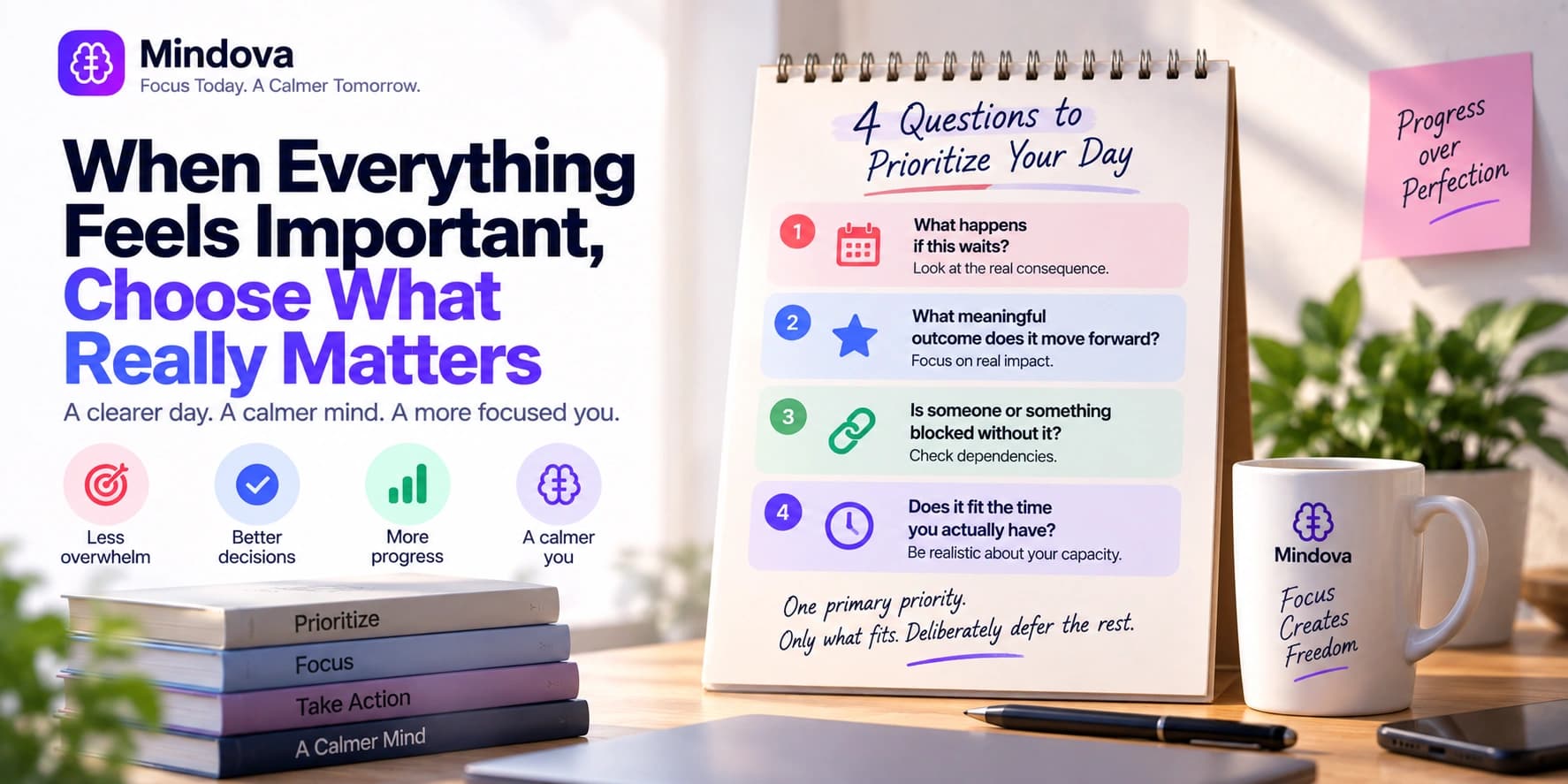
everything Feels Important
Some days, the problem is not that you have no priorities.
It is that everything feels important.
You have deadlines, messages waiting for replies, a project that needs real concentration, small tasks that cannot be ignored, and several things that would all be reasonable to work on first.
Trying to keep all of that in your head usually makes the problem worse.
A better approach is to accept one constraint:
Your day has limited capacity.
When everything feels important, first work out how much usable time you actually have. Then compare the serious candidates by consequence, impact, dependencies, and whether they realistically fit that time.
Choose one primary priority.
Add only what the remaining capacity can support.
Deliberately defer the rest.
That is prioritization.
What Prioritizing Actually Means
Prioritizing does not mean arranging every task into the perfect order so you can complete all of them.
Often, you cannot.
Prioritizing means deciding:
- what deserves attention first;
- what can wait;
- what should not be done today;
- what changes if new information arrives.
That last part matters.
A list with ten items labeled “high priority” is not really prioritized.
It is still a list of competing demands.
Step 1: List What Is Competing for Today
Start with the work that is genuinely competing for your attention today.
Not every project in your life.
Not your entire backlog.
For example:
- finish the client proposal;
- approve the homepage design;
- prepare for tomorrow's meeting;
- answer an important customer email;
- review an invoice;
- update project documentation.
Getting the candidates onto a page removes some of the mental noise.
Now you can compare them rather than repeatedly remembering them.
Step 2: Turn Projects Into Specific Actions
Projects are difficult to prioritize because they are too large.
For example:
Launch the website.
That could mean dozens of different things.
Instead, ask:
What is the next concrete action?
For example:
Review and approve the final homepage copy.
Or:
Fix the checkout error reported yesterday.
Now you are comparing actions that could realistically happen today.
The same applies to vague goals.
Instead of:
Work on marketing.
use:
Draft the landing-page headline options.
Specific actions are easier to compare for urgency, impact, time, and dependencies.
Step 3: Check How Much Time You Actually Have
This is the step many prioritization systems skip.
Suppose your day contains:
- two hours of meetings;
- lunch;
- administrative work;
- several fixed commitments.
You may technically have an eight-hour workday but only three hours of flexible working time.
If your task list requires six hours, the solution is not to rank the six hours more aggressively.
Something has to move.
Research published in 2026 found that when people manage multiple goals, they can set targets whose combined demands exceed the time actually available. Having people allocate their available time before setting targets improved how realistically they planned their effort.
So before asking:
What should I do first?
also ask:
How much work can actually fit today?
Step 4: Use the Four-Question Priority Test
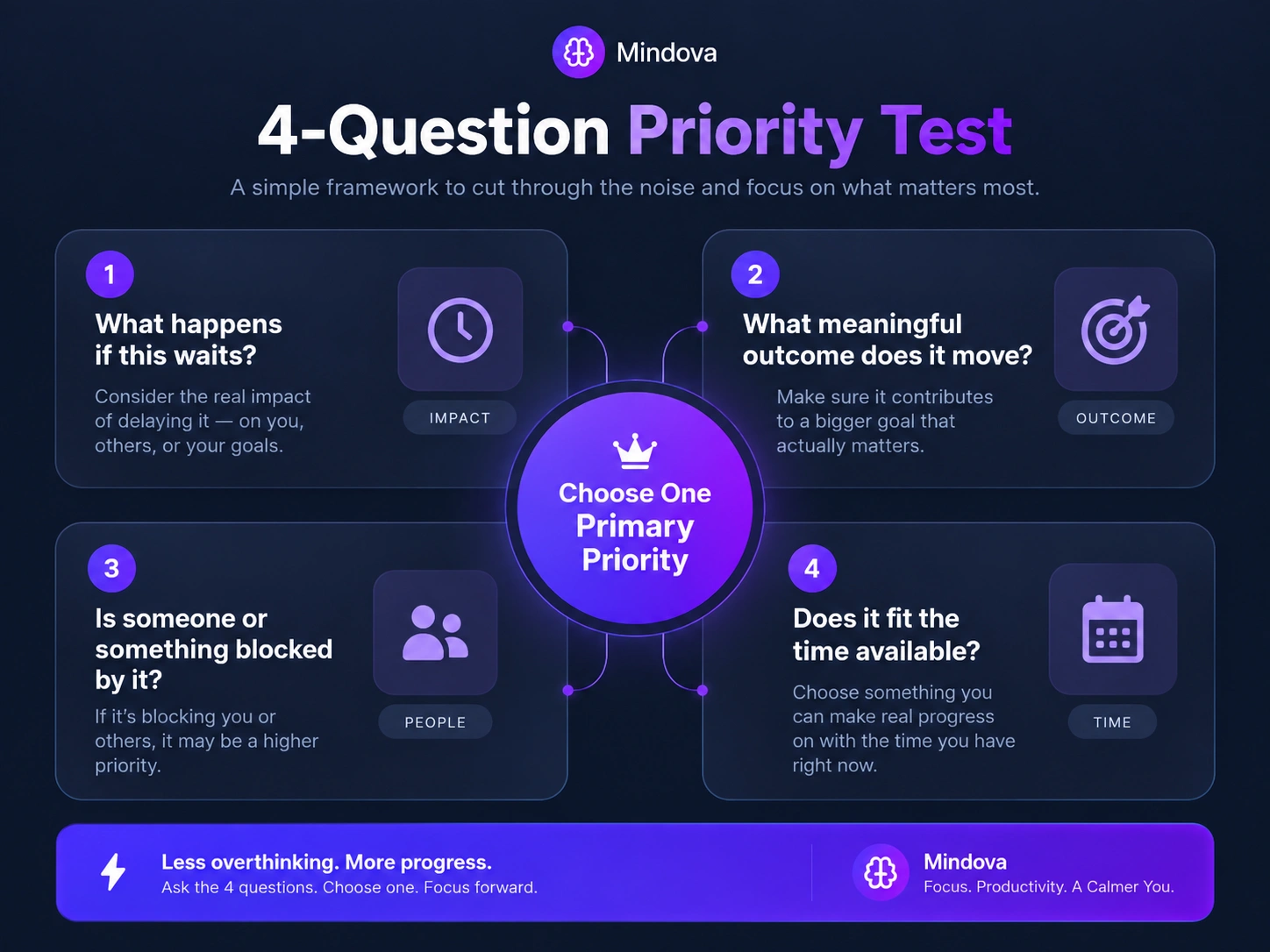
For each serious candidate, ask four questions.
1. What happens if this waits?
Look for a real consequence.
Not:
It feels urgent.
But:
- Does a deadline expire?
- Does a client get blocked?
- Does a problem become harder or more expensive?
- Is there almost no consequence if it moves to tomorrow?
Urgency is more useful when you understand what actually happens if you delay.
2. What meaningful outcome does it move forward?
A task can be urgent without being especially important.
Another task may have no immediate deadline but materially advance:
- a major project;
- revenue;
- a customer relationship;
- a critical decision;
- an important responsibility.
Ask:
What changes if I complete this?
That helps separate activity from progress.
3. Is someone or something else waiting on it?
Dependencies are easy to underestimate.
Imagine:
Task A: update an internal spreadsheet.
Task B: approve a design so three other people can continue their work.
Task B may deserve earlier attention even if both appear equally important on your personal list.
Sometimes the highest-leverage task is simply the one that unblocks other work.
4. Does it realistically fit the time I have?
A task can deserve attention and still not fit today.
Suppose you have 40 minutes before the next meeting.
Starting a two-hour piece of concentrated work may not be the best use of that window.
You could:
- do a smaller necessary task now;
- protect a larger block later;
- postpone the deep task to a time when you can meaningfully advance it.
Capacity is part of prioritization.
Step 5: Choose One Primary Priority
After comparing the candidates, choose one task that gets first claim on your meaningful work time.
Not five top priorities.
One primary priority.
For example:
Finish the client proposal before 1 p.m.
Then add secondary commitments only if the remaining time realistically supports them.
For example:
Primary priority
- Finish client proposal.
Secondary
- Approve homepage copy.
- Prepare meeting questions.
Deferred
- Clean up project documentation.
- Reorganize files.
- Research a non-urgent idea.
The deferred list matters.
You are not pretending those tasks disappeared.
You are deciding that they do not get today's limited attention.
What About Urgent vs Important?
The urgent-versus-important distinction can still be useful.
An urgent task needs attention soon.
An important task contributes meaningfully to an outcome or responsibility.
But the distinction should be a filter, not an automatic rule.
For example:
Task A
- Due today
- Takes 10 minutes
- Low consequence if slightly delayed
Task B
- Due tomorrow
- Requires 90 minutes
- Blocks several other people
A simple “today = first” rule may miss the dependency created by Task B.
So consider urgency alongside:
- consequences;
- impact;
- dependencies;
- capacity.
What If Several Tasks Are Genuinely Important?
Sometimes there is no obvious winner.
Two or three tasks may all be legitimate priorities.
Use tie-breakers.
Ask:
- Which has the earliest meaningful consequence?
- Which unblocks another person or task?
- Which requires a work window that will disappear later?
- Which can realistically be completed or meaningfully advanced now?
If they are still genuinely equal, choose an order.
You do not need to discover a hidden perfect answer.
Equal importance does not require simultaneous execution.
You still need sequence.
What If a New “Urgent” Task Arrives?
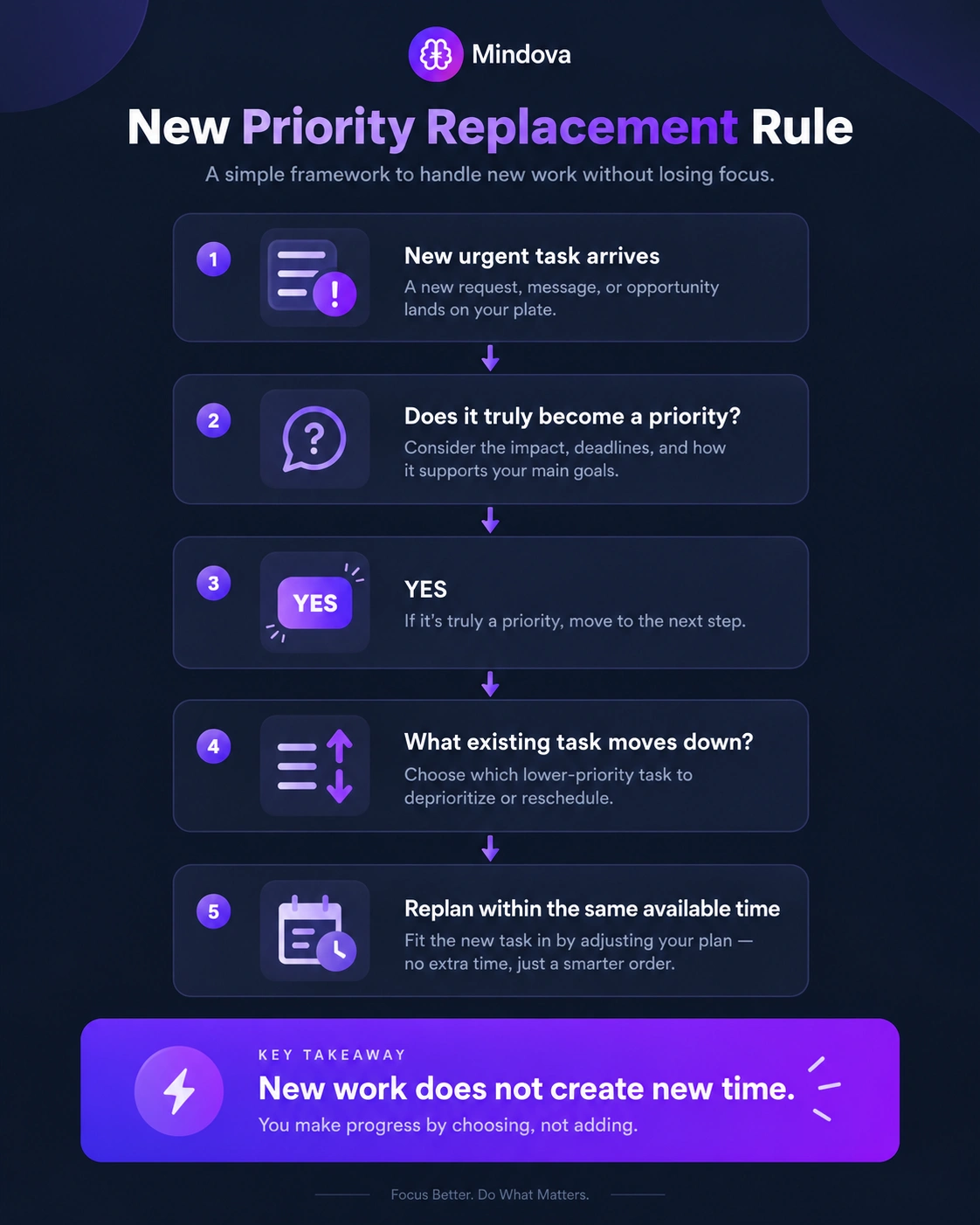
This is where a good plan often collapses.
You choose the day's priorities.
Then at 11:20 a.m. someone sends:
Can you do this ASAP?
The easiest response is to add it on top of everything else.
That creates an impossible day.
Instead, use a replacement rule:
If this becomes a priority, what existing priority moves down?
Maybe the new task truly deserves immediate attention.
Fine.
But your available time did not increase because the request arrived.
Something else now needs to:
- move later;
- move tomorrow;
- be delegated;
- be reduced;
- be dropped.
This keeps reprioritization honest.
Stop Re-Prioritizing Every Five Minutes
Prioritization can become another form of procrastination.
You rank the tasks.
Ten minutes later you reconsider.
Then you create another system.
Then another task appears and you rethink everything again.
Do not continuously rebuild the plan unless something meaningful changed.
Good reasons to reprioritize include:
- a real deadline changed;
- new information changed the consequences;
- a dependency appeared;
- an important task was completed sooner than expected;
- your available time changed significantly.
The uncomfortable feeling of doing difficult work is not automatically a reason to choose something else.
Protect the Priority Once You Choose It
Choosing the priority is only the first half.
Now the task needs time.
If your primary priority requires concentration, give it a realistic work period rather than hoping it happens between messages and meetings.
This is where time blocking becomes useful.
Prioritization answers:
What deserves my attention?
Time blocking answers:
When will I give it that attention?
For the second part, see Time Blocking: How to Plan Your Day and Protect Your Focus.
Reduce Predictable Distractions
Even a perfectly chosen priority can lose to an easier distraction.
You decide to finish the proposal.
Five minutes later:
- Reddit;
- YouTube;
- news;
- social media;
- another unnecessary tab.
That is no longer a prioritization problem.
It is an execution environment problem.
If certain websites repeatedly interrupt your important work, reduce their availability before beginning.
See How to Block Distracting Websites.
Review What Actually Happened
At the end of the day, do not ask only:
Did I finish everything?
That encourages unrealistic planning.
Instead ask:
- Did the primary priority move forward?
- Did unexpected work replace something intentionally?
- Did I underestimate how long a task would take?
- Did something I called urgent turn out not to matter?
- Did I leave enough capacity for reality?
If the same planning mistake keeps repeating, adjust the system.
That turns prioritization into a simple feedback loop rather than a daily guessing exercise.
For a deeper framework, see How to Use Feedback Loops for Personal Productivity.
Prioritization vs Analysis Paralysis
Sometimes the problem is not that you have too much work.
You simply cannot commit to a choice.
You compare options repeatedly, search for more information, rethink the decision, and stay stuck.
That is closer to analysis paralysis than workload prioritization.
If that sounds more familiar, see Analysis Paralysis: What It Is and How to Overcome It.
Where Mindova Fits
Mindova does not decide what your priorities should be.
That decision is yours.
Its role begins after you decide what deserves your attention.
Suppose today's primary priority is:
Finish the first draft of the proposal.
You could:
- choose the proposal as your priority;
- open the work you need;
- start a timed Mindova Focus Session;
- keep distracting websites unavailable during that work period;
- review your focus and browsing patterns afterward.
Mindova currently supports:
- website blocking;
- Individual Site Limits;
- an overall distraction limit;
- timed Focus Sessions;
- browsing and focus insights;
- optional AI Nudges.
The priority tells you what deserves attention.
Mindova can help reduce predictable browser distractions while you work on it.
Frequently Asked Questions
How do I prioritize when everything feels important?
First check how much usable time you actually have. Then compare the serious tasks by consequence, impact, dependencies, and whether they fit that capacity. Choose one primary priority and deliberately defer what cannot fit.
What should I do first when I have too many tasks?
Start with the tasks that have meaningful consequences, advance important outcomes, unblock other work, and fit the time available.
Do not choose purely by which task feels loudest.
How many priorities should I have in a day?
There is no universal number.
A useful approach is to choose one primary priority, then add secondary commitments only if the remaining time realistically supports them.
What is the difference between urgent and important?
Urgent refers to how soon something requires attention.
Important refers to how much it matters to a meaningful outcome or responsibility.
A task can be urgent but low impact, or important without an immediate deadline.
What if two tasks are equally important?
Use practical tie-breakers such as consequences, dependencies, available work windows, and time required.
If they remain equal, simply choose an order.
They do not need to happen simultaneously.
How should I handle a new urgent task?
Ask:
If this moves up, what moves down?
Treat new work as a replacement decision rather than automatically adding it to an already full day.
Should I use the Eisenhower Matrix?
It can be useful for separating urgent and important work.
But if everything still appears important, add other information such as consequences, dependencies, impact, and your available capacity.
Make the Day Fit the Time You Actually Have
A clear day does not require completing everything.
It requires knowing what deserves limited attention first.
Get the competing work out of your head.
Turn vague projects into specific actions.
Check how much time is genuinely available.
Compare the serious candidates.
Choose one primary priority.
Protect time for it.
When something new arrives, decide what it replaces.
And let the rest wait intentionally.
The goal is not to make an impossible day efficient.
It is to stop pretending that everything can happen at once.
Source
Time Before Goals — Research on Multiple Goals and Limited Time
Mouhsine
Admin
Passionate about helping people achieve peak mental performance through evidence-based strategies and mindful technology use.
Related Articles

How to Focus on Writing Without Digital Distractions
Learn how to stay focused while writing by separating drafting from research, reducing digital distractions, and keeping the online tools you actually need
Creative Block: How to Get Unstuck and Start Creating Again
Feeling creatively stuck? Learn what creative block can look like, how to identify what is stopping you, and practical ways to generate ideas and move forward
How to Avoid Distractions While Working: 10 Practical Strategies
Learn how to avoid distractions while working by reducing digital triggers, managing notifications, limiting distracting websites, and protecting focused work time.
Comments
Be the first to comment.
Ready to protect your focus?
Block distracting sites, set daily limits, and run focus sessions. Mindova is free.