Time Systems That Prevent Analysis Paralysis
Written by Mindova Team
Admin
Published February 19, 2026 · Updated July 7, 2026

The decisions that drain you are the ones you make twice
You can win a fight with analysis paralysis in the moment and still lose the week. If every choice arrives fresh, with no structure around it, you'll keep getting stuck on the same kinds of decisions over and over. The fix isn't better willpower. It's building a few time-management systems so most decisions are handled before they have a chance to stall you.
This is prevention, not rescue. Set these up once and the everyday overthinking mostly stops happening.
Give every decision a default time budget
Overthinking expands to fill whatever time you give it. So decide, in advance, how much time a decision is worth. A reasonable default: trivial choices get two minutes, ordinary ones get the length of a single focus block, and only genuinely big ones get a scheduled session.
The trick is making this automatic, not a case-by-case judgment. When "how long should I spend on this?" already has an answer, you skip the meta-decision that often causes the stall in the first place.
Make routine choices once, then turn them into rules
The most efficient decision is the one you never have to make again. Look at the choices you face repeatedly and replace them with standing rules. Same breakfast on workdays. First hour goes to the most important task, no exceptions. Email twice a day at set times.
Each rule you set removes a recurring decision from your plate. Say you waste ten minutes every morning deciding what to work on first. A rule ("I start with the hardest thing") deletes that ten minutes permanently, along with the small dread that comes with it.
Plan the week before it starts
A lot of in-the-moment paralysis is really planning you didn't do earlier. When you sit down with no plan, every task competes for attention at once and the overwhelm freezes you. A short weekly planning session fixes this. Pick a consistent time, list what matters, and rough out where it goes.
Now the daily question shrinks from "what should I do with my whole life?" to "what's next on the plan?" That's a question you can answer without spiralling.
Time-block so the day decides for you
Time blocking means assigning specific work to specific slots on your calendar instead of pulling from an open list. Its quiet benefit is that it removes the constant "what now?" decision. When 9 to 10:30 is already marked for one task, you don't deliberate. You just start.
Leave buffer between blocks for the things that run long, and protect a block or two for deep work where you won't be interrupted. The point isn't to schedule every minute. It's to take the highest-value work off the negotiating table.
Batch similar choices together
Switching between different kinds of decisions is exhausting and slow. Batching groups them so you decide in bulk. Answer all your messages in one sitting. Make the week's small purchases in one pass. Handle every quick yes-or-no in a single ten-minute block.
Deciding ten similar things in a row is far faster than deciding them one at a time across the day, because you're not reloading the context each time.
Protect your decisions from distraction
Every notification is an interruption that resets your focus and makes the next choice harder. Decision fatigue is real, and a day full of pings burns the mental energy you need for the choices that matter. So build guardrails into your environment, not just your schedule.
Silence non-urgent alerts during focus blocks. Keep your planning time genuinely offline. If your attention leaks toward the same handful of sites whenever a task gets hard, block them during work hours so the temptation isn't a click away. A tool that enforces those limits on a schedule means you set the rule once and it holds, instead of relying on willpower every afternoon.
Build in a weekly review
Systems drift. A short weekly review keeps them honest. Look back at where you got stuck, which rules held, and which blocks you kept blowing through. Then adjust. Maybe a time budget was too tight, or a rule needs to change.
Over a few weeks this turns into a setup that fits how you actually work, and the decisions that used to eat your afternoons stop being decisions at all.
The payoff of deciding less
None of this is about squeezing more hours out of the day. It's about spending fewer of them stuck. When your routine choices are handled by rules, your week is planned before it starts, and your environment protects your focus, analysis paralysis runs out of room to grow. You face fewer decisions, make the remaining ones faster, and save your real deliberation for the few that deserve it.
Start with one system. Add a single rule, or block out next week before it begins. The goal isn't a perfect schedule. It's a day where you spend your energy doing the work instead of deciding whether to.
Put this into practice with Mindova
Mindova is a website and app blocker that turns these ideas into daily habits — set focus schedules, block distracting sites and apps, and track your progress across every device.
- Block distracting websites and apps in seconds
- See pricing — start free, no credit card required
- Get started free and reclaim your focus today
- Block specific apps: Block Facebook · Block YouTube
Mindova Team
Admin
Passionate about helping people achieve peak mental performance through evidence-based strategies and mindful technology use.
Related Articles

Distraction-Free Writing: A Setup for Focus
How to build a distraction-free writing setup and the habits that protect your drafting time from pings, tabs, and the urge to check.
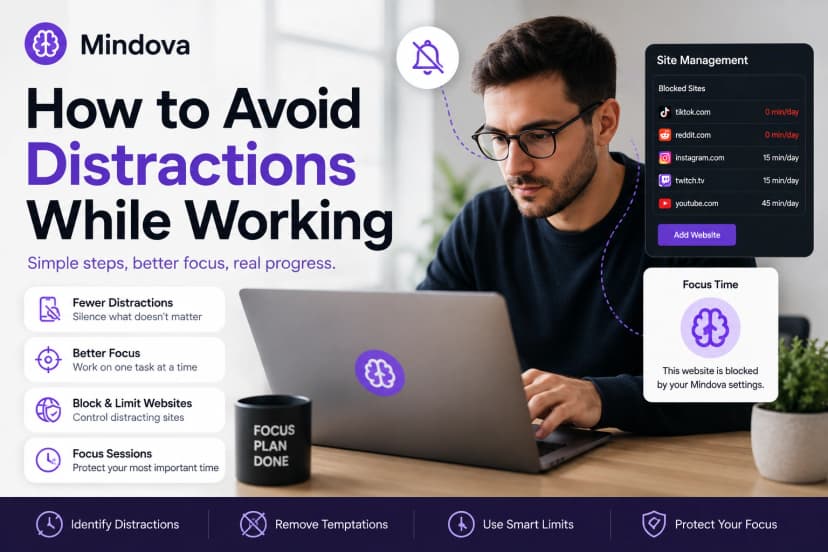
How to Avoid Distractions While Working: 10 Practical Strategies
Learn how to avoid distractions while working by reducing digital triggers, managing notifications, limiting distracting websites, and protecting focused work time.

Build Focus Habits With the Cue-Reward Loop
Break focus into cue, craving, response, and reward, and concentration stops depending on motivation.
Comments
Be the first to comment.
Ready to protect your focus?
Block distracting sites, set daily limits, and run focus sessions. Mindova is free.