Deep Work: What It Is and How to Practice It
Written by Mouhsine
Admin
Published September 3, 2026
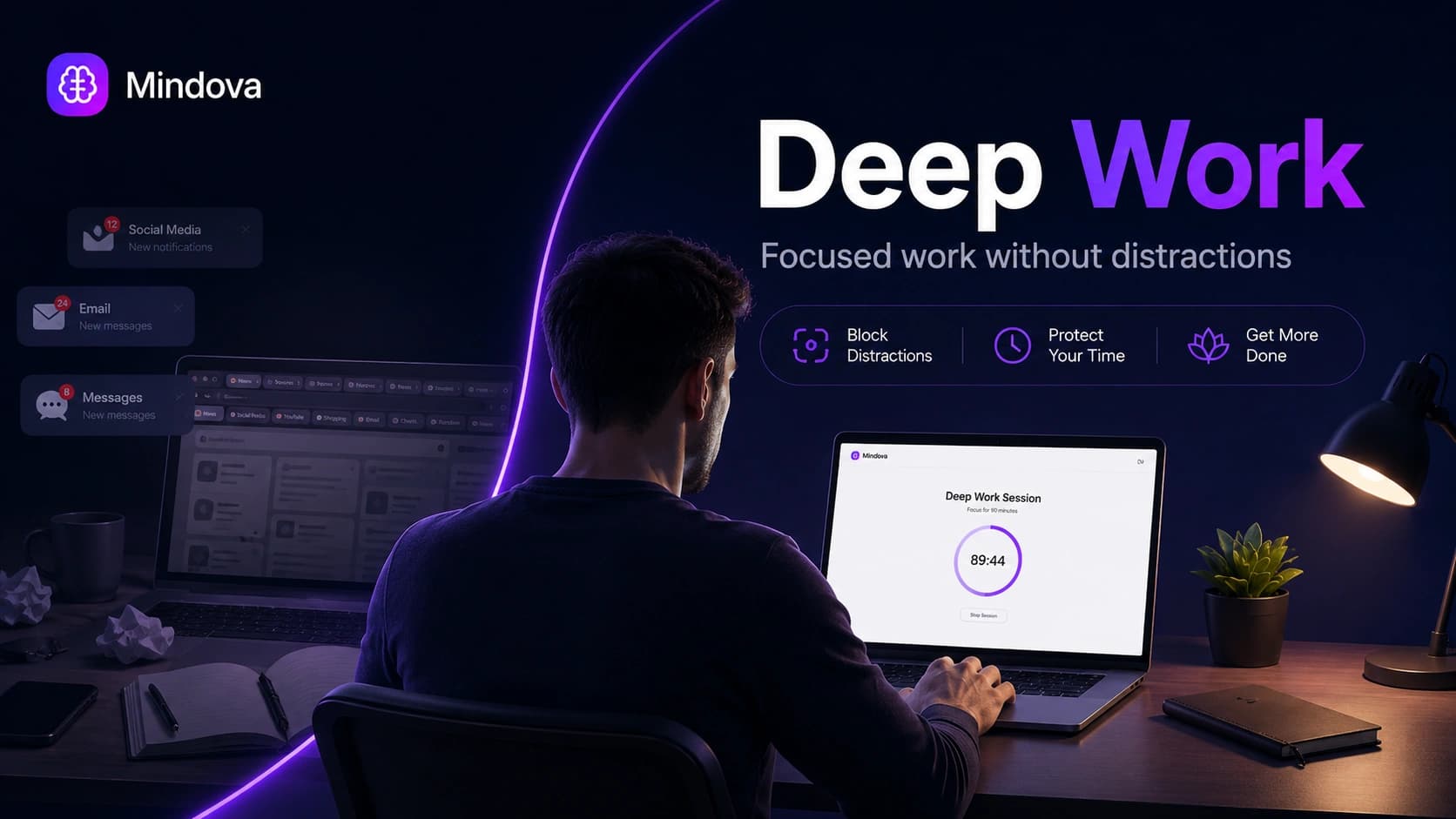
Some work can be done while half-listening to a conversation, checking email, or switching between tabs.
Other work falls apart the moment your attention does.
Writing a difficult argument, solving a technical problem, understanding complex material, designing a system, analyzing evidence, or learning a demanding skill usually requires something different: sustained concentration on one cognitively demanding task.
That is the basic idea behind deep work.
Cal Newport popularized the term in his 2016 book Deep Work: Rules for Focused Success in a Distracted World. He defines deep work around focusing without distraction on cognitively demanding activity.
The useful part of the idea is not that you need to disappear into a cabin for four hours every morning.
It is that some tasks deserve a different environment from email, messages, meetings, feeds, and constant switching.
Deep work means creating that environment deliberately.
What Is Deep Work?
Deep work is focused, distraction-free effort on a task that demands substantial mental attention.
The task itself matters.
Answering routine email with every notification disabled does not automatically become deep work.
Neither does organizing files for two uninterrupted hours.
Deep work usually involves work such as:
- writing;
- programming;
- difficult research;
- strategic thinking;
- complex analysis;
- studying challenging material;
- solving unfamiliar problems;
- designing or creating something that requires judgment.
The common feature is that the work becomes substantially harder when your attention is divided.
Deep Work vs Shallow Work
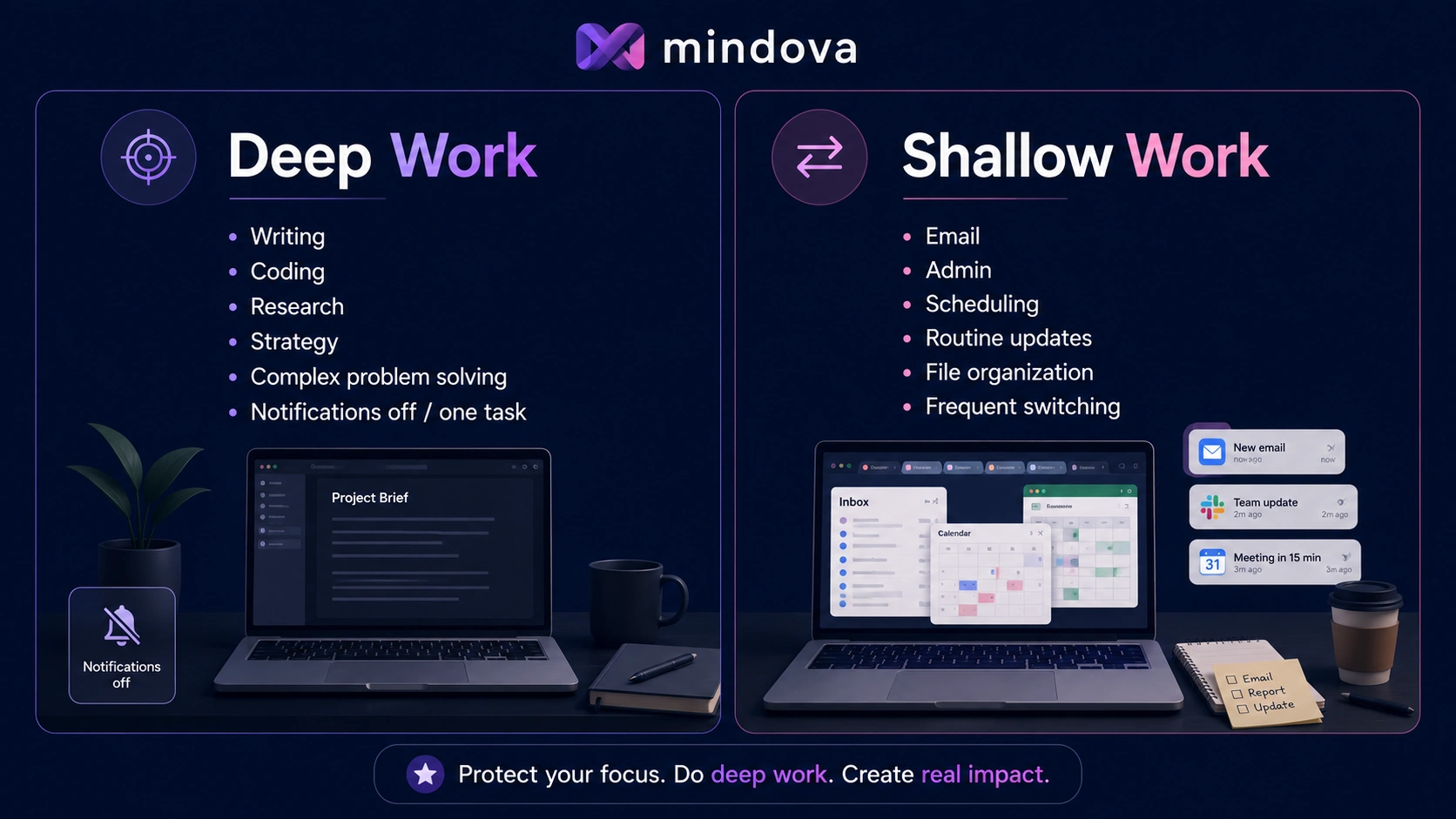
Newport contrasts deep work with shallow work.
Shallow work includes tasks that may be necessary but generally require less sustained concentration.
| Deep Work | Shallow Work |
|---|---|
| Writing an important argument | Routine email |
| Solving a complex coding problem | Scheduling a meeting |
| Learning difficult material | Updating a status |
| Strategic planning | Administrative forms |
| Analyzing research | Organizing files |
| Designing a system | Routine approvals |
Shallow work is not bad.
Most jobs require it.
The problem begins when shallow work repeatedly takes the time and attention you intended to give to more demanding work.
A morning can disappear into messages while the difficult project remains untouched.
Deep work is partly about making that trade-off visible.
Why Interruptions Matter
The obvious cost of an interruption is the time spent on the interruption itself.
But switching tasks can create another cost.
Research by Sophie Leroy found that when people switch away from an unfinished task, some attention can remain on the previous task, making it harder to fully engage with the next one. She called this attention residue.
Read the attention residue research
That does not mean every notification destroys twenty minutes of productivity.
There is no universal recovery number that applies to every person and every task.
But broader interruption research supports the basic idea that interruptions can affect task accuracy and how quickly people resume the original task. A systematic review of laboratory studies found that interventions designed to reduce interruption costs could improve primary-task accuracy and reduce resumption lag, although the effects varied according to the task and intervention.
For deep work, the practical lesson is simple:
Do not create unnecessary switches while doing work that depends on maintaining a complex train of thought.
Deep Work Is Not the Same as Flow
These ideas are related, but they are not interchangeable.
Deep work describes how you are working: with sustained, undistracted attention on something cognitively demanding.
Flow describes a psychological state: intense absorption where action can feel smooth and self-consciousness may fade.
You can experience flow during deep work.
But deep work does not need to feel effortless.
Learning something difficult, debugging a hard problem, or developing an unfamiliar skill may feel mentally strenuous rather than enjoyable.
Sometimes productive concentration feels good.
Sometimes it feels hard.
Both can still be deep work.
How to Practice Deep Work
Deep work becomes useful when it moves from an idea to a repeatable practice.
You do not need an elaborate ritual.
Start with the conditions that matter most.
1. Choose Work That Actually Deserves Depth
Do not schedule “deep work” before deciding what the block is for.
Instead of:
Work on project.
use:
Draft the first two sections of the proposal.
Instead of:
Study.
use:
Solve problems 20–30 without checking the solutions.
Instead of:
Coding.
use:
Diagnose why the authentication flow fails after token refresh.
A specific outcome gives your attention somewhere to go.
It also makes it easier to notice when you have quietly moved onto something else.
2. Put the Session Somewhere Real
Waiting for an uninterrupted afternoon to appear is unreliable.
Give the work an actual place in your day.
For example:
9:00–10:00 — Draft report
or:
2:00–3:30 — Architecture work
This is where deep work and time blocking can work well together.
Time blocking answers:
When will I work on this?
Deep work answers:
What kind of attention will I protect while I do it?
For the planning method itself, see the Mindova guide to time blocking.
3. Define the Rules Before You Begin
Decide what is allowed during the session.
For example:
Allowed:
- research directly needed for the task;
- documentation;
- notes;
- necessary work tools.
Not allowed:
- checking the inbox;
- unrelated messaging;
- news;
- social feeds;
- browsing unrelated to the task.
This prevents you from renegotiating the rules every time work becomes uncomfortable.
The goal is not to use no technology.
The goal is to remove technology that competes with the task.
4. Remove Predictable Distractions
You probably already know which distractions cause most of your problems.
Maybe it is:
- Reddit;
- YouTube;
- Instagram;
- X;
- news sites;
- email;
- another tab containing something easier than your current task.
Deal with predictable distractions before the session starts.
Close unrelated tabs.
Silence nonessential notifications.
Put your phone somewhere less convenient if you do not need it.
And if there are websites you repeatedly open automatically, block or limit them while you focus.
For a broader setup, see how to avoid digital distractions while working.
5. Create a Simple Starting Ritual
The ritual does not need to be elaborate.
It could simply be:
- Clear the desk.
- Close messages.
- Open the document you need.
- Write the outcome for the session.
- Start.
Doing roughly the same thing before each session can reduce the number of decisions between:
I should work on this
and:
I am working on it.
Do not turn the ritual itself into another productivity project.
Its job is to help you start.
6. Keep Other Tasks Somewhere Safe
A common interruption comes from your own mind:
I need to reply to that message.
I should check that price.
I forgot to send that file.
Let me look something up.
Not every thought needs immediate action.
Keep a small check later list.
Write the thought down.
Then return to the current task.
When the session ends, review the list.
Some items will still matter.
Others will already feel irrelevant.
This lets you preserve legitimate thoughts without turning each one into another context switch.
How Long Should a Deep Work Session Be?
There is no scientifically established universal deep-work duration.
You will often see recommendations such as:
- 45 minutes;
- 60 minutes;
- 90 minutes;
- two hours;
- several hours per day.
Those can be useful examples.
They are not laws.
The useful duration depends on:
- the task;
- your experience;
- your schedule;
- how much context the work requires;
- interruptions you cannot control;
- how long you can realistically maintain useful concentration.
A complicated programming problem may benefit from a longer block.
Starting a difficult article may still benefit from 30 focused minutes if that is the uninterrupted time you actually have.
The important question is not:
Did I reach the correct Deep Work number?
There is no universal number.
Ask:
Was I able to work seriously on the demanding task without repeatedly switching away from it?
Can Deep Work Be Short?
Yes.
This is where the old idea behind this page — “micro deep work” — needs clarification.
Micro deep work is not an established formal productivity method.
There is no scientifically validated 10-, 15-, 20-, or 25-minute “micro deep work” protocol.
But that does not mean a short focused session is useless.
If you have only 20 or 30 uninterrupted minutes and spend them on genuinely demanding, distraction-free work, that can still be valuable.
A shorter session can be particularly useful when the alternative is:
I don't have two free hours, so I'll postpone the important work entirely.
But there is a trade-off.
Some problems require time to understand, hold multiple pieces of information in mind, and build momentum.
For those tasks, repeatedly squeezing the work into tiny gaps may create more switching than necessary.
Use shorter sessions when they fit reality.
Do not turn them into a rule that all deep work should be short.
What About Breaks During Deep Work?
Taking a break does not automatically destroy a deep-work session.
The more useful distinction is what the break becomes.
Standing up, stretching, getting water, taking a short walk, or simply resting is different from:
I'll check Instagram for five minutes.
The first pauses the task.
The second introduces a different stream of information that can compete for your attention when you return.
So do not treat taking a break as failure.
The goal is to preserve the continuity of demanding work, not to maintain an arbitrary streak on a timer.
Deep Work vs Pomodoro
Deep Work and the Pomodoro Technique can both support focused work, but they solve different problems.
Pomodoro
Traditionally uses:
25 minutes work → short break → repeat
It can be useful when:
- starting feels difficult;
- you want a small commitment;
- the task can be divided into shorter intervals.
Deep Work
Does not prescribe one fixed timer.
The emphasis is:
- cognitively demanding work;
- sustained attention;
- fewer unnecessary switches;
- protecting enough uninterrupted time for the task.
A Pomodoro interval can contain deep work if the task is demanding and you are genuinely focused.
But deep work does not require stopping every 25 minutes.
If a fixed timer repeatedly interrupts useful concentration, a longer interval may fit better.
For the complete method, see the Mindova guide to the Pomodoro Technique.
Ways to Fit Deep Work Into a Real Schedule
You do not have to organize your entire life around deep work.
Different schedules need different approaches.
Regular blocks
You reserve roughly the same period repeatedly.
For example:
8:00–9:30 every weekday.
This can work when your schedule is relatively predictable.
Opportunistic blocks
You use meaningful gaps when they appear.
For example:
A meeting is cancelled, so you use the free hour for demanding project work rather than filling it with email.
Larger protected periods
Some people separate longer periods for demanding work from normal reactive work.
For example:
Several normal workdays plus one protected morning for an important project.
Highly protected schedules
A small number of people have jobs that allow them to minimize shallow or reactive work for long periods.
Most people do not.
You do not need an extreme schedule to benefit from protecting some concentrated work.
Deep Work for Students
Deep work applies to studying when the learning itself requires sustained mental effort.
Examples include:
- solving unfamiliar problems;
- writing an essay;
- reconstructing concepts from memory;
- understanding difficult theory;
- working through proofs;
- practicing a demanding skill.
Simply having a textbook open is not automatically deep work.
Neither is rereading notes while checking your phone every few minutes.
A better block might be:
4:00–4:45 — Solve five calculus problems without checking the worked solutions.
or:
7:00–8:00 — Recall the chapter from memory, then identify what I could not explain.
The timer organizes the space.
The learning activity determines the quality of the work.
Deep Work for Writing, Coding, and Creative Work
These tasks often benefit from depth because they involve maintaining context.
Writing
A deep block may be used to:
- build an argument;
- draft;
- restructure;
- synthesize research.
Keep research focused on what the draft actually requires instead of allowing it to become open-ended browsing.
Coding
Deep work can be useful when:
- debugging;
- designing architecture;
- understanding unfamiliar code;
- implementing complex behavior.
Routine edits may require much less depth.
Research
Define the question before opening more tabs.
Otherwise “research” can become an endless information-gathering loop.
Creative work
Depth can give ideas enough uninterrupted space to develop.
But creative work does not need to feel like flow every time.
Difficulty and uncertainty are normal parts of demanding work.
Common Deep Work Mistakes
Treating every task as deep
Email does not become deep work because you turned off notifications.
Reserve the label for work that genuinely requires sustained concentration.
Starting with no defined outcome
“Work on project” invites drift.
Know what you are trying to move forward.
Choosing an arbitrary session length
Do not force 90 minutes because a productivity article told you to.
Match the block to the work and the time you can genuinely protect.
Checking messages during the block
You are introducing another attention context into work that may depend on maintaining the current one.
Trying to eliminate all shallow work
Most people cannot.
Email, meetings, coordination, and administration still need to happen.
Contain them rather than pretending they can disappear.
Waiting for perfect conditions
A noisy week does not mean important work has to stop.
A shorter protected session can still be useful.
Confusing deep work with flow
Deep work can feel difficult.
You do not need to enter a special psychological state before the work counts.
Using the productivity system to avoid the work
You can spend an hour:
- designing a ritual;
- choosing a timer;
- reorganizing the calendar;
- configuring apps;
and never begin the difficult task.
The setup should eventually disappear into the background.
Does Deep Work Actually Make You More Productive?
Deep Work is a productivity framework, not a standardized scientific intervention with one universally tested protocol.
That distinction matters.
Research supports important principles behind it, particularly that interruptions and task switching can create performance costs.
That does not prove that:
- everyone needs 90-minute sessions;
- four hours is a universal daily maximum;
- one ritual is best;
- every deep-work session creates flow;
- deep work automatically doubles productivity.
A more defensible conclusion is:
For tasks that depend on sustained concentration, reducing unnecessary interruption and switching creates better conditions for doing that work.
That is enough reason to experiment with deep work without turning it into neuroscience mythology.
How Mindova Can Support Deep Work
Mindova does not create deep work for you.
It cannot decide which project deserves your attention or make a vague task cognitively demanding.
Its role is narrower:
reduce avoidable website distraction while you are trying to work deeply.
Mindova currently supports:
- website blocking;
- Individual Site Limits;
- an overall daily distraction limit;
- timed Focus Sessions;
- browsing and focus insights;
- optional AI Nudges.
It works in supported desktop Chromium browsers including Chrome, Edge, Brave, Opera, and Vivaldi.
Mindova does not currently provide recurring schedules, Locked Mode, native iPhone or Android app blocking, or cross-device blocking enforcement.
A practical setup might be:
- Decide exactly what you will work on.
- Close unrelated tabs.
- Identify the websites that repeatedly pull you away.
- Start a timed Focus Session.
- Work on the task.
- Review what interrupted you afterward.
If a website is sometimes useful but repeatedly consumes more time than you want, an Individual Site Limit may fit better than blocking it permanently.
For the full blocking workflow, see how to block distracting websites and stay focused.
Frequently Asked Questions
What is deep work?
Deep work is focused, distraction-free effort on a cognitively demanding task. Cal Newport popularized the term through his 2016 book Deep Work.
What is the difference between deep work and shallow work?
Deep work requires sustained concentration and usually involves difficult thinking, learning, problem-solving, or creation.
Shallow work consists more of logistical, routine, or administrative tasks that can often be completed with less concentration.
How long should a deep work session last?
There is no universal duration.
Choose a block long enough to make meaningful progress and realistic enough that you can genuinely protect it.
Is 30 minutes enough for deep work?
It can be.
A short distraction-free session on a demanding task can still be valuable, particularly when longer blocks are not available.
Some tasks, however, benefit from more sustained context and may work better in longer sessions.
Is “micro deep work” a real method?
Not as a well-established formal productivity method.
The phrase can describe doing demanding focused work in shorter sessions, but it should not be presented as a scientifically validated technique with a required duration.
Is deep work the same as flow?
No.
Deep work describes a way of working: distraction-free concentration on a demanding task.
Flow describes a psychological state of intense absorption.
Deep work can happen without flow.
Is Deep Work scientifically proven?
Research supports several principles relevant to Deep Work, particularly the costs associated with interruptions and task switching.
But Deep Work itself is a broader productivity framework, and not every recommendation associated with it has been tested as one standardized scientific protocol.
How many hours of deep work should I do per day?
There is no universal requirement.
The amount depends on your work, schedule, experience, and the cognitive demands of what you are doing.
Quality and relevance matter more than maximizing a daily hour count.
Can I use Pomodoro for deep work?
Yes, if shorter intervals fit the task.
But you do not need to stop every 25 minutes simply because you are working deeply.
Use a session structure that supports the work.
Is deep work useful for studying?
Yes, particularly for demanding learning activities that require sustained concentration, such as problem-solving, writing, retrieval, or understanding complex material.
Can Mindova help with deep work?
Mindova can help reduce distracting website access during focused periods through website blocking, per-site limits, and timed Focus Sessions.
It supports the browser environment around deep work; it does not create concentration or choose the task for you.
Deep Work Does Not Have to Look Impressive
Deep work is easy to turn into another productivity performance.
The perfect desk.
The perfect playlist.
A 90-minute timer.
A carefully color-coded calendar.
None of those things are the point.
The point is much simpler:
Choose work that needs your full attention, then create enough uninterrupted space to actually give it that attention.
Sometimes that space will be two hours.
Sometimes it will be forty minutes.
Sometimes a difficult day gives you twenty.
Use the time you can protect.
Remove the switches you can control.
Know what you are trying to accomplish.
And when the block begins, do the work instead of continuing to optimize the system around it.
Mouhsine
Admin
Passionate about helping people achieve peak mental performance through evidence-based strategies and mindful technology use.
Related Articles

How to Focus on Writing Without Digital Distractions
Learn how to stay focused while writing by separating drafting from research, reducing digital distractions, and keeping the online tools you actually need
Creative Block: How to Get Unstuck and Start Creating Again
Feeling creatively stuck? Learn what creative block can look like, how to identify what is stopping you, and practical ways to generate ideas and move forward
How to Avoid Distractions While Working: 10 Practical Strategies
Learn how to avoid distractions while working by reducing digital triggers, managing notifications, limiting distracting websites, and protecting focused work time.
Comments
Be the first to comment.
Ready to protect your focus?
Block distracting sites, set daily limits, and run focus sessions. Mindova is free.