Flow State: What It Is and How to Get Into Flow
Written by Mouhsine
Admin
Published September 3, 2026
You may know the feeling.
You start writing, coding, studying, designing, playing music, or solving a difficult problem. At some point, you stop thinking about the fact that you are concentrating. Your attention stays with the activity. The next action seems to follow naturally from the last one, and time may feel different from usual.
Psychologists call this experience flow.
A flow state is a period of deep absorption in an activity. The concept is closely associated with psychologist Mihály Csíkszentmihályi, whose work on flow began in the 1970s.
The important part is what flow is not.
It is not a productivity switch you can activate whenever you want.
You cannot guarantee flow by setting a 90-minute timer, playing the right playlist, or following a five-step morning routine.
What you can do is create conditions that may make deep absorption more likely: choose one clear task, make progress visible, work at a level of challenge that engages your skills, reduce avoidable distractions, and give the activity enough uninterrupted attention to develop.
What Is a Flow State?
Flow is a psychological state of intense involvement in an activity.
When people describe being in flow, several experiences commonly appear:
- concentration becomes strongly centered on the activity;
- action can feel less self-conscious and more natural;
- the person may feel a sense of control;
- awareness of unrelated concerns can fade;
- the perception of time may change;
- the activity can feel rewarding in itself.
Not every flow experience needs to include every characteristic in exactly the same way.
That matters because popular productivity advice often reduces flow to:
I concentrated for a long time.
Concentration is important, but flow is a richer subjective experience than simply keeping your eyes on a task. Researchers have also debated exactly how its different characteristics should be defined and measured. (Frontiers)
What Does Flow Actually Feel Like?
Flow is sometimes described as being “in the zone.”
Imagine you are writing.
Normally, you may notice every difficult sentence. You consider opening another tab. You wonder whether the draft is good. You check the time.
During flow, much of that self-monitoring can recede.
You remain highly engaged with the writing itself.
Or imagine programming.
Instead of bouncing between the code, messages, news, and unrelated tabs, the problem occupies most of your attention. Each test gives you information about what to try next.
In sport, music, games, art, and other skilled activities, flow can feel more physical: action and attention seem closely connected.
But flow does not always involve dramatic time distortion or effortless brilliance.
A quieter experience of absorption can still be meaningful.
What Makes Flow More Likely?
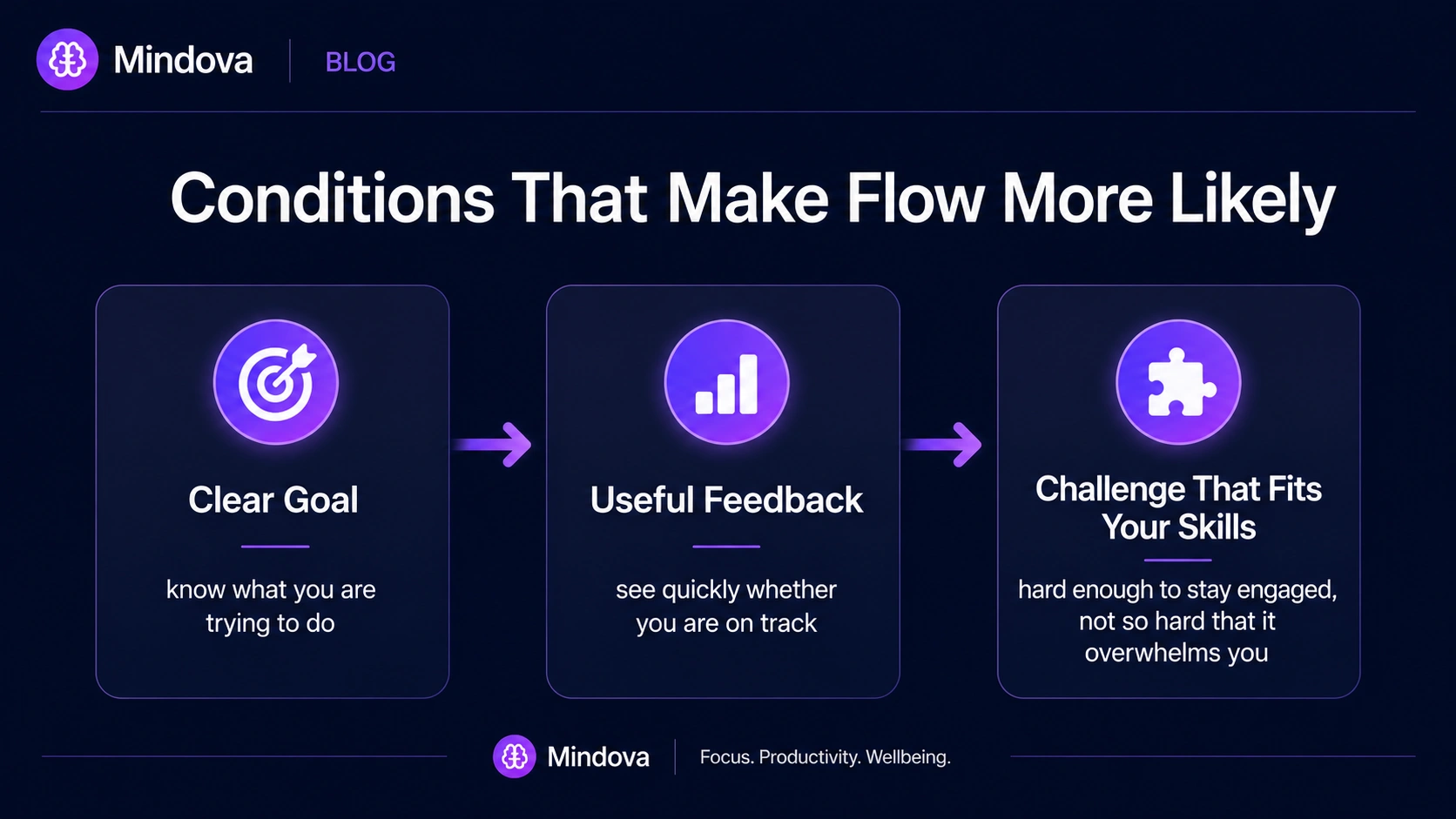
Classic flow theory emphasizes several conditions, especially clear goals, useful feedback, and an appropriate relationship between the challenge of an activity and the skills available to meet it.
These should be treated as conditions associated with flow, not buttons that guarantee it.
A meta-analysis of 28 studies found a moderate relationship between challenge-skill balance and flow, while also showing that the relationship varies by context. Clear goals and sense of control were important too.
1. A Clear Goal
“Work on my project” is vague.
Your attention still has to decide what to do.
Compare that with:
Draft the opening section of the proposal.
Or:
Solve problems 15 through 25 without checking the answers first.
Or:
Find why the authentication request fails after token refresh.
Now the activity has direction.
A clear goal reduces ambiguity about what the next useful action is.
That does not guarantee flow.
It simply gives focused attention a better target.
2. Feedback You Can Use
Flow-friendly activities often tell you something about how you are doing.
A programmer runs the code.
A musician hears the note.
A designer sees the layout change.
A chess player sees the consequences of a move.
A student solving practice questions learns whether an answer works.
The feedback does not need to arrive as a score.
It only needs to give you enough information to adjust what you do next.
Knowledge work sometimes makes this difficult because feedback is delayed.
You can make progress more visible by breaking a vague project into smaller outcomes.
Instead of:
Write report.
try:
Create the argument, draft section one, then check whether the evidence supports it.
You now have intermediate points where the work itself tells you whether you are progressing.
3. A Challenge That Fits Your Skills
This is probably the most famous part of flow theory.
If an activity is far below your ability, it may become boring.
If it feels far beyond your current ability, it may become frustrating or overwhelming.
Flow is often associated with demanding activities where your skills are sufficient to engage with the challenge.
But be careful with the internet version of this idea.
There is no universal percentage by which a task must exceed your ability.
You may see claims that a challenge should be exactly 4% harder than your skill level.
Do not treat that as a scientific formula.
Research suggests a meaningful relationship between challenge and skill, but the relationship is more contextual and complicated than a single number.
A better practical question is:
Is this task demanding enough to require my attention while still giving me a believable next step?
If it is painfully easy, increase the challenge.
If it feels impossible, reduce the scope.
How to Get Into a Flow State
You cannot command yourself to enter flow.
So a better goal is:
Prepare for focused engagement and let flow be a possible result.
Here is a practical way to do that.
Choose One Real Task
Flow becomes harder when your session contains five competing objectives.
Do not begin with:
I need to work.
Decide what you are actually doing.
For example:
Draft 500 useful words explaining the recommendation.
Or:
Debug the checkout failure.
Or:
Complete ten difficult practice problems.
You can do other work later.
For this period, give one activity priority.
Make the First Action Obvious
The beginning of difficult work often contains unnecessary friction.
You sit down, then decide:
What document?
What chapter?
What problem?
What tab?
What should I do first?
Resolve that before the session.
Open what you need.
Write the next action.
Then begin with it.
Do not spend twenty minutes designing a ritual to avoid five minutes of uncertainty.
Remove Predictable Distractions
You do not need a perfectly silent world.
You do need to control distractions you can predict.
If you know that you automatically open Reddit whenever a paragraph becomes difficult, deal with Reddit before you begin.
If YouTube repeatedly turns a research question into thirty minutes of unrelated browsing, create the boundary before the session.
Close unrelated tabs.
Mute unnecessary notifications.
Move the phone if you do not need it.
Block or limit websites you habitually check.
Reducing these exits does not create flow by itself.
It simply gives the task more opportunity to keep your attention.
For the practical browser setup, see how to block distracting websites.
Give the Work Enough Room
Flow is difficult to schedule because you cannot know exactly when — or whether — it will happen.
What you can schedule is an opportunity for sustained engagement.
Instead of asking:
How long does it take to enter flow?
ask:
How much uninterrupted time does this particular task deserve?
There is no scientifically established universal flow entry time.
You do not reliably enter flow after 10 minutes.
Or 15.
Or 23.
Or 90.
Different activities and people require different amounts of time, and sometimes flow does not happen at all.
That is normal.
A session can still produce excellent work without becoming flow.
Stay With the Task Through the Awkward Beginning
One reason people chase flow is because they want demanding work to feel effortless.
But the beginning may not feel effortless.
You might feel restless.
The sentence might be difficult.
The problem might resist you.
The first attempt might be wrong.
Do not interpret ordinary difficulty as proof that the session failed.
Give the task a reasonable opportunity to capture your attention before switching to something easier.
You Cannot Force Flow — and That Is Useful to Know
This distinction makes your productivity system much healthier.
If your goal is:
I must enter flow today.
you can finish a valuable work session feeling as if you failed because you never experienced the special state you expected.
Instead, judge what you can control.
Did you choose meaningful work?
Did you give it sustained attention?
Did you remove unnecessary switching?
Did you move the work forward?
If yes, the session can be successful whether or not you experienced flow.
Flow is an experience.
Focused work is a behavior you can practice.
Flow State vs Deep Work
Flow and deep work overlap, but they are not the same thing.
Deep work describes a way of working: sustained, distraction-free concentration on a cognitively demanding task.
Flow describes a psychological experience of deep absorption.
That creates several possibilities.
You can do deep work without experiencing flow.
A complicated piece of research may demand intense concentration while still feeling slow and difficult.
You can also experience flow outside conventional knowledge work.
A musician, athlete, artist, chess player, gamer, or craftsperson may experience flow during an activity that has nothing to do with office productivity.
And sometimes deep work can develop into flow.
The concepts intersect.
They should not be used as synonyms.
For the broader work method, see the Mindova Deep Work guide.
Flow vs Ordinary Focus
You also do not need to call every focused moment “flow.”
You can concentrate while:
- reading an email;
- filling out a form;
- reviewing a spreadsheet;
- organizing files;
- following instructions.
That can be useful focus.
Flow normally implies a stronger degree of absorption in an activity.
This distinction matters because otherwise “flow state” becomes another internet synonym for:
I wasn't distracted.
Not being distracted is useful.
It just does not automatically mean you were in flow.
Flow State at Work
Some jobs naturally provide more flow-friendly activities than others.
Programming can offer clear problems and rapid feedback.
Writing can provide visible progress.
Design produces a changing artifact.
Analysis provides questions that can be investigated and resolved.
But a normal workday also contains activities that are less suited to flow:
email, coordination, short meetings, approvals, scheduling, and routine administration.
Do not try to force every task into a flow session.
Instead, identify the work where sustained absorption could actually help.
Then protect that work from the reactive parts of your day.
For example, instead of alternating continuously between Slack, email, research, and writing, you might reserve one block for the demanding work and handle coordination separately.
If scheduling those blocks is the main problem, the Mindova time-blocking guide explains that planning method separately.
Flow State for Studying
Students often search for a “flow state” because they want studying to stop feeling difficult.
That is understandable, but flow is not a substitute for effective learning.
Start with the learning task.
“Study biology” is vague.
A more flow-friendly activity could be:
Explain cellular respiration from memory, then identify what I cannot explain.
Or:
Complete 15 practice questions and correct every mistake.
Or:
Work through this proof without looking at the worked solution.
These tasks provide:
a clear objective, challenge, and feedback.
Passive rereading may sometimes become absorbing, but absorption alone does not tell you whether you are learning effectively.
So do not optimize studying solely around the feeling of flow.
Optimize for learning first.
Flow is a possible bonus.
Does Flow Improve Performance?
This is another area where popular claims get ahead of the evidence.
A systematic review and meta-analysis examining sport and computer-gaming studies found a moderate association between flow and performance.
But the researchers could not establish the causal direction.
Flow might contribute to good performance.
Good performance might make flow more likely.
The relationship might work both ways.
Other factors may contribute to both.
So:
Flow is associated with performance in some research.
is defensible.
Enter flow and you will perform at your peak.
is not.
The available evidence does not justify treating flow as a guaranteed performance enhancement technique.
Common Flow State Myths
“You can trigger flow on command.”
You can influence the conditions.
You cannot guarantee the state.
“It takes exactly 10 or 15 minutes to enter flow.”
There is no universal scientifically established entry timer.
“Flow requires a 90-minute session.”
No universal duration has been established.
Different tasks need different amounts of uninterrupted time.
“The task should be exactly 4% harder than your skill level.”
Treat the precise 4% rule skeptically.
The broader challenge-skill idea has research support; the neat universal percentage does not follow from that evidence.
“Flow means peak performance.”
Flow and performance are associated in some research, but causation is unresolved.
“If the work feels difficult, you are not in flow.”
Flow can involve a sense of fluid absorption, but demanding activities can still contain difficult moments.
More importantly, useful work does not need to become flow.
“Deep work and flow state are the same thing.”
Deep work is a work practice.
Flow is a psychological experience.
One may occur during the other, but they are distinct concepts.
How Mindova Can Support Better Conditions for Flow

Mindova cannot put you into flow.
It does not detect a psychological flow state, and it cannot guarantee that concentration will become effortless.
Its role is narrower:
help reduce avoidable browser distractions while you are trying to stay with one task.
On supported desktop Chromium browsers, Mindova currently provides website blocking, Individual Site Limits, an overall distraction limit, timed Focus Sessions, browsing and focus insights, and optional AI Nudges.
For example, before a writing session you might identify the websites you habitually open when the draft becomes difficult and block them during a timed Focus Session.
If a website is useful but tends to consume too much time, an Individual Site Limit may make more sense than blocking it completely.
The goal is not to force flow.
It is to remove some of the predictable exits that repeatedly pull you away from the activity.
Mindova does not currently provide recurring focus schedules, a Locked or Strict Mode, native iPhone or Android app blocking, or cross-device blocking enforcement.
Frequently Asked Questions
What is a flow state?
A flow state is an experience of deep involvement and absorption in an activity. Attention becomes strongly centered on what you are doing, and experiences such as reduced self-consciousness, sense of control, or altered perception of time may occur.
Who discovered flow state?
Psychologist Mihály Csíkszentmihályi introduced the concept into psychological research in the 1970s and later developed it through decades of work on optimal experience.
How do you get into a flow state?
You cannot guarantee flow, but you can create more favorable conditions by choosing a clear task, making feedback available, matching the challenge reasonably well to your skills, reducing avoidable distractions, and giving the activity sustained attention.
How long does it take to enter flow?
There is no universal evidence-based entry time.
Claims that everyone enters flow after a specific number of minutes should be treated cautiously.
Can you force yourself into flow?
Not reliably.
You have more control over the environment and the way you structure the task than over whether a particular psychological experience appears.
Does flow increase productivity?
Flow has been associated with performance in some research, but evidence does not establish that entering flow directly causes better performance in every context.
What is the difference between flow and deep work?
Deep work is sustained, distraction-free work on a cognitively demanding task.
Flow is a psychological state of intense absorption.
You can perform deep work without entering flow.
Can students experience flow?
Yes, flow has been studied across many kinds of activities, including learning. Clear, challenging activities with useful feedback can provide better conditions for absorption than vague goals such as “study for two hours.”
Do I need music to enter flow?
No.
Some people prefer music for particular activities while others focus better without it. Music is not a required condition of flow.
Can Pomodoro help me enter flow?
It can help structure a period of focused work, but Pomodoro does not guarantee flow.
A fixed break may also arrive while you are deeply engaged, so the useful session structure depends on the task.
Does Mindova create a flow state?
No.
Mindova can help reduce avoidable website distraction and provide timed Focus Sessions, but flow itself depends on the person, task, skills, context, and other factors.
Add Mindova to Chrome — Free
Mouhsine
Admin
Passionate about helping people achieve peak mental performance through evidence-based strategies and mindful technology use.
Related Articles

How to Focus on Writing Without Digital Distractions
Learn how to stay focused while writing by separating drafting from research, reducing digital distractions, and keeping the online tools you actually need
Creative Block: How to Get Unstuck and Start Creating Again
Feeling creatively stuck? Learn what creative block can look like, how to identify what is stopping you, and practical ways to generate ideas and move forward
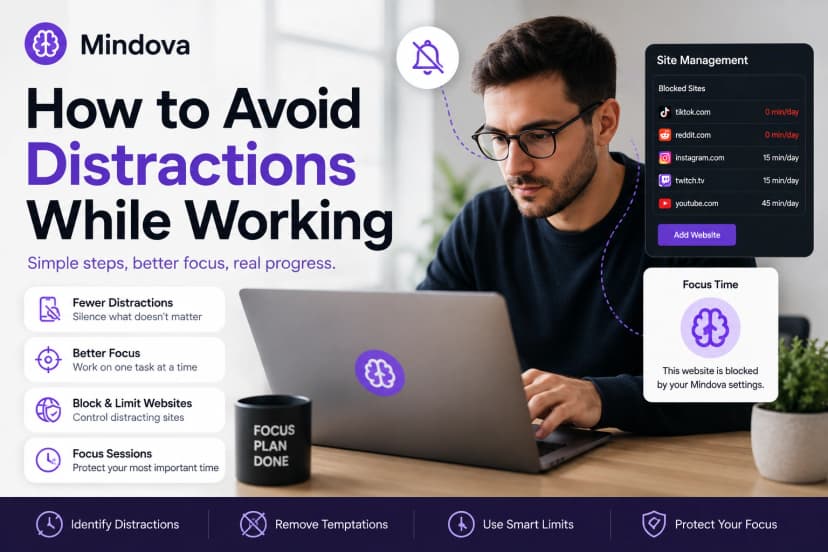
How to Avoid Distractions While Working: 10 Practical Strategies
Learn how to avoid distractions while working by reducing digital triggers, managing notifications, limiting distracting websites, and protecting focused work time.
Comments
Be the first to comment.
Ready to protect your focus?
Block distracting sites, set daily limits, and run focus sessions. Mindova is free.