How to Focus on Reading: 8 Practical Ways to Stop Drifting
Written by Mouhsine
Admin
Published September 28, 2026
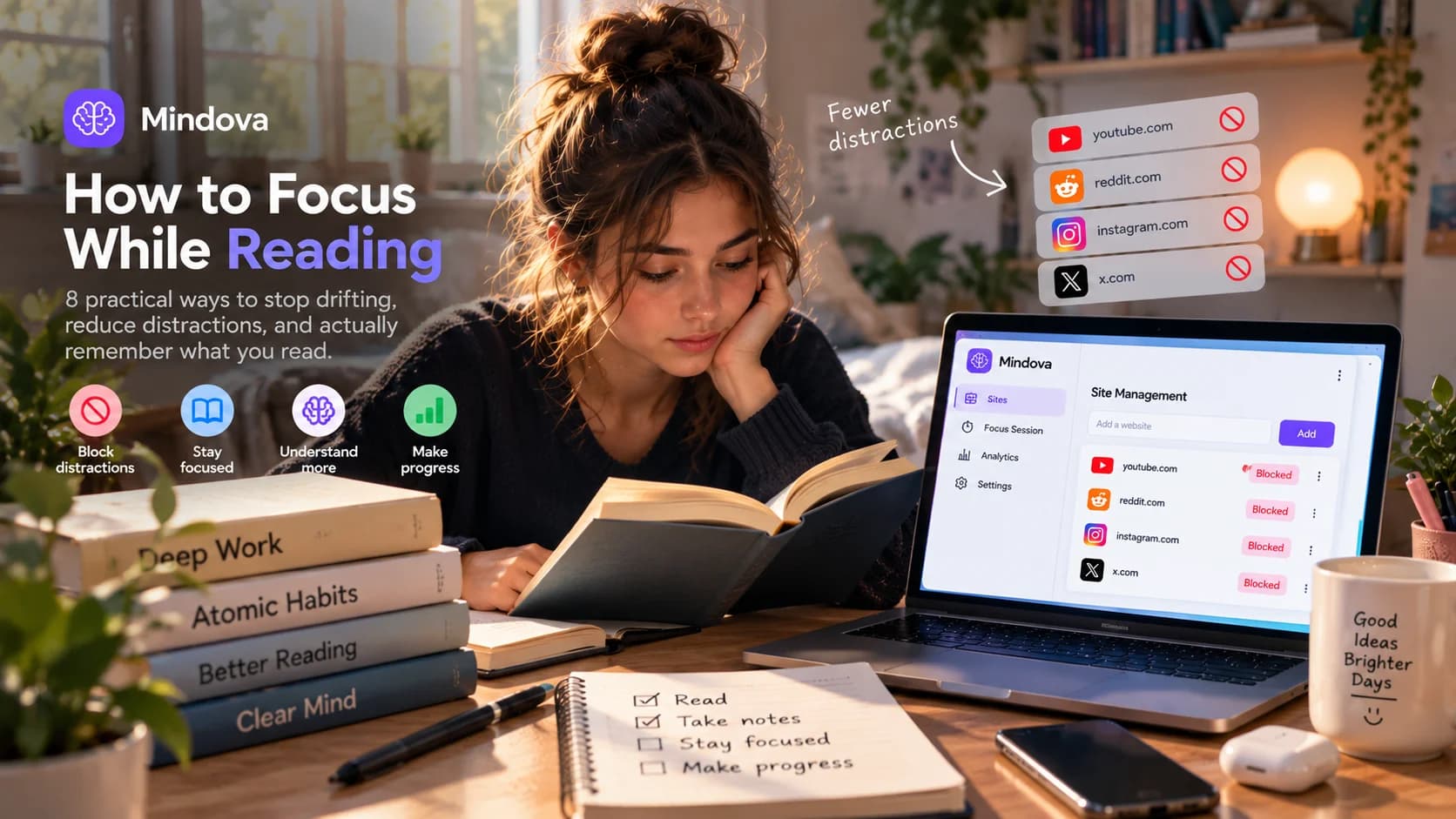
You reach the bottom of a page and realize you have no idea what you just read.
Your eyes moved across every sentence.
You may even have turned the page.
But somewhere along the way, your attention left the text.
Sometimes the problem is obvious. A notification appeared, you opened another tab, or you checked your phone.
Other times, nothing interrupted you. Your body stayed with the book while your thoughts moved somewhere else.
And sometimes the problem is not attention at all. The text is difficult, you do not understand a key idea, you are tired, or you simply have no interest in what you are reading.
That is why “focus harder” is not very useful advice.
A better approach is to identify why you lost the thread and use the smallest fix that addresses that problem.
Quick answer: To focus while reading, decide what you are reading for, remove the interruptions you repeatedly follow, begin with a manageable reading block, and use a simple recovery move whenever your mind wanders: stop, find the last idea you clearly remember, return there, and continue. If the text itself is difficult, slow down and solve the comprehension problem instead of repeatedly forcing yourself through the same paragraph.
Why Can You Read a Page Without Absorbing It?
Reading requires more than moving your eyes across words.
Your attention has to remain connected to the meaning of the text.
Research on mind wandering and reading has consistently found that when attention moves away from the text toward unrelated thoughts, reading comprehension tends to be lower.
But not every loss of focus has the same cause.
Before trying another concentration trick, identify what is actually happening.
| What happens while you read | What may be going wrong | First thing to try |
|---|---|---|
| You stop reading to check another site or device | External distraction | Remove or restrict the distraction |
| Your eyes continue reading while your thoughts go elsewhere | Mind wandering | Return to the last idea you remember |
| You keep rereading because the passage does not make sense | Comprehension difficulty | Slow down and clarify the difficult part |
| You cannot make yourself begin | The commitment feels too large | Start with a smaller reading block |
| You can focus on other books but not this one | Interest or text fit | Change the book if the reading is optional |
| You lose focus on almost everything you try to read | The problem may be broader than the book | Look beyond ordinary reading hacks |
The important distinction is this:
You can block a distracting website. You cannot block a thought.
Different problems need different solutions.
1. Decide What You Are Reading For
Before you begin, ask:
What am I trying to get from this reading?
The answer changes how you should read.
If you are reading a novel
Your goal may simply be to follow the story and enjoy it.
You probably do not need to stop every two pages and take notes.
If you are reading nonfiction
You may want to understand the author's main argument or learn how something works.
If you are reading for work
You may be looking for:
- a decision;
- a requirement;
- a fact;
- an explanation;
- or something you need to act on.
If you are reading to learn
Your goal may be to understand and remember the material well enough to explain it later.
A vague goal such as:
Read this chapter.
gives your attention very little direction.
A clearer goal might be:
Understand why the author thinks this happened.
or:
Find the three changes I need to make after reading this report.
or:
Read pages 20–35 and be able to explain the main idea afterward.
You do not need a complicated reading system.
You just need to know what you are looking for.
2. Remove the Interruptions You Actually Follow
Do not spend an hour trying to build a perfectly distraction-free environment.
Start with the interruptions that repeatedly make you stop reading.
That might be:
- notifications;
- WhatsApp;
- Discord;
- email;
- Reddit;
- YouTube;
- Instagram;
- X;
- news sites;
- another browser tab;
- or your phone.
Notifications are especially easy to underestimate because you do not need to respond for them to interrupt what you are doing.
A 2026 experiment found that social-media-style notifications temporarily slowed processing during an ongoing cognitive task. That does not mean every notification ruins a reading session, but it is a good reason to silence alerts you do not need while trying to follow a text.
A simple reading setup can be:
- Silence unnecessary notifications.
- Close unrelated browser tabs.
- Put your phone out of reach if you repeatedly pick it up.
- Keep only the reading material and anything you genuinely need beside you.
The goal is not to create perfect silence.
The goal is to remove the easiest exits from the reading session.
3. Make the Reading Commitment Smaller
Sometimes the hardest part of reading is not staying focused.
It is starting.
“I need to read for two hours” can make the task feel larger than it needs to be.
Instead, make the first commitment deliberately small.
Try:
10 minutes
or:
5 pages
or:
one section
or:
until the next chapter heading
There is nothing scientifically special about those numbers.
They are simply easier to begin.
Once you are engaged, you can continue.
If you are not, you have still completed a defined reading block rather than spending twenty minutes avoiding the book.
This is especially useful when you have built up resistance to reading because every session feels like it needs to become a long one.
Do not ask:
Can I focus for the next two hours?
Ask:
Can I read these five pages without doing something else?
That is a much easier question to answer.
4. Use a Recovery Move When Your Mind Wanders
Your goal should not be to prevent every wandering thought.
That is unrealistic.
A better skill is learning how to recover quickly when you notice that your attention has left the text.
Imagine you reach page 27 and suddenly realize:
I remember what happened on page 24, but almost nothing after that.
Do not automatically restart the entire chapter.
Try this instead:
Step 1: Stop
Do not keep moving your eyes forward once you know you have lost the thread.
Step 2: Ask what you last remember
What is the last sentence, argument, event, or idea you clearly understood?
Step 3: Return there
Go back to that point.
It may only be a sentence, a paragraph, or a line or two.
Step 4: Read forward again
This time, slow down slightly until the meaning reconnects.
Research examining what readers do after mind-wandering episodes found that participants reread nearly half the time, typically retracing only a small amount of text.
That matches a useful practical principle:
Return to the last point you understood, not automatically to the beginning.
The faster you notice the drift, the less reading you need to recover.
5. Treat Difficult Text as a Comprehension Problem
Sometimes you are not distracted.
The text is simply difficult.
You read a sentence.
It does not make sense.
So you read it again.
Still nothing.
Then again.
Eventually your eyes are moving through the paragraph, but you are thinking about something completely unrelated.
At that point, telling yourself to “focus harder” may not help.
Research has found that more difficult texts can be associated with more mind wandering and poorer comprehension.
When a difficult passage breaks your attention, diagnose the problem.
Ask:
Is there a word I do not understand?
Did I miss an earlier idea this sentence depends on?
Is the sentence unusually dense?
Do I understand the individual words but not the argument?
Then fix that specific problem.
You might:
- look up one necessary term;
- break a long sentence into smaller parts;
- reread the previous paragraph;
- write the idea in simpler language;
- or continue more slowly.
For example, instead of rereading a paragraph four times, stop and write:
I think the author is saying ______.
If you cannot complete that sentence, you have found the real problem.
That is not necessarily a concentration failure.
It may be a comprehension problem.
6. Read Actively When You Need to Remember
Not every kind of reading needs to be active.
If you are enjoying a novel, constantly stopping to test yourself can destroy the experience.
But if you are reading because you need to understand or remember something, passive rereading can become deceptive.
The words start looking familiar.
That familiarity can feel like understanding even when you would struggle to explain the idea without looking.
Try occasionally stopping and asking:
What did that section actually say?
Then explain it in your own words.
For example:
Original text: a three-page explanation of why a system failed.
Your recap:
The failure happened because A created B, and nobody noticed C until it was too late.
That forces you to reconnect the individual sentences into one idea.
Research on self-explanation has found positive learning effects across a range of educational conditions.
You do not need to summarize every paragraph.
Use this technique at natural stopping points:
- after a section;
- after a difficult explanation;
- after several pages;
- or whenever you realize you are reading mechanically.
For study-specific strategies such as retrieval practice and structured revision, see our guide on how to focus while studying.
7. Choose a Reading Format That Removes Extra Friction
Should you read on paper instead of a screen?
The answer is more complicated than:
Paper is always better.
Recent research comparing reading formats suggests that paper can have comprehension advantages in some situations, particularly when digital reading involves significant scrolling.
But that does not mean everyone needs to print every article.
The more useful question is:
Which format makes it easiest for you to stay with the text?
A browser may work well when:
- you need links;
- you need search;
- you are reading documentation;
- you are researching;
- or the text is designed for web reading.
An e-reader may work better when:
- your normal browser keeps tempting you into other tabs;
- you want fewer interface distractions;
- or you are reading a long book.
Paper may work better when:
- you repeatedly leave digital reading to do something else;
- you need to annotate heavily;
- scrolling makes it difficult to remember where ideas appeared;
- or you simply comprehend long material better that way.
You do not need to turn this into an ideological debate about screens.
Try the format that removes the most unnecessary choices.
If you understand and enjoy a book perfectly well on an e-reader, there is no reason to move to paper just because someone online told you that “real reading” must happen on a physical page.
8. Know When Interest—or Your Energy—is the Problem
Suppose you can read a thriller for an hour without checking your phone.
But ten minutes into another book, your mind is everywhere except the page.
That tells you something.
Interest can affect how often attention wanders during reading.
A 2025 study with university students found that higher topic interest predicted less mind wandering, which was in turn associated with better comprehension.
For optional reading, there is a simple lesson:
You are allowed to stop reading a book you do not enjoy.
You do not earn extra points for forcing yourself through 400 pages of something you dislike because somebody said it was important.
Try another book.
But there is an important exception.
You cannot always choose what you read.
A textbook, contract, work document, research paper, or required book may still need to be finished.
In that situation, do not depend on interest.
Use structure:
- define why you are reading it;
- divide it into manageable sections;
- clarify difficult passages;
- summarize important ideas;
- and remove unnecessary distractions.
Also check your energy
If you are repeatedly rereading the same sentence late at night, the problem may not be your reading technique.
You may simply be tired.
A better decision may be:
I will stop here and continue tomorrow.
rather than turning the session into a fight against exhaustion.
If Your Browser Is the Distraction: A Mindova Reading Setup
Mindova cannot stop your mind from wandering.
It also cannot make a difficult book interesting.
But if the thing interrupting your reading is repeatedly opening distracting websites, you can change the browser environment.
The current public Mindova browser extension works on supported desktop Chromium browsers including Chrome, Edge, Brave, Opera, and Vivaldi.
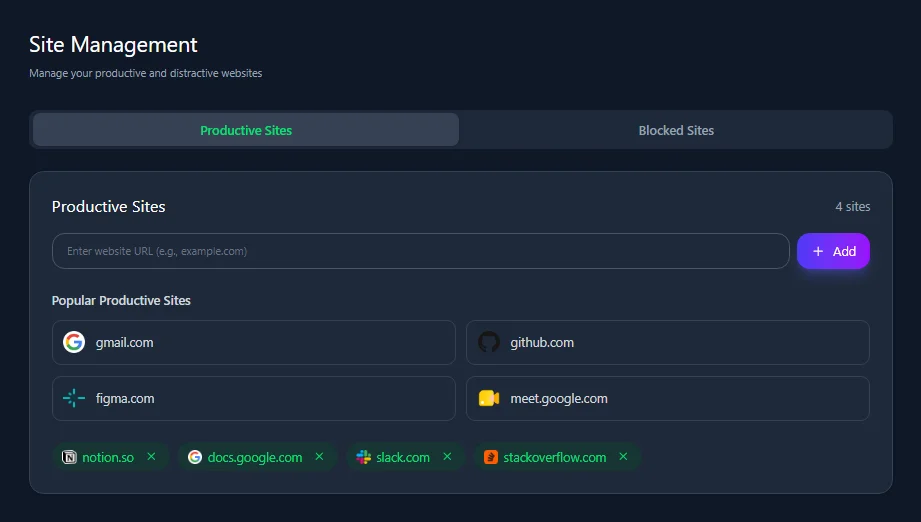
Keep websites you genuinely need available
If you are reading online or researching while you read, you may need websites such as:
- Google Scholar;
- documentation;
- online libraries;
- research databases;
- reference websites.
During a Mindova Focus Session, mark the websites you need as Productive so they remain available during the focused work period.
Limit useful websites that easily become distractions
Maybe you occasionally need:
- YouTube;
- Reddit;
- a forum;
- or another research source.
You do not necessarily need to block them for the entire day.
You can give a website an Individual Site Limit instead.
For example:
Reddit → 15 minutes/day
The exact number is up to you.
The purpose is to keep a useful resource available without giving it unlimited time.
If Reddit is a frequent distraction, see how to block or limit Reddit.
Block websites you do not need while reading
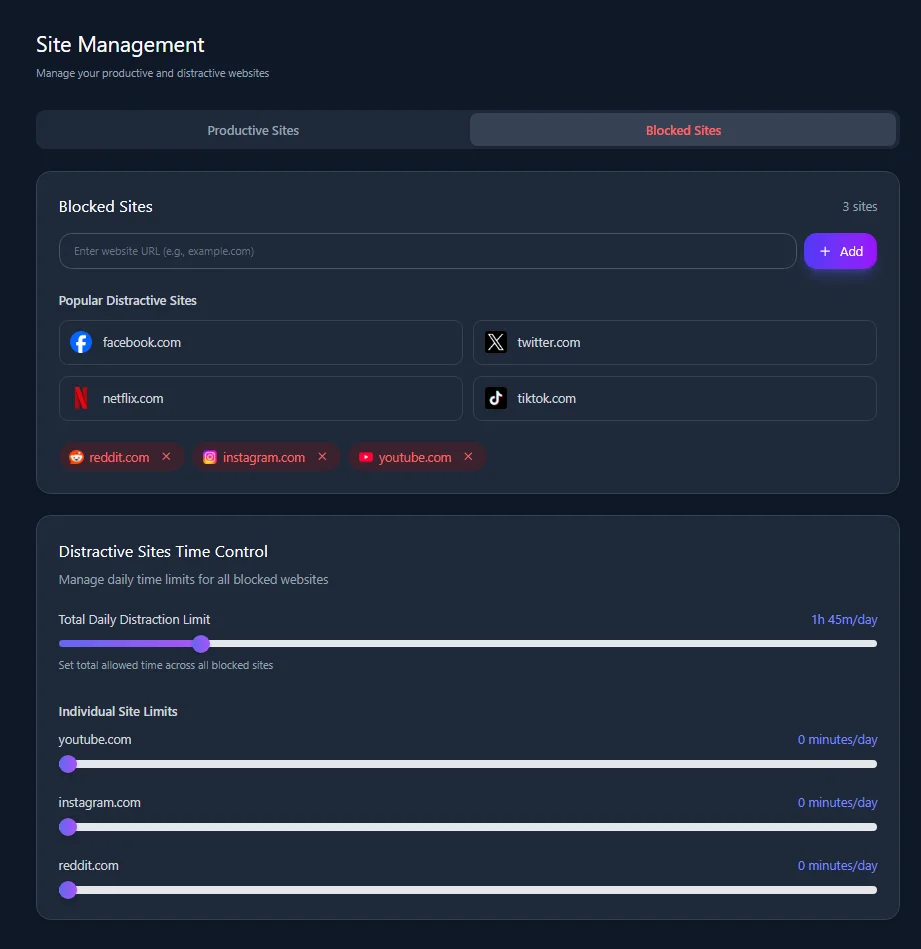
If you know you do not need a particular website during your reading period, set its Individual Site Limit to:
0 minutes/day
In Mindova, a zero-minute limit means the website is blocked when you try to visit it.
Use a Focus Session for a dedicated reading period
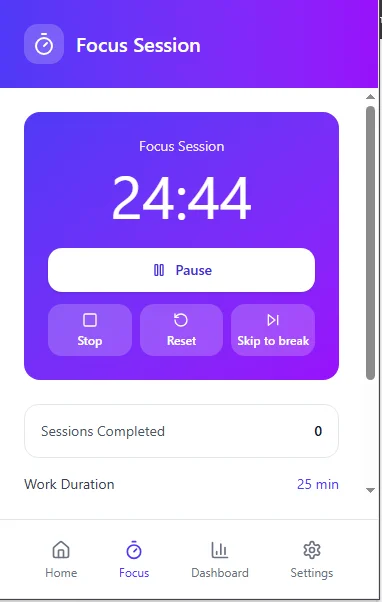
If you want to read for a defined period without repeatedly switching websites:
- Decide what you are going to read.
- Mark any websites you genuinely need as Productive.
- Close unrelated tabs.
- Start a Focus Session.
- Read until the session or your chosen section is complete.
If browser distractions affect more than your reading, see our broader guide on how to block distracting websites.
7-day free trial for new users. No credit card required to start. View pricing.
Important: The current public Mindova browser extension controls websites in supported desktop browsers. It does not block native mobile apps.
A Simple 20-Minute Reading Reset
If you have not been able to focus on reading recently, try this once.
Twenty minutes is not a scientifically optimal reading duration.
It is simply a small enough starting point to test what is actually breaking your attention.
Minutes 0–2: Decide the goal
Write one sentence.
For example:
Read pages 40–50 and understand why the author disagrees with the previous theory.
Or:
Read one chapter for enjoyment without checking another screen.
Minutes 2–17: Read
Silence unnecessary notifications.
Keep only what you need nearby.
When your attention wanders:
- notice it;
- identify the last idea you remember;
- return there;
- continue.
If a passage is difficult, stop and solve the comprehension problem rather than repeatedly pushing forward.
Minutes 17–20: Close the loop
If you are reading to learn, ask:
What were the main ideas?
If you are reading fiction, ask something simpler:
What just happened, and where did I stop?
Then decide whether you want to continue.
If twenty minutes felt easy, keep reading.
If it felt impossible, you now have something useful to diagnose.
What to Do If You Still Cannot Focus on Reading
Do not immediately add another productivity app.
Look at the exact moment the reading session fails.
You keep checking your phone
Silence unnecessary notifications and move the phone farther away if you repeatedly reach for it.
You keep opening websites
Close unrelated tabs and block or limit the sites you automatically visit.
Your eyes keep moving but your mind leaves
Use the recovery method:
stop → identify the last idea you remember → return there → continue
You reread the same paragraph repeatedly
Ask whether the passage is actually difficult.
Identify the sentence, concept, or term that is breaking comprehension.
You understand the words but remember nothing
Pause after a section and explain the main idea in your own words.
You cannot make yourself start
Reduce the commitment.
Try five pages, one section, or ten minutes.
You can focus on other books but not this one
If the reading is optional, consider changing the book.
Not every book needs to be finished.
You cannot focus on almost anything you read
Ordinary reading strategies may not explain the whole problem.
Difficulty concentrating can have many causes, and a blog article cannot diagnose why it is happening.
Frequently Asked Questions
How can I focus better while reading?
Start by deciding why you are reading and what you want to get from the session.
Remove the interruptions you repeatedly follow, begin with a manageable amount of reading, and when your mind wanders, return to the last idea you clearly remember instead of continuing mechanically.
Why can't I focus on reading anymore?
There is no single explanation.
You may be getting interrupted, mind wandering, reading text that is too difficult, starting with sessions that feel too large, reading something that does not interest you, or simply trying to read when you are tired.
Identify where the reading session actually breaks before choosing a solution.
Why do I read without remembering anything?
Sometimes your eyes continue moving through the text even after your attention has shifted elsewhere.
Mind wandering during reading is associated with poorer comprehension.
When you notice it, stop and return to the last part you clearly remember understanding.
How do I stop my mind from wandering while reading?
You probably will not eliminate every unrelated thought.
Instead, practice noticing the drift sooner.
Once you notice it:
- stop;
- identify the last idea you remember;
- return there;
- continue reading.
Improving recovery can be more realistic than expecting perfect concentration.
Should I reread a page if I wasn't paying attention?
You may not need to reread the entire page.
Try finding the last sentence, paragraph, or idea you remember understanding and restart from there.
Research on rereading after mind wandering has found that readers often retrace only a small amount of text.
How long should I read before taking a break?
There is no universal reading duration that works for everyone.
Try a manageable block such as 10–20 minutes if getting started is difficult, then increase it if you remain engaged.
A novel, technical paper, textbook, and work document may each require a different rhythm.
Is reading on paper better for concentration?
Not always.
Research suggests paper can have comprehension advantages in some contexts, particularly when digital reading involves significant scrolling, but the differences depend on how and what you are reading.
If the browser itself is distracting you, paper or a dedicated e-reader may help simply because there are fewer alternatives available.
Should I listen to music while reading?
Use the environment that helps you understand the text.
If music fades into the background and you continue reading normally, it may be fine.
If you keep changing songs, following lyrics, or thinking about the music instead of the text, try silence or simpler background sound.
Can website blockers help me focus on reading?
They can help when websites are the thing interrupting you.
A website blocker will not solve internal mind wandering or make a difficult passage easier to understand.
But it can remove easy digital escape routes such as repeatedly opening Reddit, YouTube, or another distracting website during a reading session.
Does trouble focusing on reading mean I have ADHD?
Not necessarily.
Difficulty focusing while reading can happen for many reasons and is not enough by itself to diagnose ADHD or any other condition.
This guide focuses on ordinary reading habits and distraction management rather than diagnosis.
Stop Trying to Force Perfect Concentration
Reading focus is not about keeping your mind perfectly still.
Attention will drift sometimes.
The useful skill is noticing what happened and recovering without letting one interruption end the session.
If an external distraction pulled you away, remove it.
If your mind wandered, return to the last idea you understood.
If the text is difficult, solve the comprehension problem.
If the commitment feels too large, make it smaller.
If the book is optional and you genuinely do not care about it, consider reading something else.
And if your browser is the thing repeatedly pulling you away, change the environment instead of relying entirely on willpower.
The goal is not to become a person who never loses focus.
It is to make it easier to find the thread again.
Mouhsine
Admin
Passionate about helping people achieve peak mental performance through evidence-based strategies and mindful technology use.
Related Articles
How to Focus on Writing Without Digital Distractions
Learn how to stay focused while writing by separating drafting from research, reducing digital distractions, and keeping the online tools you actually need
Creative Block: How to Get Unstuck and Start Creating Again
Feeling creatively stuck? Learn what creative block can look like, how to identify what is stopping you, and practical ways to generate ideas and move forward
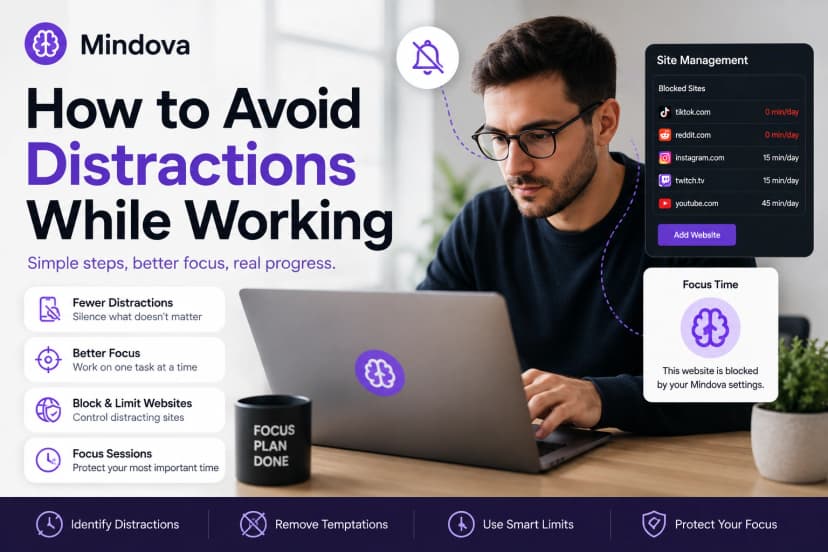
How to Avoid Distractions While Working: 10 Practical Strategies
Learn how to avoid distractions while working by reducing digital triggers, managing notifications, limiting distracting websites, and protecting focused work time.
Comments
Be the first to comment.
Ready to protect your focus?
Block distracting sites, set daily limits, and run focus sessions. Mindova is free.