Why You Overthink Decisions, and How to Stop
Written by Mindova Team
Admin
Published February 12, 2026 · Updated June 26, 2026

The decision isn't hard; you're making it harder
Some choices stall you out of all proportion to their size. You can spend a week agonising over something a stranger would settle in an afternoon. That gap is the tell. The problem usually isn't the decision in front of you. It's what you're bringing to it.
If you want to stop getting stuck, it helps to understand why you freeze in the first place. Most analysis paralysis traces back to two forces, and once you see them clearly, a simple framework can cut through both.
Perfectionism: the hunt for an option that doesn't exist
A lot of overthinking is perfectionism wearing a disguise. You're not gathering information to decide. You're looking for the option with no downside, the choice you can make with zero risk of being wrong. That option almost never exists. Every real path has trade-offs, so the search never ends, and you stay frozen waiting for a certainty that isn't coming.
Underneath it is usually fear: if I choose and it goes badly, that says something about me. So not choosing starts to feel safer than choosing. It isn't. Indecision is itself a choice, and usually the worst-performing one, because you carry the cost of the problem and get none of the progress.
Choice overload: more options, less action
The second force is the sheer number of options. It seems like more choices should help. In practice, past a handful, more options make deciding harder, not easier. Each one adds something to compare, a new way to second-guess, another road not taken to regret.
You've felt this with anything that comes in thirty varieties. A short menu is easy. A wall of near-identical options is paralysing, and you walk away with nothing rather than risk picking wrong. Most decisions now arrive with that overwhelming wall attached, from which tool to use to which path to take.
Loss aversion makes the freeze worse
There's a third piece sitting under both: we feel the pain of a loss more sharply than the pleasure of an equivalent gain. So when you weigh options, the possible downsides loom larger than the upsides, and every choice looks riskier than it is. That imbalance is why "do nothing" feels comfortable even when standing still is quietly costing you the most.
A framework that cuts through both
You can't talk yourself out of perfectionism or wish away the number of options. But you can run decisions through a structure that doesn't give either one room to operate. Five steps.
1. Define what "good enough" means first
Before you look at a single option, write down the two or three things this decision genuinely has to deliver. Not everything you'd like, the things it must have. This sets the bar in advance, while you're still calm, instead of letting it drift higher the more you look. It also defuses perfectionism directly: you're now choosing the option that clears a real bar, not chasing a flawless one.
2. Cap your options early
Don't evaluate everything. Quickly cut the field to a shortlist of three or fewer, then refuse to add to it. Yes, you might skip a slightly better option you never saw. That's the trade you're making on purpose, and it's a good one, because the cost of comparing endlessly is far higher than the cost of missing a marginal upgrade.
3. Match the effort to the stakes
Ask how reversible and how important the decision really is. If it's small or easily undone, decide fast and don't apologise for it; it doesn't deserve more of your life. Save the careful deliberation for the rare choices that are both big and hard to reverse. Most decisions that trap people are neither, which is exactly why the time spent on them is wasted.
4. Set a deadline and decide when it arrives
Give the decision a hard finish line that fits its size, and commit when you reach it. The deadline does the thing perfectionism won't: it forces a stop. Without one, you'll always find a reason to look a little longer.
5. Treat the choice as a step, not a verdict
Most decisions aren't permanent. Make the call, watch what happens, and adjust. Reframing a decision as an experiment you'll learn from, rather than a final judgment on you, takes most of the fear out of it. And action gives you real information that no amount of upfront analysis can.
Making it stick
The framework only helps if you can actually reach it, and overthinking thrives on a steady drip of new input: one more review, one more tab, one more opinion. Cutting that input is part of the work. When you've defined good enough and capped your options, stop consuming. If your attention keeps sliding back to the same research holes, closing them off for a while removes the temptation to keep feeding a decision you've already made.
The deeper shift is accepting that no choice comes with a guarantee, and that waiting for one is its own decision, with its own growing price. Set the bar, limit the field, decide, and move. You'll be wrong sometimes. You'll also be unstuck, which is the only state from which anything actually gets better.
Put this into practice with Mindova
Mindova is a website and app blocker that turns these ideas into daily habits — set focus schedules, block distracting sites and apps, and track your progress across every device.
- Block distracting websites and apps in seconds
- See pricing — start free, no credit card required
- Get started free and reclaim your focus today
- Block specific apps: Block LinkedIn
Mindova Team
Admin
Passionate about helping people achieve peak mental performance through evidence-based strategies and mindful technology use.
Related Articles

Distraction-Free Writing: A Setup for Focus
How to build a distraction-free writing setup and the habits that protect your drafting time from pings, tabs, and the urge to check.
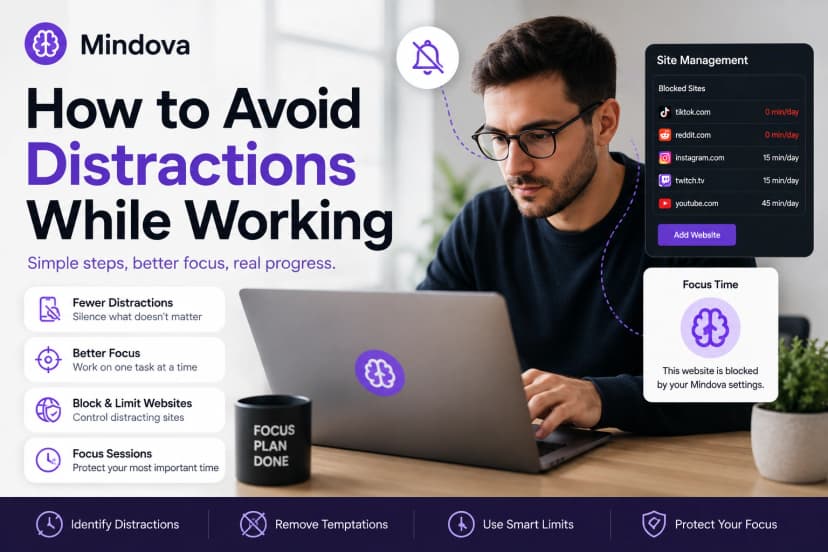
How to Avoid Distractions While Working: 10 Practical Strategies
Learn how to avoid distractions while working by reducing digital triggers, managing notifications, limiting distracting websites, and protecting focused work time.

Build Focus Habits With the Cue-Reward Loop
Break focus into cue, craving, response, and reward, and concentration stops depending on motivation.
Comments
Be the first to comment.
Ready to protect your focus?
Block distracting sites, set daily limits, and run focus sessions. Mindova is free.