Sleep and Productivity: How Sleep Affects Focus and Work Performance
Written by Mouhsine
Admin
Published September 6, 2026
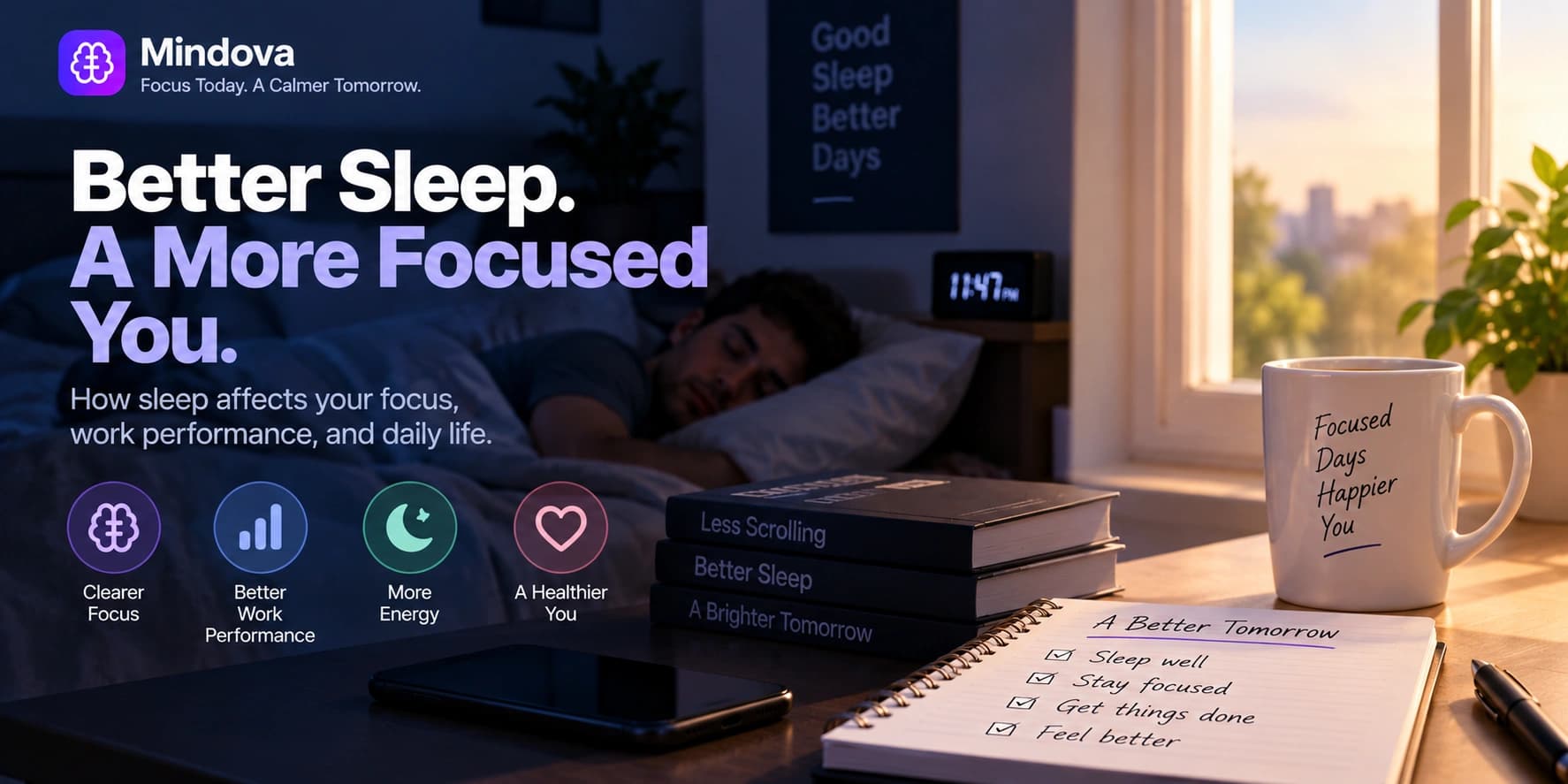
You stay up late to gain another hour of work.
The next morning, that extra hour can look less valuable.
You reread the same paragraph. Your attention slips more easily. A task that normally feels straightforward takes more effort to stay with.
Sleep does not determine whether you will have a productive day, and one bad night does not make every cognitive ability collapse.
But research does show something important:
Too little sleep can make sustained attention less reliable, and broader sleep loss can interfere with some of the mental processes you depend on for demanding work.
So the useful question is not:
How many productivity hacks can compensate for poor sleep?
It is:
What does insufficient sleep actually change about the way I work, and what can I realistically do about it?
Does Sleep Really Affect Productivity?
Yes, but the relationship is more nuanced than “more sleep equals more productivity.”
A meta-analysis of 75 independent samples found a positive overall relationship between sleep and work performance.
But the strength of that relationship varied depending on:
- whether researchers measured sleep quantity or sleep quality;
- what type of work performance they measured;
- how sleep and performance were reported;
- whether the study took place in a laboratory or real workplace.
So it would be misleading to promise that sleeping an extra hour will increase your productivity by a fixed percentage.
What the evidence supports is simpler:
Sleep is relevant to how people function at work, and insufficient sleep can interfere with abilities that many jobs require.
What Happens to Focus After Too Little Sleep?
Sustained attention is one of the clearest effects.
A 2024 systematic review and meta-analysis combined 44 studies in which participants had only 2–6 hours of sleep opportunity for one night.
After that restricted night, participants were:
- sleepier;
- slower on sustained-attention tasks;
- more likely to experience attentional lapses.
The same analysis did not find significant effects across every cognitive measure it examined, including working memory and inhibitory control.
That distinction matters.
One short night does not mean:
Your entire brain stops functioning properly.
A more accurate takeaway is:
Staying consistently attentive may become harder, even when other abilities are less clearly affected after a single restricted night.
At work, that can matter when you need to:
- read something carefully;
- monitor details for a long period;
- stay with a repetitive task;
- resist drifting into unrelated browsing;
- notice when your attention has left the task.
One Bad Night and Repeated Sleep Loss Are Not Exactly the Same Problem
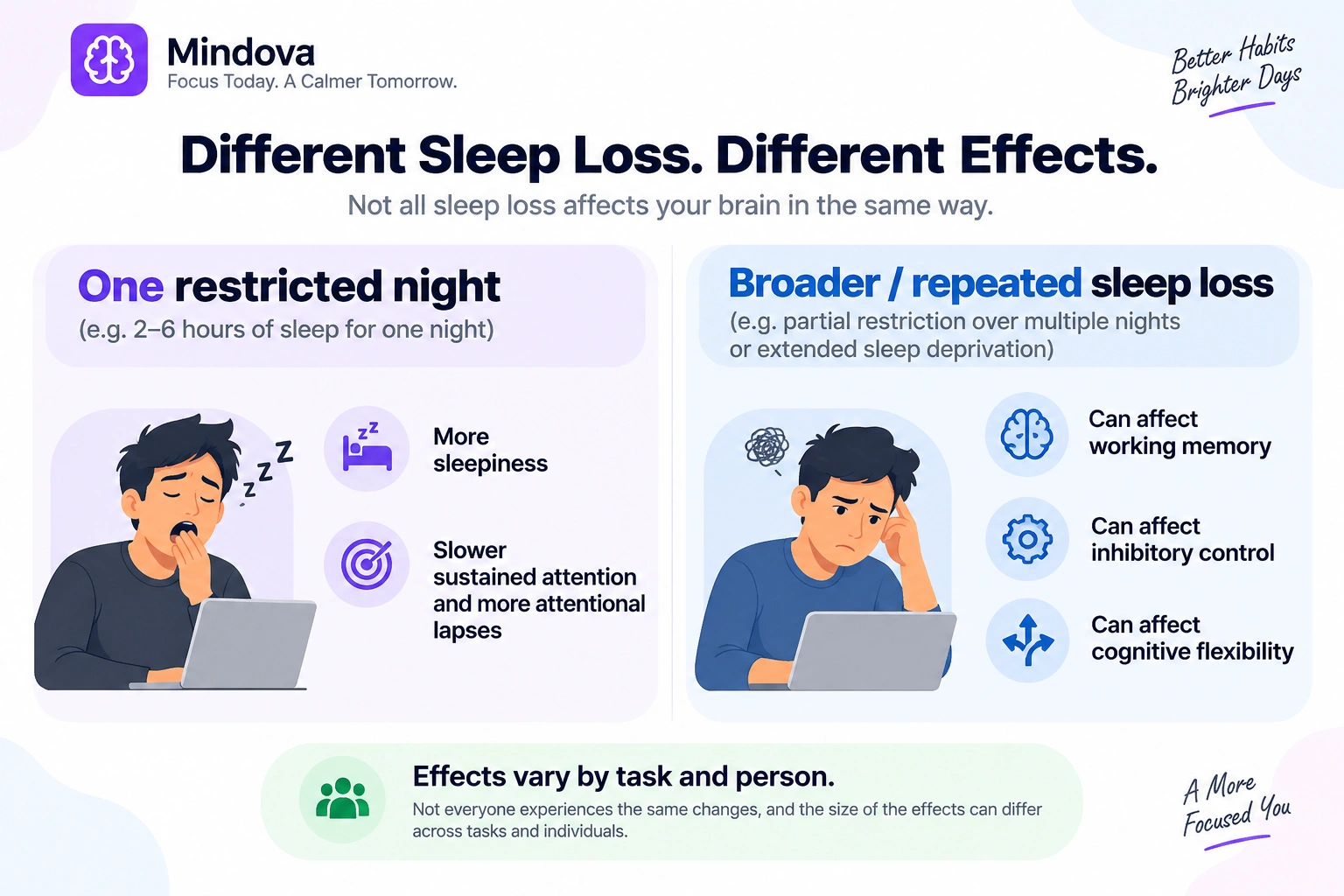
It is useful to separate a single short night from broader sleep loss.
The one-night research above found its clearest effects in sleepiness and sustained attention.
When researchers look across a wider range of sleep loss—including partial restriction and total sleep deprivation—the effects can extend further.
A 2025 meta-analysis covering 79 publications examined three core executive-function areas:
- working memory;
- inhibitory control;
- cognitive flexibility.
The researchers found impairments across these areas, although the size and form of the effect varied by task and whether researchers measured reaction time or accuracy.
So we should avoid two extremes:
Too weak:
Sleep only makes you feel tired.
Too strong:
One late night destroys your memory, judgment, creativity, and focus.
Neither describes the evidence well.
The effects depend on the type and extent of sleep loss, the cognitive task, and the person.
Why Trading Sleep for More Work Can Backfire
Staying awake longer gives you more clock time.
That is real.
If you work from midnight until 1 a.m., you technically gained another hour in which you could work.
But the calculation does not end there.
If that extra work reduces sleep, some of tomorrow's attention may be less reliable.
That creates a trade-off:
One more hour tonight versus how well you can use tomorrow's hours.
There is no universal equation that tells you exactly when the trade becomes negative.
But repeatedly treating sleep as the first place to borrow time from is not a free productivity strategy.
Sometimes the better question is not:
How can I squeeze more into today?
It is:
What does not actually need to happen today?
If your workload routinely exceeds the hours available, that is partly a prioritization problem—not something another late night necessarily solves.
See How to Prioritize Your Day When Everything Feels Important.
How Much Sleep Do Adults Need?
There is no single perfect number for every person.
For adults ages 18–60, the CDC recommends 7 or more hours of sleep per day. Recommendations vary for other age groups.
That does not mean exactly seven hours is ideal for every adult.
It is a population-level recommendation, not a personalized prescription.
Sleep quality matters too. Enough time in bed is not automatically the same as getting adequate, refreshing sleep.
Practical Habits That Support Better Sleep
You do not need to turn sleep into another optimization project.
Start with the basics.
Keep Your Sleep and Wake Times Reasonably Consistent
The CDC recommends going to bed and getting up at roughly the same time each day.
That does not require a perfectly identical minute every night.
The useful goal is to avoid treating your sleep schedule as something completely different from one day to the next.
Give the End of the Day a Clear Transition
If work, messages, entertainment, and browsing continue until the exact moment you try to sleep, there is little separation between the active part of your day and bedtime.
A simple wind-down period can create that boundary.
It might include:
- finishing work;
- putting away the laptop;
- preparing for the next day;
- reading;
- taking care of a simple evening routine.
It does not need to be elaborate.
Reduce Late-Night Electronic Use
The CDC recommends turning off electronic devices at least 30 minutes before bedtime.
But it is useful not to reduce the entire issue to “screens are bad.”
Sometimes the practical problem is behavioral:
You intended to go to bed, opened one website, and were still browsing much later.
If that describes you, the useful intervention may simply be making late-night browsing less easy to continue.
Be Sensible About Caffeine, Alcohol, and Late Meals
CDC sleep guidance also recommends:
- avoiding caffeine in the afternoon or evening;
- avoiding large meals before bedtime;
- avoiding alcohol before bedtime.
You do not need a complex sleep-hacking protocol to start.
Basic timing choices are enough to work on first. (CDC)
Make the Bedroom Support Sleep
CDC guidance recommends a bedroom that is:
- quiet;
- relaxing;
- comfortably cool.
You do not need to buy a collection of sleep products.
Start with obvious sources of light, noise, or stimulation that you can realistically change.
If Late-Night Browsing Is What Keeps Delaying Bedtime
This is where a productivity problem can quietly become a sleep problem.
You finish what you needed to do.
Then you open:
- YouTube;
- Reddit;
- news;
- social media;
- another feed.
You are not necessarily unable to sleep.
You simply keep postponing the point at which you try.
In that situation, the target is not “fix my brain.”
It is:
Make the behavior that keeps extending the evening less automatic.
You could:
- decide when you intend to stop using your computer;
- finish the work that genuinely needs to happen;
- close unnecessary tabs;
- make the websites that commonly extend the evening less available;
- move into your normal bedtime routine.
The simpler the boundary, the easier it is to understand whether it helped.
What Should You Do After a Bad Night?
Do not turn one poor night into another productivity challenge.
You do not need to “win back” the lost sleep by forcing yourself through an extreme workday.
Instead, recognize that your attention may be less reliable than usual.
Protect the work that requires careful attention
If possible, reduce unnecessary interruptions while doing work where lapses matter.
Be realistic about the day
A tired day may not be the best time to build an unusually ambitious task list.
Prioritize what genuinely matters.
Do not assume a productivity technique completely cancels sleep loss
A timer, task system, caffeine, or website blocker may change your environment or workflow.
None of them replaces adequate sleep.
Return to adequate sleep opportunity
Do not treat one poor night as proof that you need an entirely new sleep system.
Return to your normal sleep routine and pay attention to whether the problem is occasional or persistent.
If you regularly struggle to sleep, stay asleep, feel rested, or daytime sleepiness is affecting your life, the CDC recommends talking with a healthcare provider.
Where Mindova Fits

Mindova is not a sleep app or treatment.
It cannot diagnose a sleep problem, measure your sleep quality, or replace adequate sleep.
Its role is narrower.
If distracting websites are one reason you keep browsing later than you intended—or if poor sleep makes you especially vulnerable to browser distraction the next day—Mindova can help you add boundaries to your desktop browsing.
Mindova currently supports:
- website blocking;
- Individual Site Limits;
- an overall distraction limit;
- timed Focus Sessions;
- browsing and focus insights;
- optional AI Nudges.
For example, if Reddit or YouTube repeatedly turns a short evening check into another hour online, you can block or limit that website in Mindova.
During the workday, if you know your attention is less reliable after a poor night, a Focus Session can also help remove predictable browser distractions while you work on one defined task.
Mindova does not currently provide recurring bedtime schedules, native iPhone or Android app blocking, or cross-device blocking enforcement.
For the broader blocking setup, see How to Block Distracting Websites.
Frequently Asked Questions
Does lack of sleep reduce productivity?
Insufficient sleep can interfere with abilities that matter for productive work, particularly sustained attention.
Research also finds an overall relationship between sleep and work performance, although the size of that relationship varies considerably between studies and measures.
How does lack of sleep affect focus?
A meta-analysis of one-night sleep restriction found slower responses and more attentional lapses on sustained-attention tasks.
That means staying continuously engaged with a task may become harder after restricted sleep.
Can one bad night affect your work?
Yes.
Even one restricted night can increase sleepiness and impair sustained attention.
However, the same research did not find significant impairment across every cognitive function it tested.
One bad night matters, but it does not mean every mental ability suddenly fails.
Does sleep affect memory?
Sleep is relevant to memory and learning, and sleep restriction has been associated with poorer memory formation.
But the size of the effect depends on the type of memory task and sleep disruption involved.
The practical takeaway is not that every fact you learn after poor sleep will be forgotten, but that adequate sleep is part of supporting normal cognitive function.
How much sleep do adults need?
For adults ages 18–60, the CDC recommends at least seven hours per day.
Individual needs vary, and sleep quality matters alongside duration.
Can I catch up on lost sleep?
Sleep after a short night may help with recovery, but “catch-up sleep” is not a good reason to make chronic sleep restriction your normal routine.
If insufficient or poor-quality sleep is persistent, treat the underlying pattern rather than relying on occasional recovery days.
Does using screens at night hurt productivity the next day?
It depends on what the screen use does to your sleep.
If late-night browsing delays when you go to bed and reduces your sleep, that shorter sleep can affect next-day attention.
The useful question is often not simply whether you used a screen, but whether the activity kept you awake later than intended.
Can Mindova improve my sleep?
Mindova does not directly improve or treat sleep.
It can help with one narrower problem: limiting or blocking distracting websites when desktop browsing is contributing to staying online longer than you intended.
Sleep Is Not Lost Productivity Time
It is tempting to see sleep as hours that could have been used for something else.
But productivity is not measured by how many hours you remain available to work.
It depends partly on what you can actually do with those hours.
The research does not justify dramatic promises that perfect sleep will make you maximally productive.
It supports a more practical conclusion:
Insufficient sleep can make sustained attention harder, broader sleep loss can affect executive functions, and sleep is meaningfully related to work performance.
So when the workday is overflowing, do not automatically take the missing hours from sleep.
Prioritize the work.
Protect the attention you have.
Reduce late-night browsing if it keeps extending the day.
And give tomorrow's brain a reasonable chance to do its job.
Sources
The Impairments of Sleep Loss on Core Executive Functions — Meta-Analysis
Mouhsine
Admin
Passionate about helping people achieve peak mental performance through evidence-based strategies and mindful technology use.
Related Articles

How to Focus on Writing Without Digital Distractions
Learn how to stay focused while writing by separating drafting from research, reducing digital distractions, and keeping the online tools you actually need
Creative Block: How to Get Unstuck and Start Creating Again
Feeling creatively stuck? Learn what creative block can look like, how to identify what is stopping you, and practical ways to generate ideas and move forward
How to Avoid Distractions While Working: 10 Practical Strategies
Learn how to avoid distractions while working by reducing digital triggers, managing notifications, limiting distracting websites, and protecting focused work time.
Comments
Be the first to comment.
Ready to protect your focus?
Block distracting sites, set daily limits, and run focus sessions. Mindova is free.