Analysis Paralysis: What It Is and How to Overcome It
Written by Mouhsine
Admin
Published September 1, 2026 · Updated September 2, 2026
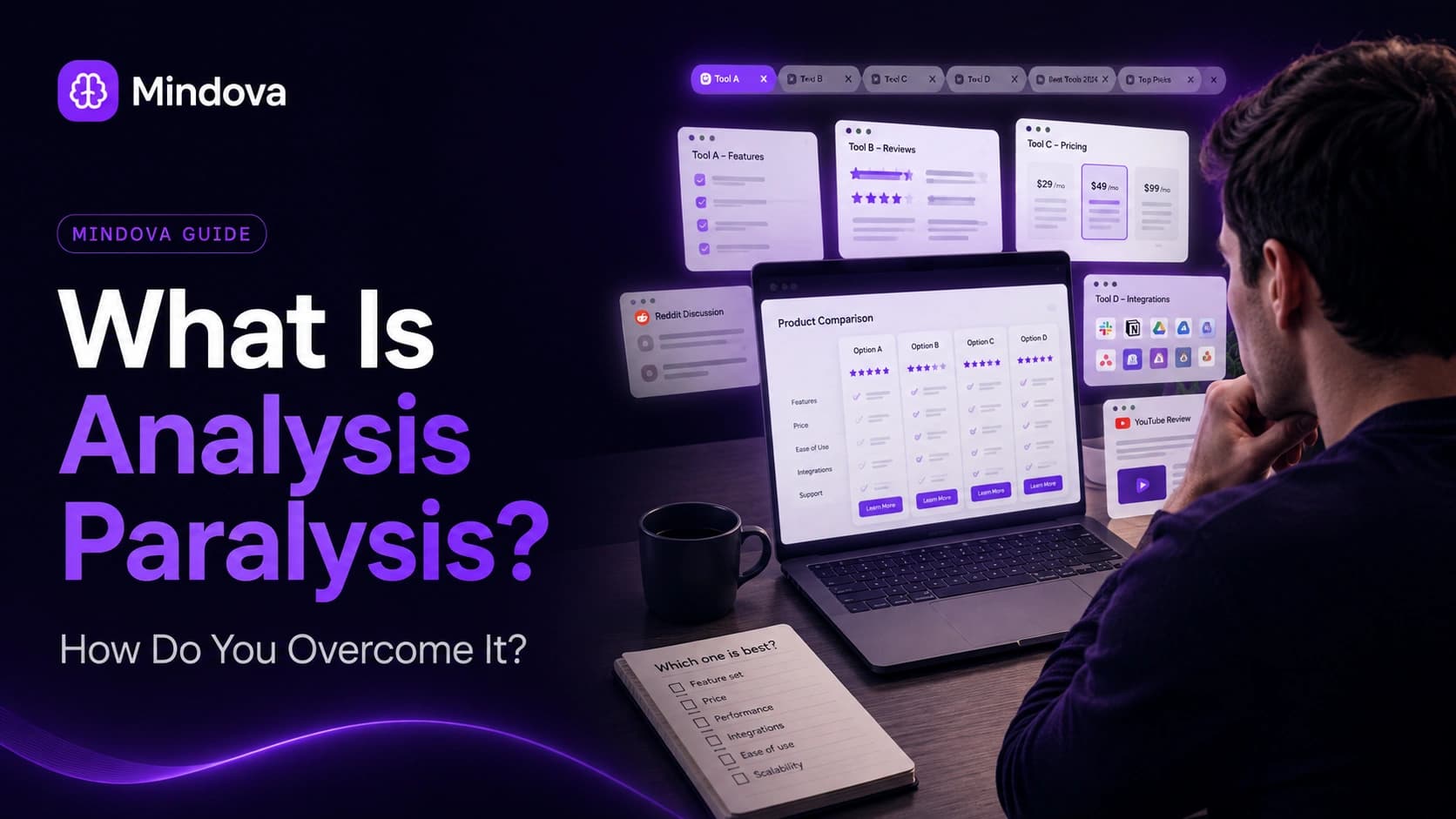
You have enough information to make a decision.
But instead of deciding, you open another review.
Then another comparison.
Then you ask someone else what they would choose.
The decision does not become clearer. It becomes heavier.
That pattern is often called analysis paralysis: thinking about a decision so extensively that the analysis itself starts preventing you from making one. Cleveland Clinic describes it as deliberating to the point where you struggle to choose and get stuck in repeated “what if” thinking.
Analysis paralysis can happen with major decisions, but it can also show up in ordinary ones: choosing software, buying a laptop, deciding what project to start, picking a course, or spending an hour comparing products that are almost identical.
The goal is not to stop thinking carefully.
It is to recognize when thinking has stopped producing useful information and started delaying action.
What Does Analysis Paralysis Mean?
Analysis paralysis is not simply being undecided for a few minutes.
It is the point where researching, comparing, predicting, reconsidering, or seeking reassurance keeps expanding while the decision itself remains stuck.
Typical examples look like this:
You compare ten productivity tools because you are afraid of choosing the “wrong” one.
You keep rewriting the pros-and-cons list for a decision that is easily reversible.
You ask several people for advice, but each new opinion gives you another variable to analyze.
You repeatedly reopen the same tabs after you have already identified the options that meet your needs.
The common feature is not just thinking a lot.
It is thinking without moving closer to a decision.
Analysis paralysis itself is not a formal mental-health diagnosis. Indecision can occur on its own, although persistent difficulty making decisions can also appear alongside conditions such as anxiety, depression or ADHD.
What Are the Signs of Analysis Paralysis?
Healthy decision-making can take time, especially when the consequences matter.
The warning sign is when additional analysis repeatedly fails to improve the decision.
You may be dealing with analysis paralysis when you keep researching information you have already seen, delay a decision despite having enough information to act, repeatedly ask for reassurance, keep adding new options instead of narrowing them, change your mind every time you encounter another opinion, or spend far more time deciding than the consequences seem to justify.
Cleveland Clinic similarly lists repeated research, chronic overthinking, postponing decisions, reassurance-seeking and fear of making the wrong choice among common signs.
A useful question is:
If I spend another hour thinking about this, what specific new information am I expecting to get?
If you cannot answer that, the extra hour may be serving the anxiety around deciding rather than the decision itself.
Why Does Analysis Paralysis Happen?
There is no single cause.
Several factors can make a decision harder to close.
Perfectionism can turn a good decision into an impossible one
Sometimes you are not searching for an option that works.
You are searching for an option with no downside.
That changes the standard from:
Which option meets my needs?
to:
Which option guarantees that I will never regret choosing it?
Real decisions rarely offer that guarantee.
Every option may involve trade-offs, uncertainty or information you cannot know in advance.
If your standard is “I must be certain this is the best possible choice,” there may never be enough research to finish.
Fear of making the wrong choice can make inaction feel safer
Choosing creates responsibility.
Once you decide, you lose the possibility of choosing the alternatives.
If you are especially worried about regret, criticism or failure, continuing to research can feel safer than committing.
But postponing a decision also has consequences.
The useful comparison is not always:
Option A vs Option B.
Sometimes it is:
Option A vs Option B vs continuing to spend time and attention avoiding the choice.
Too much information can make the important information harder to see
More research is useful when it resolves an important uncertainty.
It becomes less useful when it simply adds more details to compare.
Imagine choosing between three laptops after identifying the specifications that matter.
Now imagine comparing 27 laptops across price, battery, processor, weight, screen brightness, reviews, warranty, ports, colors and dozens of edge cases.
At some point, the problem can change from lack of information to difficulty identifying which information deserves weight.
More options can make some decisions harder — but not always
The popular version of “choice overload” says that more options automatically make people less likely to choose.
The evidence is more nuanced.
An influential series of experiments found situations where people were more likely to act and were more satisfied when offered smaller choice sets.
But a later meta-analysis of 50 experiments found that the average choice-overload effect was close to zero, with large differences between contexts.
Subsequent meta-analytic work found that overload becomes more likely when the choice itself is difficult, the options are complex, preferences are unclear or the person is trying to minimize decision effort.
So the useful lesson is not:
More options are always bad.
It is:
More options can become a problem when they add complexity without adding meaningful value.
Trying to maximize every decision can increase regret
Another useful distinction is between maximizing and satisficing.
A maximizer tries to identify the best possible choice.
A satisficer defines what an acceptable option must accomplish and chooses one that meets that standard.
Research by Barry Schwartz and colleagues found that people with stronger maximizing tendencies reported more regret and lower satisfaction with some decisions.
A later study of graduating students found an interesting trade-off: maximizers obtained higher-paying jobs on average but reported lower satisfaction with the jobs they chose and more negative feelings during the search.
That does not mean you should never optimize an important decision.
It means optimization has a cost.
For low-stakes decisions, searching indefinitely for the theoretical best option can cost more attention than the improvement is worth.
Analysis Paralysis vs Careful Decision-Making
Not every difficult decision should be made quickly.
A medical choice, major financial commitment, career change or other high-stakes decision may deserve substantial research and professional advice.
The difference is whether the analysis is productive.
Productive deliberation tends to narrow uncertainty.
You learn something important, eliminate an option, clarify a priority or identify a real risk.
Analysis paralysis tends to recycle uncertainty.
You revisit the same evidence, imagine more scenarios, add marginal options and remain no closer to choosing.
So do not judge the process by how many hours it took.
Judge it by whether the additional thinking is still changing the decision.
How to Overcome Analysis Paralysis
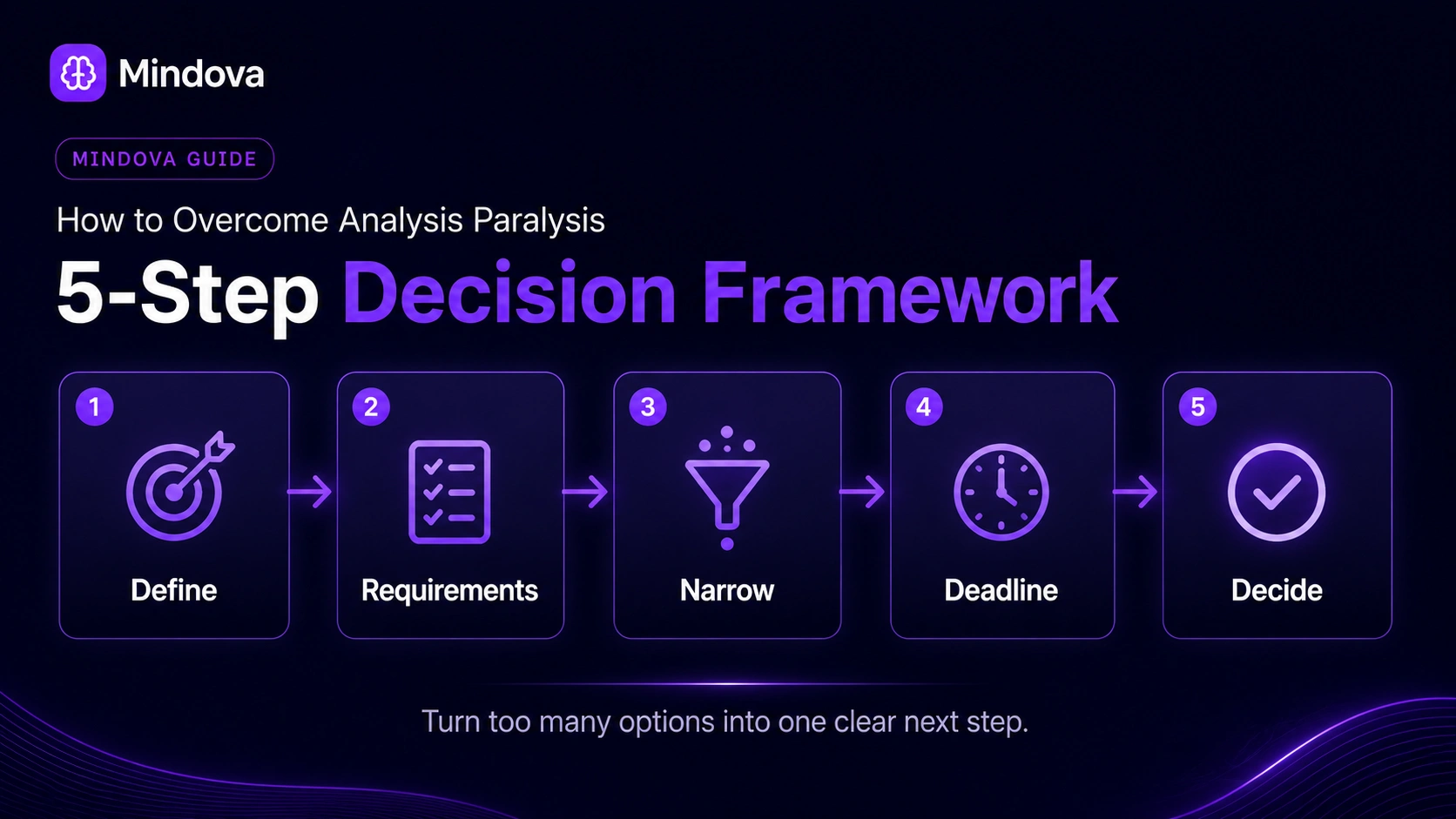
You do not need one perfect decision-making system for every situation.
You need enough structure to stop the decision from expanding indefinitely.
1. Define the decision in one sentence
Before researching more, write down what you are actually deciding.
Not:
What laptop should I buy?
Try:
Which laptop under $1,200 gives me enough battery life and performance for writing and light video editing?
That forces the decision to become specific.
A vague decision invites endless research because almost any information might appear relevant.
A defined decision tells you what information matters.
2. Separate requirements from preferences
Write down the few things the option genuinely must provide.
Then separate them from things that would simply be nice to have.
Suppose you are choosing project-management software.
Your requirements might be:
It supports your team size.
It has the integrations you actually use.
It fits the budget.
Everything beyond that is a preference.
Once you know the threshold, you are no longer asking:
Which tool is best?
You are asking:
Which available tool meets the requirements that matter to me?
That is much easier to finish.
3. Reduce the field
Do not compare every possible option equally.
Remove anything that clearly fails your requirements.
Then compare the remaining serious candidates.
The exact number is not magical. You do not need a productivity rule saying every decision must have exactly three options.
The goal is simply to stop weak candidates from continuing to consume attention.
If eight of ten choices clearly fail your requirements, eliminate them.
You gain very little by continuing to research them “just in case.”
4. Match the amount of research to the stakes
Ask two questions:
How costly would a bad decision be?
and:
How difficult would it be to reverse?
Choosing a restaurant and choosing a mortgage deserve different amounts of research.
So do choosing a note-taking app and choosing whether to leave a job.
For a low-cost, easily reversible choice, perfection is expensive.
For a high-cost, difficult-to-reverse choice, more deliberation may be justified.
This also helps stop a common pattern: treating every decision as though it carries permanent consequences.
5. Decide what new information could actually change your mind
This is one of the fastest ways to identify useless research.
Ask:
What fact am I still missing that could realistically change the decision?
If the answer is specific, go find it.
For example:
I need to know whether this plan allows five team members.
That is useful research.
But if the answer is:
I just want to read a few more opinions.
you may have reached the point where research is becoming reassurance-seeking.
6. Give the decision a deadline
Without a stopping rule, research can expand indefinitely.
The deadline should match the stakes.
A trivial decision may deserve a few minutes.
A product purchase may deserve an evening.
A major life decision may deserve weeks, professional advice and deliberate reflection.
The specific duration matters less than deciding beforehand that the analysis will end.
Healthline similarly recommends placing limits around decision time rather than allowing the thinking process to consume unlimited attention.
A deadline does not guarantee the perfect decision.
It guarantees that the decision eventually becomes a decision.
7. Use “good enough” deliberately
“Good enough” does not mean careless.
It means defining an acceptable standard and refusing to keep searching once an option clears it.
Suppose three products all satisfy your requirements and their differences are minor.
You can spend another four hours trying to identify which is 3% better.
Or you can choose one and use those four hours for something that matters more.
This is where satisficing can be useful.
Not every decision deserves optimization.
8. Stop reopening the research loop
This is especially relevant to online decisions.
A large part of analysis paralysis can happen inside the browser:
review → Reddit thread → YouTube comparison → another review → another search → another opinion.
At some point, the tabs stop adding information and start keeping the decision alive.
When you reach your research deadline, close them.
If you repeatedly return to the same sites even after deciding that research is finished, create some friction around those sites for the period when you need to act.
For broader strategies, read how to avoid digital distractions while working.
9. Take the smallest reversible action
Sometimes you do not need to decide the entire future.
You only need to create information through action.
Unsure which course fits you?
Watch a sample lesson.
Unsure whether a software tool works for your workflow?
Try the free version with one real task.
Unsure whether a writing routine fits?
Test it for three days.
The important word is reversible.
An experiment can turn an abstract prediction into actual experience without requiring a permanent commitment.
10. Accept that uncertainty remains after a good decision
You can make a careful decision and still not know how it will turn out.
That is not proof you analyzed incorrectly.
It is part of making decisions with incomplete information.
Trying to remove all uncertainty before acting can itself create paralysis.
Cleveland Clinic and Healthline both emphasize learning to tolerate some uncertainty rather than continuing to search for a guarantee that may not exist.
A useful goal is therefore not:
I must feel 100% certain.
It is:
I have enough information to make a reasonable decision at this level of risk.
What If You Still Cannot Decide Between Two Good Options?
Sometimes analysis does its job.
You narrow the field.
Both choices meet your requirements.
The consequences are similar.
And there is still no obvious winner.
That may be evidence that the decision is genuinely close.
You can choose based on a secondary preference, convenience, cost, availability or simply whichever option you currently lean toward.
The fact that one option is not clearly superior does not mean you failed to analyze the decision.
Sometimes there simply is no uniquely correct answer.
What About the Coin-Flip Trick?
You may have heard the suggestion to assign each option to a side of a coin and pay attention to how you feel when it lands.
That can be a useful reflection exercise.
But it is not a scientific diagnostic that reveals a hidden “true answer.”
If the result makes you notice a preference, use that as another piece of information.
Do not turn the coin into another rule you need to obey.
How Mindova Can Help With the Research Loop
Mindova cannot make an important decision for you.
It does not know which job you should accept, which product you should buy or which path is right for your life.
What it can help with is a narrower problem:
the browser loop that continues after useful research has ended.
Mindova currently works as a website blocker and focus extension inside supported desktop browsers. You can block selected websites, set per-site daily limits, use timed Focus Sessions, review browsing insights and enable optional AI Nudges.
For example, suppose you decide:
I have researched this purchase enough. I am choosing tonight.
But every time you sit down to make the choice, you reopen Reddit and YouTube and start comparing again.
You could temporarily block or limit those research rabbit holes while you make the decision.
If you still need access to a useful site but want less open-ended browsing, a per-site daily allowance may fit better than blocking it completely.
And if you want a defined period to stop researching and act, a timed Focus Session can create that browser boundary.
Mindova's role is not to remove uncertainty.
It is to help you enforce the point where you already decided that the research is finished.
If a softer interruption fits better than a block, see what a focus nudge is and when to use one.
Mindova currently operates through supported desktop browsers and does not block native iPhone or Android apps. (Mindova)
When Analysis Paralysis Deserves More Than a Productivity Technique
Everyone gets stuck on decisions occasionally.
But if indecision becomes persistent enough to interfere with work, school, relationships or everyday responsibilities, the problem may be bigger than a decision framework.
Cleveland Clinic recommends considering professional support when indecision causes significant distress, disrupts responsibilities or relationships, or is accompanied by substantial anxiety or other symptoms.
Analysis paralysis is not itself a diagnosis.
But you also do not need to force every persistent decision problem into a productivity hack.
Sometimes talking with a qualified mental-health professional can help identify what is driving the pattern.
Frequently Asked Questions
What is analysis paralysis?
Analysis paralysis is a pattern of overthinking a decision so extensively that the analysis itself delays or prevents you from choosing.
What causes analysis paralysis?
Potential contributors include fear of making the wrong choice, perfectionism, information overload, uncertainty and difficult or complex choice sets. No single factor explains every case.
Is analysis paralysis a mental-health disorder?
No. Analysis paralysis is not a formal diagnosis. Persistent indecision can occur on its own or alongside conditions including anxiety, depression or ADHD.
Is analysis paralysis the same as overthinking?
They overlap, but analysis paralysis refers specifically to overanalysis that prevents or delays a decision or action. Overthinking can involve many other subjects that do not require a choice.
How do you stop analysis paralysis quickly?
Define the decision, identify the requirements that matter, narrow the options, determine what information could genuinely change your choice, and give the decision a stopping point.
For low-stakes reversible decisions, it is often reasonable to use less research and act sooner.
Does having more choices cause analysis paralysis?
Not automatically.
Research on choice overload is mixed. Larger choice sets can make decisions more difficult in some contexts, especially when options are complex, preferences are unclear or the decision itself is demanding.
What is satisficing?
Satisficing means choosing an option that meets a defined acceptable standard rather than continuing to search indefinitely for the theoretical best option.
Research comparing maximizing and satisficing suggests that maximizing can sometimes be associated with more regret and lower satisfaction, although it may also produce better objective outcomes in some contexts.
How do I know when I have researched enough?
Ask what specific missing information could realistically change your decision.
If you have already answered the important questions and additional research is mainly repeating the same comparisons or seeking reassurance, it may be time to stop.
Can website blocking help with analysis paralysis?
It can help with one specific form of it: repeatedly reopening online research after you have already gathered enough information.
Blocking or limiting the sites that keep restarting the research loop can support a decision boundary, but it does not replace the actual decision-making process.
You Do Not Need Perfect Certainty to Move
Some decisions deserve patience.
Some deserve research.
Some deserve expert advice.
But not every decision deserves unlimited attention.
When you notice analysis turning into paralysis, reduce the problem to what actually matters:
Define the decision.
Know your requirements.
Remove weak options.
Match the research to the stakes.
Find the information that could genuinely change your answer.
Set a stopping point.
Then choose.
You may still wonder whether another option would have been slightly better.
That uncertainty is not necessarily a sign that you made the wrong decision.
Sometimes it is simply the cost of finally making one.
Mouhsine
Admin
Passionate about helping people achieve peak mental performance through evidence-based strategies and mindful technology use.
Related Articles

How to Focus on Writing Without Digital Distractions
Learn how to stay focused while writing by separating drafting from research, reducing digital distractions, and keeping the online tools you actually need
Creative Block: How to Get Unstuck and Start Creating Again
Feeling creatively stuck? Learn what creative block can look like, how to identify what is stopping you, and practical ways to generate ideas and move forward
How to Avoid Distractions While Working: 10 Practical Strategies
Learn how to avoid distractions while working by reducing digital triggers, managing notifications, limiting distracting websites, and protecting focused work time.
Comments
Be the first to comment.
Ready to protect your focus?
Block distracting sites, set daily limits, and run focus sessions. Mindova is free.